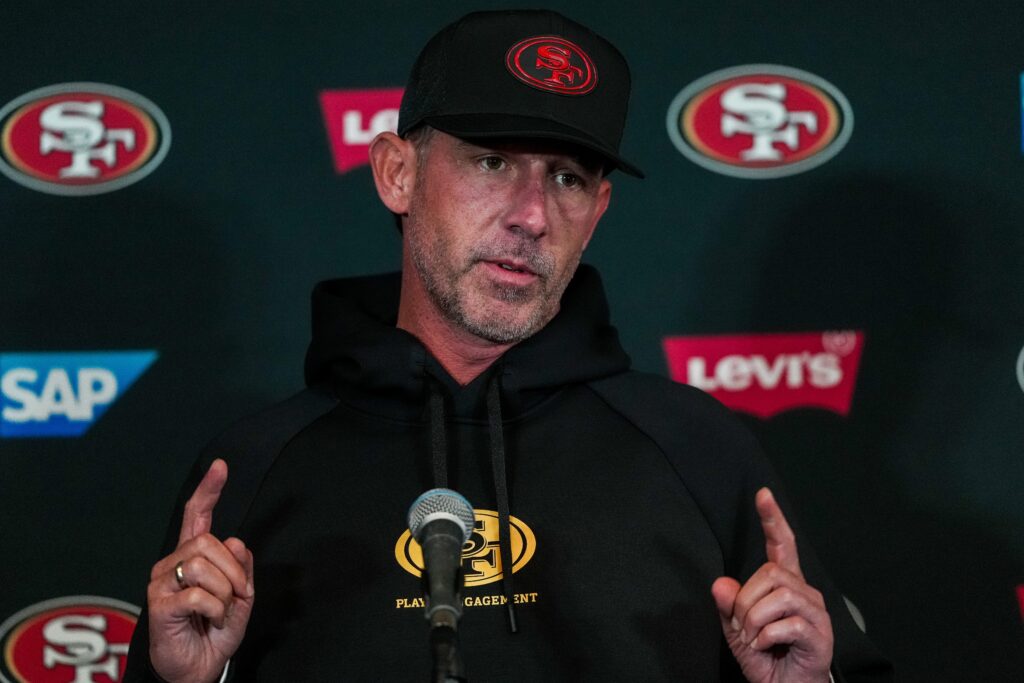
Kyle Shanahan was physically in Australia, but part of him was still living yesterday. Or maybe tomorrow. It was all getting a little confusing.
Read more Nationals wrap up winless West Coast trip with contentious loss to Padres
“When I look at my clock and it says the time, and then I try to see my family’s time and then it says the time, but it says yesterday, I don’t even get how that’s possible,” the San Francisco 49ers coach told reporters … this week. “I feel like I’m in the future.”
While Shanahan tried to get his bearings in Melbourne on Monday, Los Angeles Rams Coach Sean McVay was still nearly 8,000 miles away, in Southern California. With the NFL’s first-ever regular season game in Australia only days away, McVay and his players had not yet boarded their flight.
The division rivals will eventually meet Friday morning at the Melbourne Cricket Ground — though it will still be Thursday evening back home. Before they share a field, they will have followed two sharply different approaches to sleep, travel and performance.
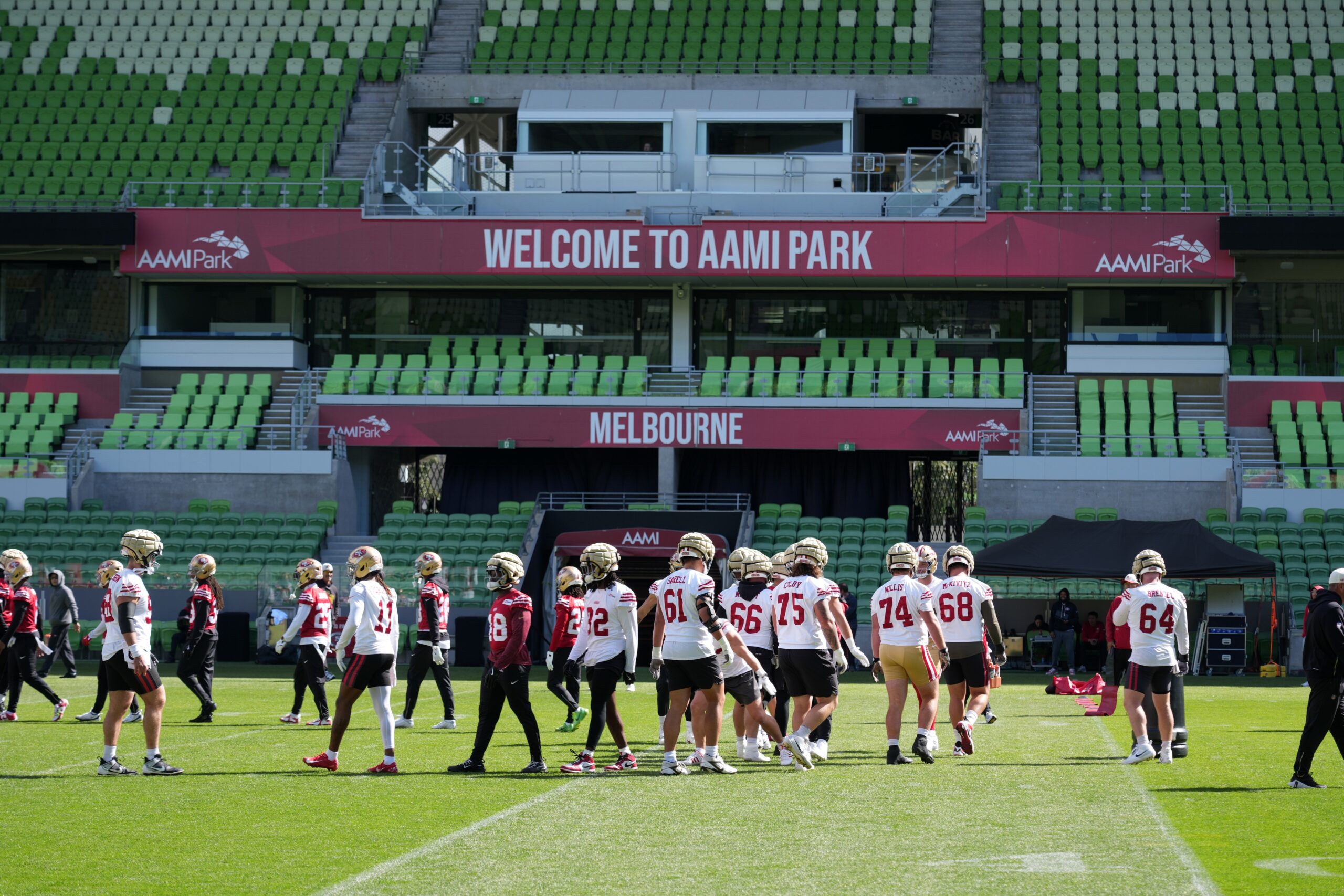
The 49ers arrived in Melbourne a full week before the game, allowing their players time to acclimate and then settle into something resembling a normal game-week routine. The Rams left late Tuesday night and landed roughly 27 hours before kickoff, attempting to keep their players as close as possible to their West Coast sleep schedules.
While one team is trying to adjust its body clocks, the other is largely trying to avoid adjusting them at all. The stakes extend beyond whether players can get a good night’s sleep.

“It really can affect not just your sleep at night, but how you feel and function during the daytime and ultimately perform on the field,” said Cheri Mah, a sleep physician and adjunct lecturer at the Stanford Sleep Medicine Center who has helped NFL teams prepare for international games.
The unusual matchup, part of the NFL’s expanding effort to globalize American football, offers a window into a broader shift across professional and Olympic sports. As research has connected sleep and circadian rhythms to recovery and performance, teams and individual athletes have become more aggressive about trying to gain an edge — consulting sleep physicians and sports scientists, tracking sleep, and carefully managing travel schedules, light exposure, meals and hotel environments. MLB star Shohei Ohtani even travels from city to city with a custom mattress.
But increased attention has not produced a universal playbook. Circumstances differ, research can be interpreted and applied in different ways, and the best strategy on paper can collide with scheduling demands, travel logistics and athlete preferences. As the Rams and the 49ers demonstrate, teams presented with the same journey can reach strikingly different conclusions about how to handle it.
Many sleep experts start here: Fatigue and jet lag are separate problems, and each requires its own solution.
Fatigue is simpler to manage. Athletes need consistent, sufficient, uninterrupted sleep. That program needs to start long before takeoff and continue long after landing.
Jet lag, on the other hand, requires some tricks. As a rough rule, Mah said, the body can take about a day to adjust for each hour its internal clock must shift. Acclimatizing involves more than simply going to bed at the local hour: Teams can gradually adjust sleep, meals and light exposure before departure and after arrival to move players’ body clocks toward destination time.
Chris Winter, a neurologist in Charlottesville who has consulted for more than 40 NFL, MLB and NBA teams, said they can even try to trick their bodies through visualization.
“When I’m eating dinner in Florida, what meal is being served in India?” he said. “So you can start to create situations where your brain is eating breakfast, but it really thinks it’s eating dinner.”
When he started studying sleep in the early 2000s, Winter said, the field barely existed. “It was, like, four bizarre little research papers,” he said. Now, when he meets with the teenagers MLB teams have just drafted, they show him the sleep data their wearable devices have collected and ask him to help them interpret it.
“It’s like how Gatorade is no longer an advantage for the University of Florida,” he said. “It’s f—-ing being sold in a gas station now. Everybody has Gatorade, and anybody who’s like, ‘I don’t think hydration’s all that important for athletics’ is insane. Sleep is just standard. It’s not that interesting anymore. We lift weights and we have mental coaches and we have a nutritionist and we have a strength person and we tape ankles when they get sprained, and this is our sleep program.”
The key, said Meeta Singh, a psychiatrist and sleep physician who consults for professional and Olympic teams, has been treating sleep like a “performance variable,” with the same importance that teams and athletes assign to nutrition and training.
“It’s a mentality shift,” she said. “Toughness doesn’t mean you require less recovery, because it’s physiology.”
Physiology is not the only factor, though. Sleep scientists tend to recommend getting a good night’s sleep after a game, then flying the next morning. But players often balk at the idea of an early wake-up to make the plane or the loss of an off day to travel, pushing instead to fly postgame. So paradoxically, the youngest teams often end up with the best sleep hygiene, because they do not have the service time to overrule their bosses.
After Game 2 of the 2022 National League Championship Series, the Philadelphia Phillies, who had spent 22 of the previous 24 days on the road and were running out of socks, declined Winter’s recommendation and flew home on a red-eye from San Diego rather than get a good night’s sleep and fly in the morning.
Sometimes the reasoning is even less tied to sleep itself: Mah once consulted for an NFL team that was taking its second trip to London. The first time, the team had flown a week early and felt prepared to perform. But it refused to follow the same itinerary this time, she said, because of a distaste for the food.
Read more Fetterman appears by video at GOP convention and says he will work with Trump
“It was not a fun experience for them to be there for a full week,” she recalled. “So [they said], ‘We’re not doing that again.’”
That can be reason enough, Winter said: “One of the things we understand about sleep is belief will often trump the science.” He recalled an MLB team whose plane had a mechanical failure, causing the manager to order buses to transport the team to its next destination in hope of getting enough sleep at the hotel.
The star pitcher argued vehemently that the team should have stayed and waited for the technicians to fix the aircraft rather than endure an uncomfortable ride. The manager prevailed, both that night and in a later kangaroo court trial. (He called Winter as an expert witness, who delivered a take on Jack Nicholson’s speech in “A Few Good Men”: “You think about sleep as a punch line at a party. It’s a life that I live day in and day out!”)
“But I can promise you this,” Winter said, recalling the disagreement. “If the pitcher believed that waiting for the plane was the right thing to do and [that riding the bus] affected his pitching — it probably did.”
For the NFL, the question is becoming more urgent. The league will stage a record nine international games this season across four continents, seven countries and eight stadiums. Owners have authorized as many as 10 beginning next season, and Commissioner Roger Goodell has spoken of eventually having every team play internationally each year.
Australia presents perhaps the league’s most extreme test. The flight from California lasts nearly 16 hours and crosses the international date line. Friday’s 10:35 a.m. kickoff in Melbourne will occur at 5:35 p.m. Thursday in California — an unusual local start time but a familiar late-afternoon hour to the players’ internal clocks.
The 49ers decided the best response was to get there early. Their traveling party of about 200 arrived Friday aboard a chartered Qantas A380. The aircraft included 14 extra-long seats, which Shanahan assigned first to the largest starting offensive and defensive linemen, and then according to seniority.
The effects of the trip varied by player — and sometimes by hour.
“Each guy’s different,” Shanahan told reporters. “I mean, some guys feel good and feel great, and then you talk to them five hours later, they’re like, ‘Never mind, that left.’ Some guys started off bad and then feel good later.”
By his third day in Melbourne, Shanahan said, he felt mostly normal. He also felt validated in the decision to come early.
“Not comparing us to them, but yeah, I was glad,” he said when asked about the Rams’ late arrival. “I know how I felt the last couple days.”
The Rams will provide an especially unusual test of the competing theories, compressing the entire 15,000-mile trip into less than 72 hours, more than 31 of it spent on a plane. Their itinerary called for them to practice Tuesday morning in California, fly overnight with lie-flat seats, lose Wednesday crossing the international date line, land Thursday morning and play Friday at 10:35 a.m. in Melbourne.
McVay said the Rams had sought input from people in other sports and from others who had made similar trips. The team also tested elements of the schedule with some players before settling on its approach.
“It doesn’t mean that we think we’re right and a different approach is wrong,” McVay said. “It’s just what we think is best based on the things that we’ve done and what we’ve learned over our time here.”
The Rams also believe they have a precedent. Last season, they arrived in London roughly 24 hours before facing Jacksonville. The Jaguars, by comparison, spent five days in London leading up to kickoff. The result: The Rams scored on their opening possession, led 21-0 at halftime, held Jacksonville scoreless until the fourth quarter and went on to rout the Jaguars, 35-7.
Australia will test that late-arrival strategy on a vastly more demanding scale. The Rams will fly home immediately afterward and are scheduled to land in Los Angeles around midday Friday — the same calendar day as the game in Melbourne.
The strategy is intended to minimize disruption at both ends of the trip. By remaining as close as possible to Pacific time, the Rams hope their players can largely avoid having to readjust after returning home. They will host the New York Giants on the night of Sept. 21, 11 days after the season opener. The 49ers, meanwhile, will have one fewer day before hosting the Miami Dolphins on Sept. 20 — and unlike the Rams, will return after spending a week attempting to acclimate to Melbourne time.
Shanahan said the effect on Week 2 was a major part of the team’s deliberations. The 49ers expect to return Friday afternoon, and although players will report Monday for workouts, they will not begin the heart of their practice week until Wednesday.
“I think five days is plenty of time for them to get adjusted,” Shanahan told reporters.
Regardless of outcome, after the final whistle Friday morning — or Thursday night, depending on your time zone and body clock — the postgame autopsy will extend beyond turnovers and missed tackles. Flight times, sleep schedules and body clocks will be dissected, too.
“I’m sure we’ll be a good case study for anybody else in the future to sit there and overthink which one helped and not,” Shanahan told reporters. “But the real thing that’s going to help this game the most or hurt this game the most is who plays better football.”
Read more Trump officials target November for final approval of massive arch