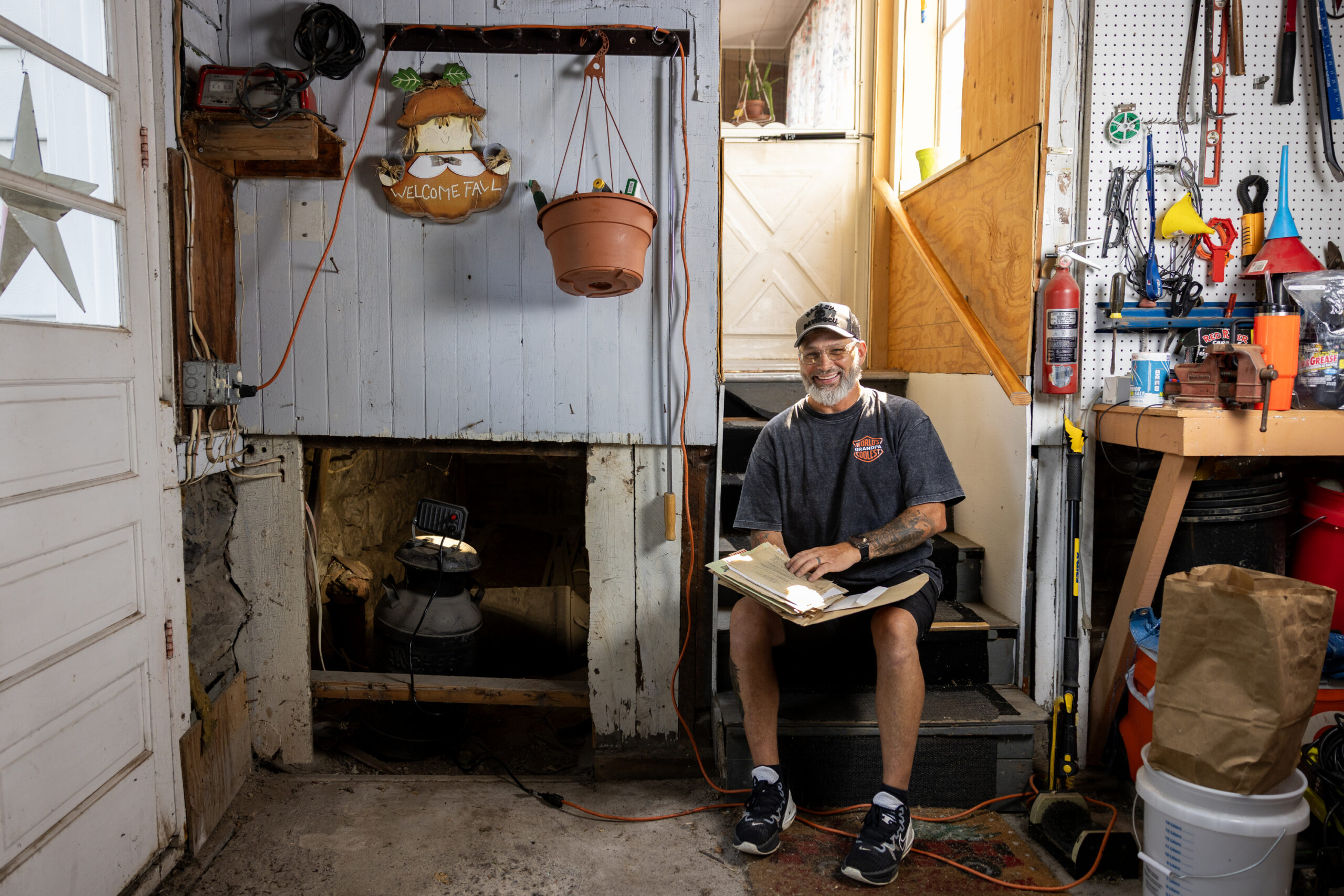
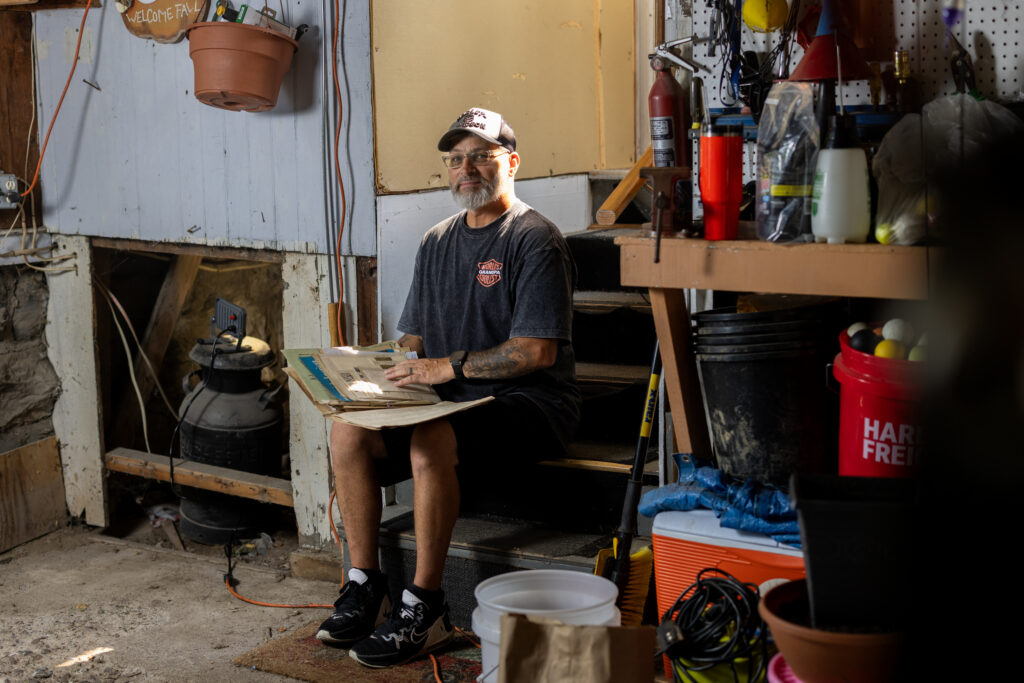
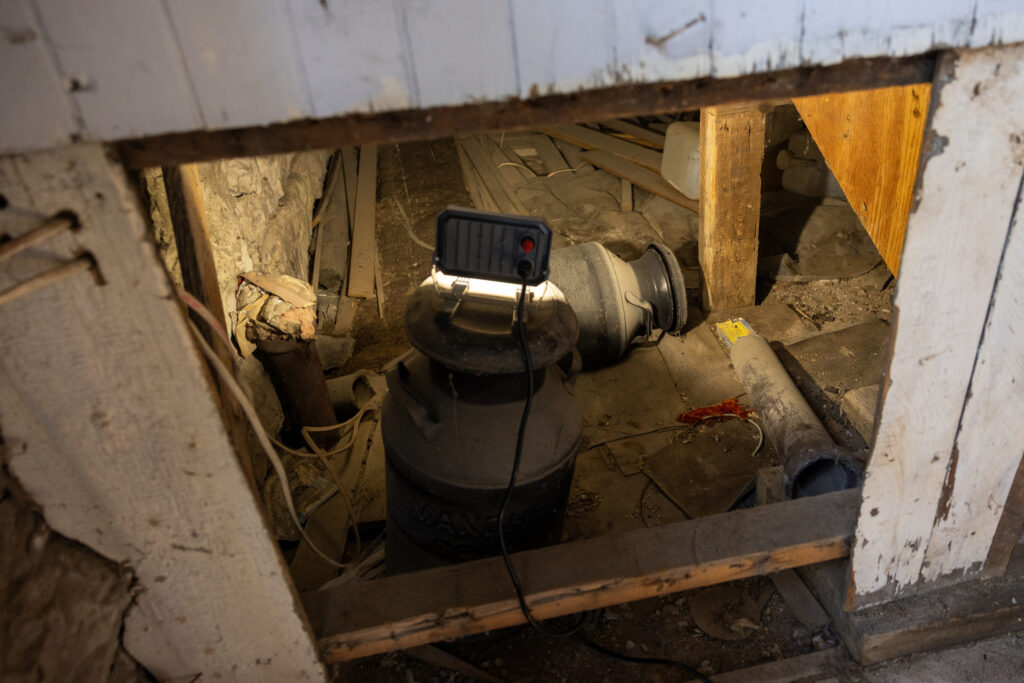
Jason Hurdle was clearing space in his garage for his Halloween decorations when he pulled back an unassuming sheet of plywood from the wall, revealing a crawl space he’d never seen before. Inside was a dusty cardboard box full of weathered files that looked like trash.
Read more These are the Trump investigations Democrats plan if they win in November
But as he carried the box out to the flatbed of his truck and reached for a garbage bin, a breeze lifted one of the covers, and a word in red block letters stopped him: “SECRET.”
A mechanic for his local school district near Waterloo, New York, Hurdle doesn’t encounter government documents with classified markings. Initially, he wasn’t sure what he was looking at. But as he read the pages, he started to get an idea.
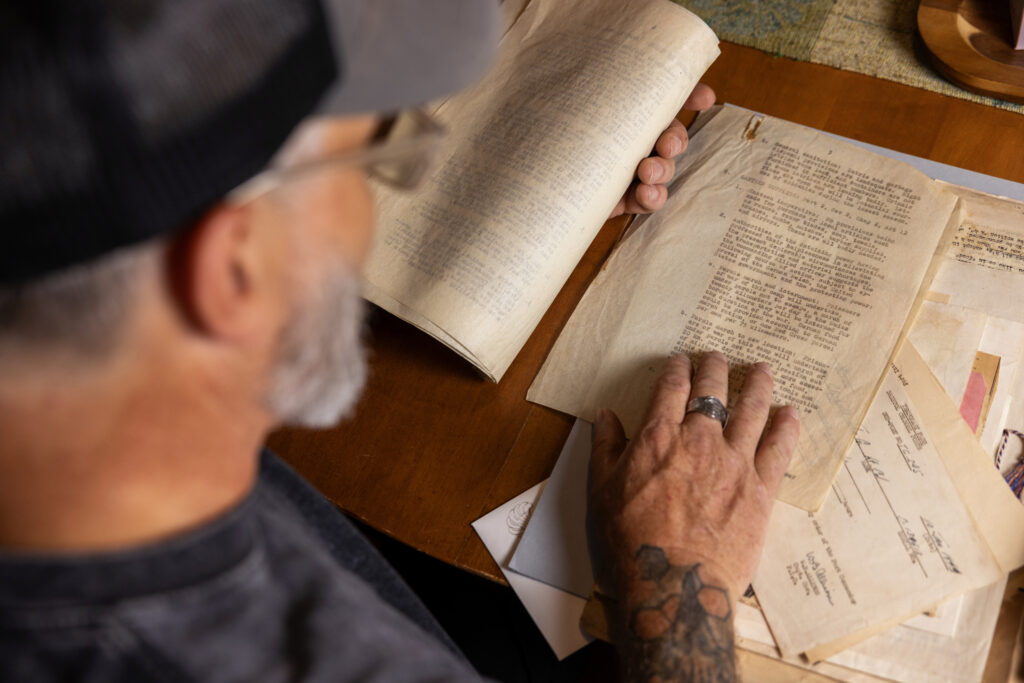
The 80-year-old, onionskin pages were mostly handwritten, first-person accounts by American prisoners of war, or POWs, describing their experiences in German captivity during World War II. The soldiers recounted being held prisoner in cramped, unsanitary conditions with little food, warmth or medicine. In total, the nearly 300 pages Hurdle discovered included more than 120 soldiers’ experiences, an astonishing record nearly forever lost had he simply thrown the file away.
In July, the National Archives announced the documents had been safely recovered by its Archival Recovery Program, a detectivelike team of archivists who hunt down federal records that are either lost or stolen. The government has also recovered Apollo mission records, a presidential pardon signed by Franklin Pierce, a 1812 congressional vote tally sheet and a 1854 letter to then-Secretary of War Jefferson Davis from Army 1st Lt. J.E.B. Stuart before the two men joined the Confederacy. All but the World War II records were recovered from auction houses or collectors.
News of the discovery of the documents, however, has not been widely disseminated. The Washington Post contacted family members of some of the soldiers who were surprised to hear such records existed. Some of the POWs had shared their experiences with their families or through oral histories and other publications, but others kept their experiences to themselves once they returned home.
Kimberly Guise, the National World War II Museum’s associate vice president of curatorial affairs, said thousands of people have contacted the New Orleans museum with records from the war, often personal documents from a relative who served. But the records found by Hurdle are especially significant because of the number of firsthand accounts included.
“It’s really lucky that this material was discovered, that the gentleman looked inside the box, and that he got it to a safe place,” Guise said after The Post asked her to review the records. “It’s pretty great in terms of POW research.”
The discovery was certainly unexpected for Hurdle. The house, which had been in his wife’s family for generations, was mostly familiar to him after 14 years of living there, and he didn’t think there would be anything mysterious in that void.
When Hurdle realized what the documents were, he brought them to a nearby museum dedicated to Memorial Day and spoke with docent and research historian Amelia Burm, who was wrapping up her bachelor’s degree in history and museums at nearby Nazareth University. Burm took the documents to her professor, who recommended she contact the National Archives and Records Administration. In January, the National Archives sent two officials to Hurdle’s house, where he laid out the records on his kitchen table.
“I’m in podunk little Waterloo, New York, and this went all the way to the National Archives,” he told The Post. “We’re kind of in shock here.”
Staff at the National Archives were just as perplexed. The federal agency did not have the records on its list of missing documents. “The discovery of these government records is important and meaningful to ensure preservation and public access to our country’s history,” NARA spokeswoman Grace McCaffrey said in a response to questions from The Post.
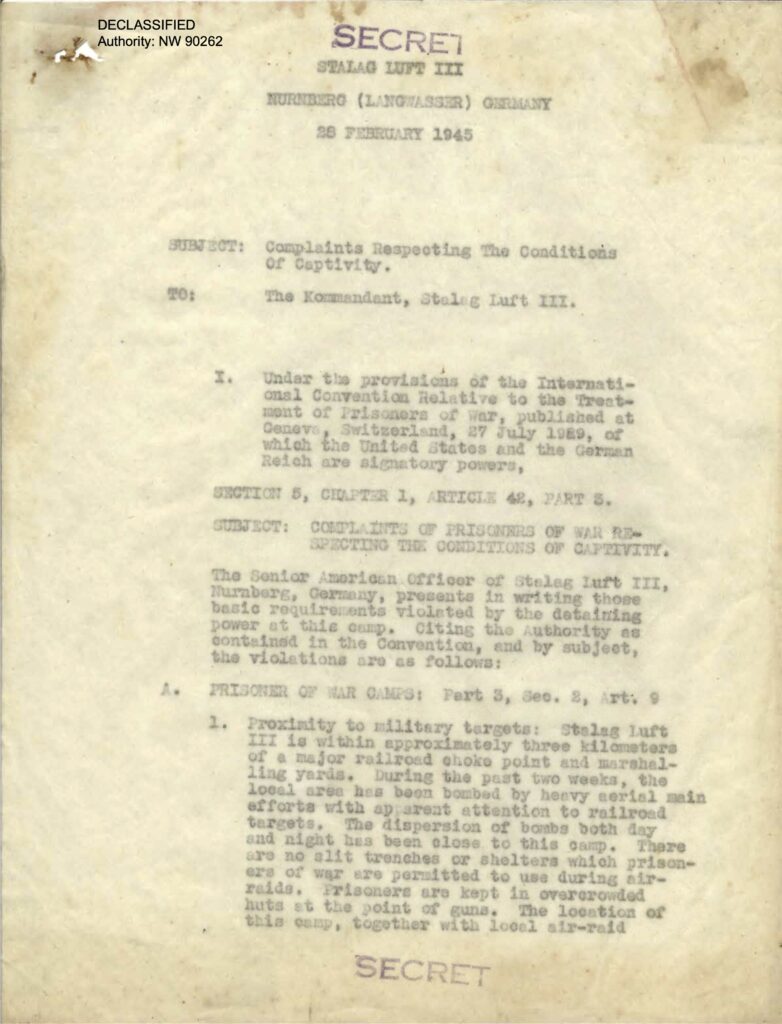
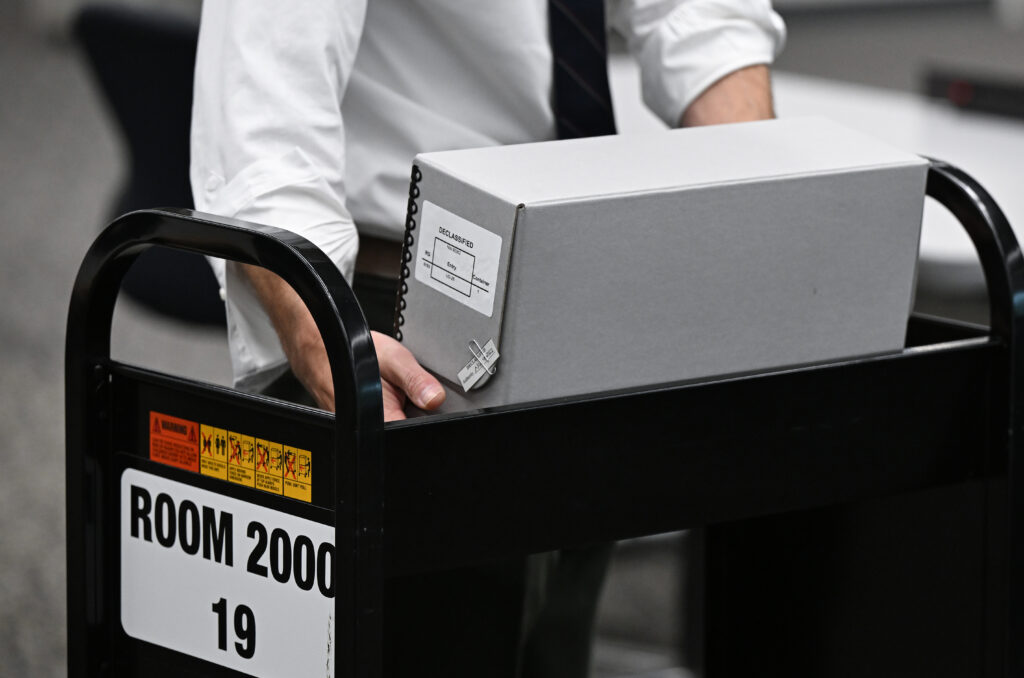
At the glass-and-metal hub of the Archives in College Park, the documents live inside a gray box with a typed label marking them “declassified.” They have been preserved in the same order they were found, divided by labeled manila envelopes. At least one page that was partly ripped was preserved in a clear plastic sleeve, and archivists are the only ones allowed to handle the records.
McCaffrey said NARA plans to digitize these records and make them available to the public in the Archives’ research room in College Park, Maryland. No one has been able to figure out how the documents got into Hurdle’s crawl space in the first place. Hurdle said they may have come from a former neighbor, because he also found memorabilia from an ancestor of that family, but the mystery remains unsolved.
Hurdle said he was grateful to the National Archives for preserving the documents and making them available for the masses.
“This stuff was stuff that you don’t learn in history books,” Hurdle said. “You actually see this and read this — that to me is very, very special. I was like, I got to find a place these can go.”
By the spring of 1945, the road home for thousands of American prisoners of war ran through Camp Lucky Strike.
It sprawled across the rolling countryside of Normandy near Saint-Valery-en-Caux, France, and seemed almost like a temporary city, with long ranks of tents, mess facilities, medical complexes, showers, trucks and processing stations, all built to move human beings through as quickly as the Army could manage.
Lucky Strike could officially accommodate 58,000 troops at a time, making it the largest of the staging areas in the region. The waypoints were collectively known as the “cigarette camps,” each given military code names borrowed from familiar brands of the era, such as Camp Old Gold, Camp Pall Mall and Camp Twenty Grand.
For the freed prisoners arriving there, the transition could be dizzying.
A few days earlier, some had been living on thin soup and scraps of bread. Others had survived forced marches ahead of the advancing Allied armies. Some arrived filthy, infested, sick and astonishingly thin. Then suddenly, there were American trucks, uniforms, cigarettes, coffee, doughnuts and quantities of food they had spent months dreaming about.
The men were interviewed and told to write down their experiences. Each man had been debriefed so U.S. forces could gather intelligence. The interviews and forms were exhaustive, to the point that one soldier dubbed the camp Mount Paper Trail. The accounts were later used by the American government and war crimes investigators in military tribunals.
The first page Hurdle saw, labeled “SECRET,” was the start of a five-page memo written by an American Army Air Forces colonel, describing in disturbing detail how prisoners of war were held in conditions that defied the 1929 Geneva Conventions.
After World War I, the United States, Germany and several other world powers had agreed to treat any future prisoners of war with dignity. Not every country signed, including Japan, which subjected prisoners to life-threatening conditions during World War II. U.S. soldiers later reported that Germany was not keeping its end of the deal and should be held responsible. American officials collected evidence, interviewing prisoners of war and asking them to write down their experiences.
When Hurdle found the documents, the memo was followed by reams of men’s forms, bound by a large metal clip.
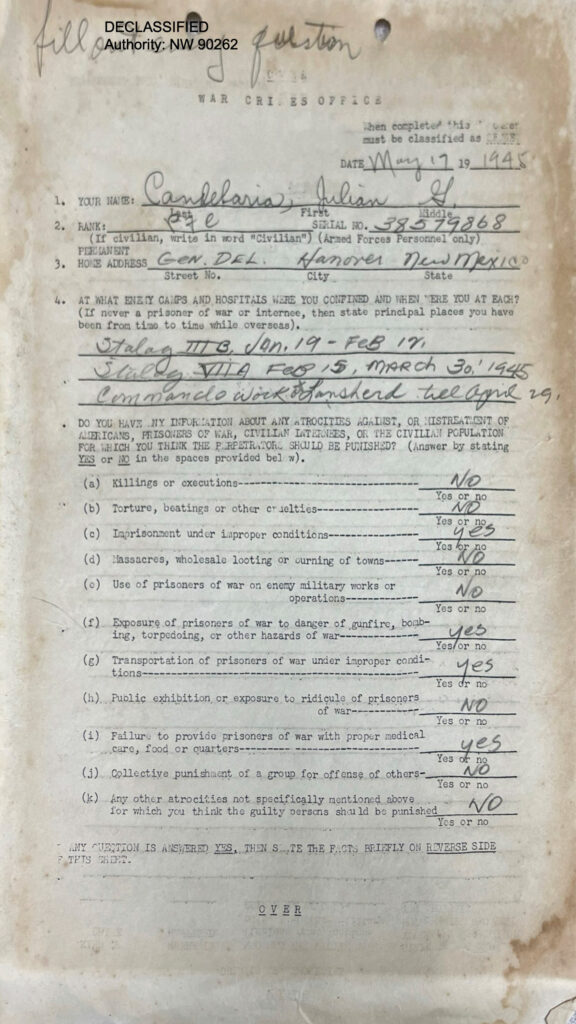
The forms asked: “DO YOU HAVE ANY INFORMATION ABOUT ANY ATROCITIES AGAINST, OR MISTREATMENT OF AMERICANS, PRISONERS OF WAR, CIVILIAN INTERNEES, OR THE CIVILIAN POPULATION FOR WHICH YOU THINK THE PERPETRATORS SHOULD BE PUNISHED?”
Read more Woman deported to Afghanistan in first use of Alien Terrorist Removal Court
Soldiers were told to mark yes or no.
Most of the stories from the documents begin with soldiers being captured during the Battle of the Bulge, then marched or sent via train to camps. Many of the men spent time in more than one camp.
Julian G. Candelaria of New Mexico was held captive in POW camps and a work camp for months. “60 men in boxcars,” he wrote, “no food no water, no sanitary facilities, crowded, exposed to bombing. Walked 3 days + nights with little food, no medical.”
Candelaria’s obituary later read: “After returning home he refused to discuss the events that occurred during his imprisonment at [the] hands of his captors, the Germans.”
In yes-or-no questions and written responses, American troops held captive by Germans said they witnessed killings and beatings, were exposed to air raids and other hazards and were imprisoned under improper conditions.
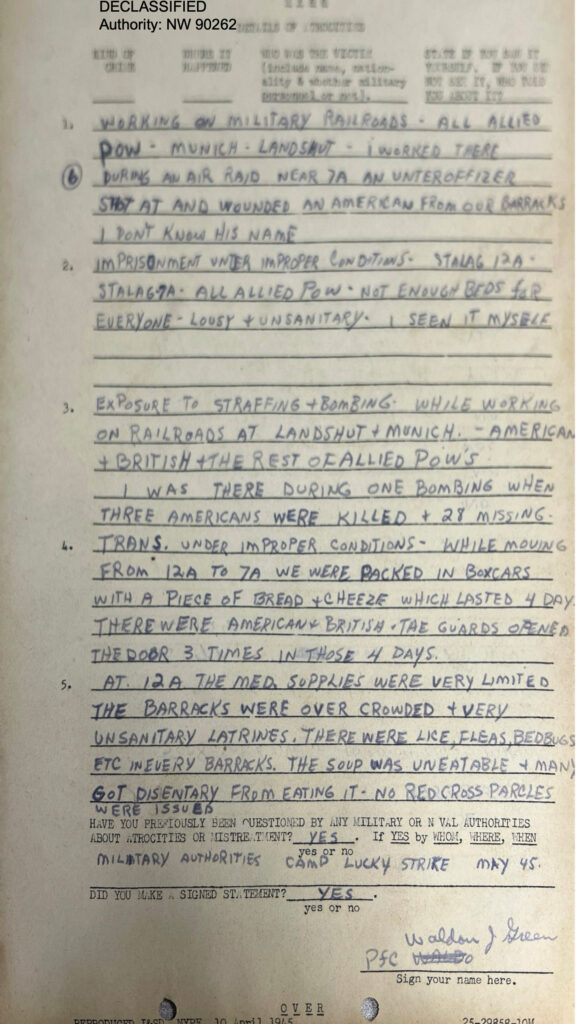
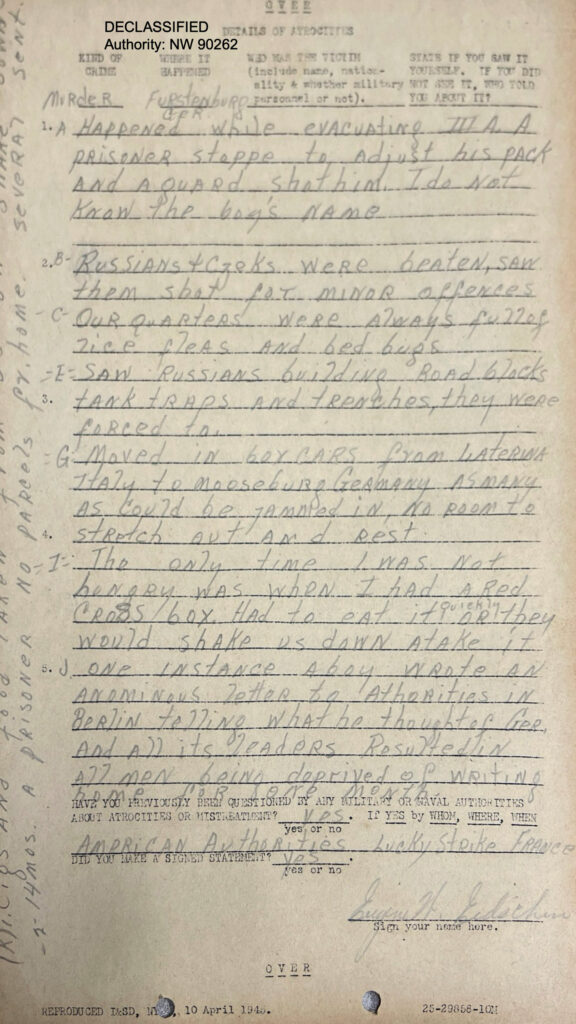
Several noted they had watched killings and beatings of other prisoners and Jewish people. Eugene William Eidschun, a first sergeant from Shady Point, Oklahoma, bore witness to a killing in Furstenberg as the soldiers were evacuating the German camp. “A prisoner [stopped] to adjust his pack and a guard shot him,” he wrote. “I do not know the boy’s name.”
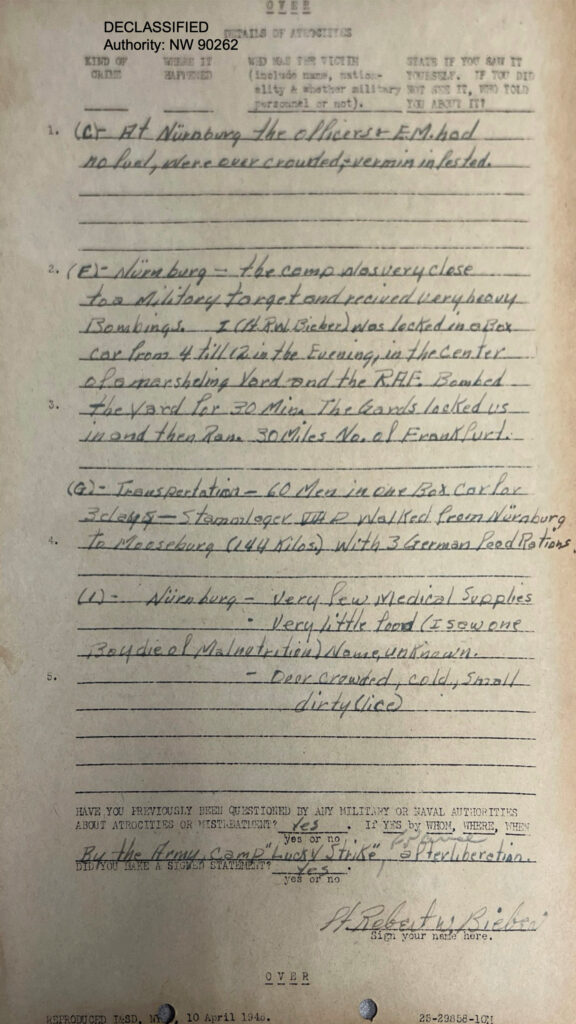
The soldiers also detailed their dismal living situations: They wrote their quarters were infested with rats, lice and other vermin. They were trapped inside for days or transported in cramped boxcars during air raids from their own forces. The men had difficulties getting medical care.
Emilio M. Membrila of Arizona wrote “POOR SANITARY conditions, NO FOOD, Living QUARTERS NOT FIT FOR HUMANS.”
He later recalled watching American bombers flying overhead and thinking, “Our friends are so close to us and yet they can’t think of anything to help us out.”
Eighty years after the end of the war, many families only have the stories passed down through generations or the records that were left behind. Some have even less.
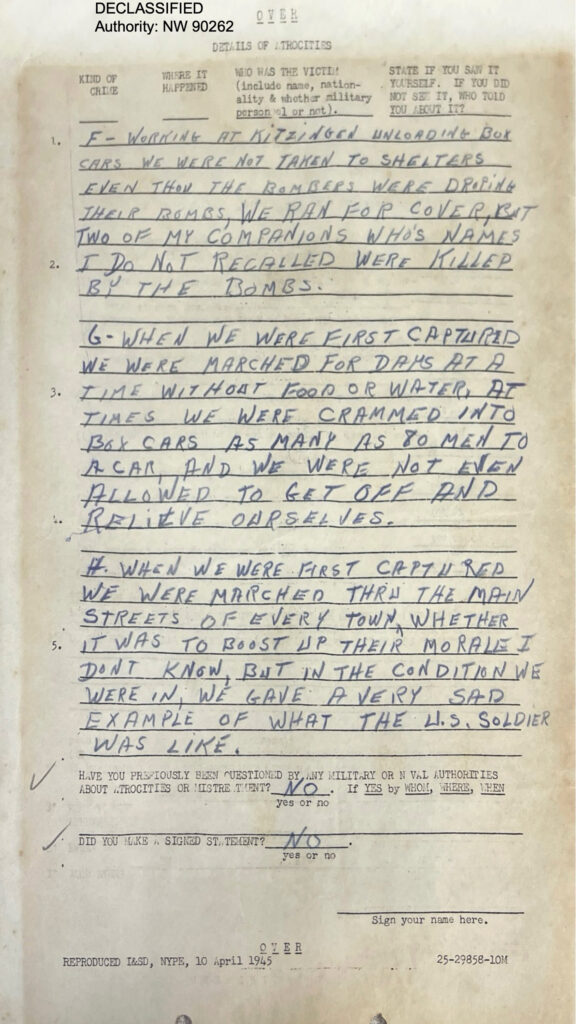
Henry Daly’s family never knew much about his war experiences until they reviewed the documents Hurdle discovered in his garage, which were shared with them by The Post. Then a young private from Phoenix, Daly was captured at the Battle of the Bulge, marched through the main streets of towns and forced to work in Kitzingen, Germany, unloading boxcars. He seemed to feel some outrage about how the prisoners were led past onlookers.
“Whether it was to boost up their morale, I don’t know, but in the condition we were in, we gave a very sad example of what the U.S. soldier was like,” he wrote.
When Allied forces struck German positions, Daly and other men were unable to make it to shelter.
“We ran for cover, but two of my companions [whose] names I do not [recall] were killed by the bombs,” Daly wrote.
The POWs described their lives in captivity — sometimes in ways that their own families had not previously heard.
The war forever changed him, his great-grandson, Michael Yanes, said. He came back from war but was unable to stay in his house and often slept at a park nearby. Yanes said his family did not know much about what he had experienced, probably because he didn’t want his six children to worry about him.
“Seeing these words written is quite heavy,” Yanes said. “This is all new to us. The emotions. I can’t even describe.”
Pete Dimas was one of many who detailed a lack of food, writing that the camp fed prisoners a diet primarily of bread and butter with a loaf shared among six men, and “a taste of meat every other day.”
His son Pete said his father, who died in 2020, didn’t talk much about his experiences in Germany. The younger Dimas, a retired historian, has sought to learn more about his family’s history and is considering producing a documentary about his father’s life and service.
Reading his father’s writing, Dimas wondered out loud about how much food meant to him.
“When we were at dinner, he would make sure we ate everything,” Dimas said. “One time, he did say that, which I found interesting, that the German civilians used to give them potato peels through the top of the fence.”
Around 2005, before his father died, Dimas started to look for more information — interviewing other veterans, visiting the war sites and requesting records from the government. Dimas had plans to go to the National Archives to look for more himself before The Post contacted him to ask him about these records.
“I’ve been picking up little things here and there and trying to put things together,” Dimas said. “That’s what I’ve been looking for.”
Top photos: National Archives and Records Administration. Reporting by Meryl Kornfield. Design by Natalie Vineberg. Development and topper animation by Aadit Tambe. Story editing by Patrick Caldwell. Design editing by Betty Chavarria. Photo editing by Peter Stevenson and Christine T. Nguyen. Copy editing by Anne Kenderdine.
Read more For years, Bush was mocked for this 9/11 moment. Now he’s painted it.