
Likely voters prefer Jackson on several key issues, but they favor Collins’s ability to steer federal dollars to the state.
Read more The politics of prediction markets
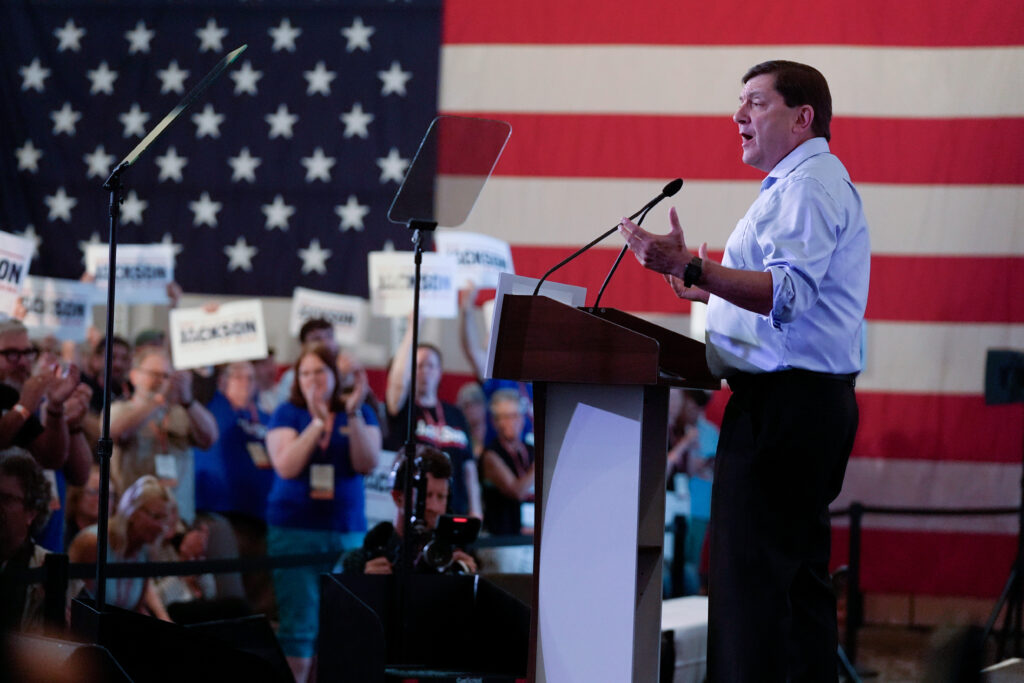
Democrat Troy Jackson has a slight edge over Republican Sen. Susan Collins with less than a month before Election Day in the Senate battleground Maine, a Washington Post-Schar School poll finds.
Jackson attracts 50 percent of likely voters compared with Collins’s 46 percent in the poll of 800 likely voters conducted Sept. 30 to Oct. 5, before the two faced off this week in the first of four debates. Jackson’s lead is within the range of sampling error.
Collins, the chair of the Senate Appropriations Committee, who is seeking a sixth term, is the only Republican senator up for reelection this year in a state that voted for Kamala Harris in 2024. The race is a key piece of the Democrats’ hopes to gain control of the Senate, where Republicans currently hold 53 seats.
Jackson, a former state Senate president, became the Democratic nominee after the party’s previous choice, Graham Platner, dropped out in July following a sexual assault allegation, which he denies.
Fewer than 4 in 10 likely voters, 36 percent, approve of President Donald Trump, presenting a challenge for Collins, who is struggling to outrun the deeply unpopular president enough to hang on in the blue state. A majority of likely voters — 58 percent — say Collins has supported Trump too much in the U.S. Senate.
There are bright spots in the poll for Collins, who defeated her Democratic challenger by nearly nine percentage points in 2020 despite consistently trailing in polls in the final month of the race.
Voters prefer Collins over Jackson by a 24 percentage-point margin on her ability to steer federal dollars to Maine, the centerpiece of the bring-home-the-bacon campaign she is running. They also favor her on the issue of bipartisanship, suggesting that at least a portion of voters are open to her argument that she has maintained some distance from the unpopular president.
But voters favor Jackson on five other key issues: abortion (by 16 percentage points), reducing corruption (15 points), understanding the problems of Maine voters (11 points), cost of living (11 points) and health care (9 points).
Abortion was central to the debate between the candidates earlier this week, when Collins stood by her vote to confirm Supreme Court Justice Brett M. Kavanaugh, who voted to overturn the right to abortion in 2022. Collins has said she does not regret her vote, even though she disagreed with Kavanaugh’s abortion decision. She has criticized Jackson, who served as president of Maine’s state Senate until 2024, for his past antiabortion stance.
Collins has also had to contend with a September report from ProPublica alleging that her team was tied to a pay-to-play bribery scheme involving a now-imprisoned defense contractor. She has denied the allegations, and the FBI has said it found no evidence of wrongdoing by Collins’s team in the earlier inquiry into the contractor.
Collins has pointed to Jackson’s son’s years as a lobbyist while he served in the state Senate. (Jackson has said his son received no improper benefit from his role.)
Read more The midterms are getting close. Why is Trump in Upstate New York?
Voters in Maine rank cost of living as their top voting issue by far. The poll shows a majority of likely voters describing daily essentials as unaffordable for their families. Sixty-three percent rank home energy and utility bills as unaffordable, with 62 percent saying the same of gasoline. Health care and groceries were also described as unaffordable by 54 percent and 56 percent of voters, respectively.
Neither candidate is particularly popular with the public, but the poll showed that a larger share of likely voters do not like Collins. Fifty-one percent of likely voters see Collins unfavorably, compared with 43 percent who don’t like Jackson.
Collins, who has built a brand as a moderate in the state over decades, is polling ahead of the Republican candidate for governor by a considerable margin. The Democratic candidate, Hannah Pingree, polled at 49 percent, while 36 percent of likely voters say they plan to vote for Republican Bobby Charles for governor. Eleven percent say they back Rick Bennett, an independent.
Collins’s competitiveness also contrasts with the 55 percent majority of Maine voters who prefer a Democratic-controlled U.S. Senate.
“Collins has been remarkably resilient in the past, beating expectations and overcoming unfavorable polling to hold on to her seat,” said Mark Rozell, a political scientist and dean at George Mason University’s Schar School of Policy and Government, which helped produce the poll. “This year just might be different given the likely blue wave of anti-Trump and anti-GOP voting.”
Collins has sought to portray Jackson, who’s backed by Sen. Bernie Sanders (I-Vermont), as too liberal for the state, criticizing his support for a Medicare-for-all government-funded health care plan and other policies.
But the poll suggests that the argument may not be landing with swing voters. Among independents, 52 percent say Collins is “too conservative” while 40 percent say Jackson is “too liberal.” (Among all likely voters, 48 percent say Collins’s views on most issues are “too conservative” for them, slightly higher than the 43 percent saying that Jackson’s views are “too liberal.”)
A majority of likely voters — 55 percent — also support a Medicare-for-all health plan. That includes 58 percent of independents. A majority of the state’s Republicans oppose the idea.
Collins is facing an anti-incumbency sentiment in the electorate, despite voters crediting her for steering millions of federal dollars back to Maine. When asked whether Collins’s nearly 30-year tenure as U.S. senator is “mainly good thing because she is more effective at getting things done” or “mainly a bad thing because she is part of the problem in Washington,” 52 percent of likely voters say it’s a bad thing while 38 percent say it’s a good thing.
The poll was conducted by The Post and George Mason University’s Schar School of Policy and Government from Sept. 30-Oct. 5 among a random sample of 800 likely voters in Maine drawn from a statewide voter database. Live-caller interviewers reached respondents on cellphones (63 percent) and landlines (12 percent); 25 percent of respondents were reached via text message and invited to take the survey online. The overall margin of error is plus or minus 3.6 among likely voters overall.
Read more Democratic women’s caucus demands Trump administration changes after Cornell accusations
Alauna Safarpour contributed to this report.