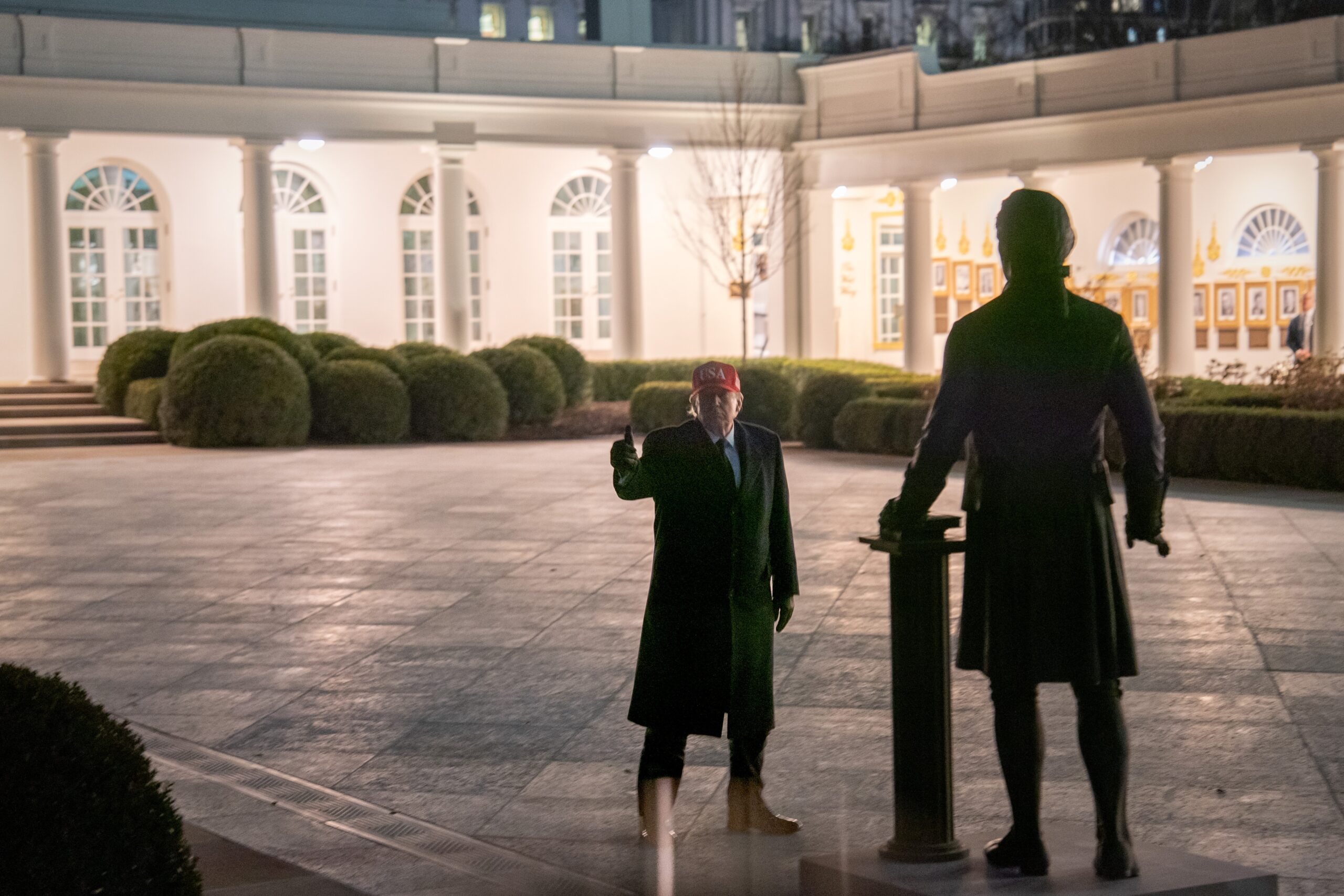
A bronze Thomas Jefferson was installed as the fifth new statue last week. Three were provided by Harlan Crow, a conservative collector and political donor.
Read more Small-town fight over corruption, abuse may haunt GOP candidate for Arizona governor
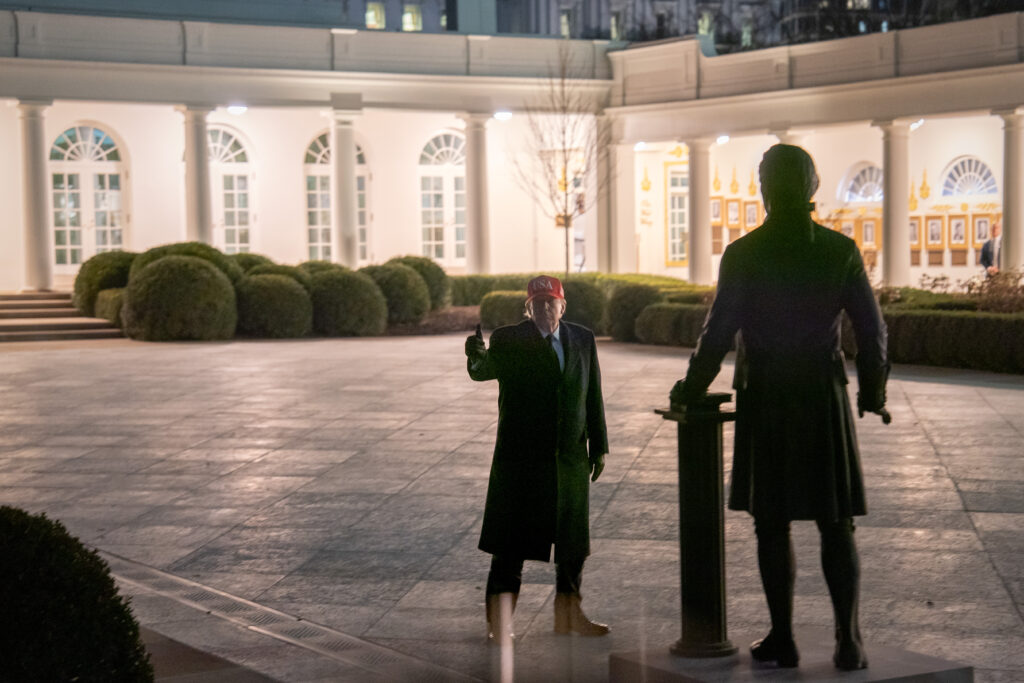
President Donald Trump installed a statue of Thomas Jefferson in the Rose Garden last week, according to two people who spoke on the condition of anonymity to describe the yet-to-be-announced move — continuing Trump’s effort to remake the White House and Washington.
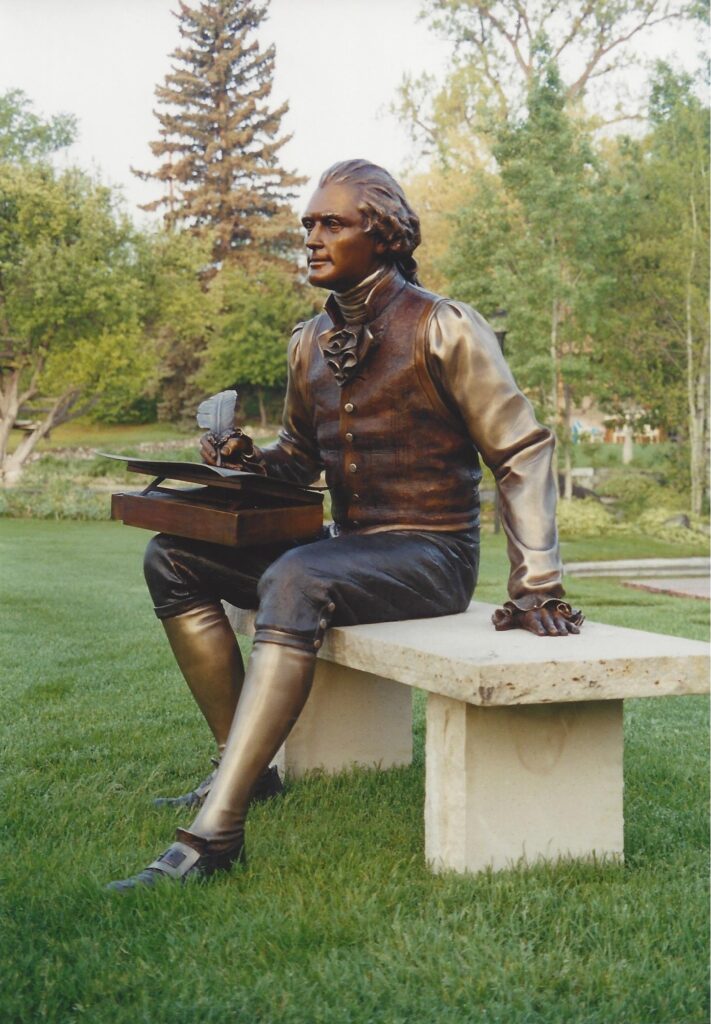
The bronze, life-size statue depicts the nation’s third president seated with a draft of the Declaration of Independence. It was sculpted by George Lundeen, who told The Washington Post that he received a congratulatory call from Trump this month.
“I just wanted to thank you. The sculpture looks really beautiful,” Trump told Lundeen, in audio that Lundeen shared with The Post.
The piece brings to five the number of sculptures Trump has installed in the Rose Garden, joining George Washington, Benjamin Franklin and Alexander Hamilton, as well as a sculpture called “Freedom’s Charge,” which honors Revolutionary War soldiers. The Franklin, Hamilton and “Freedom’s Charge” sculptures are on loan from Harlan Crow, a conservative art collector and political donor who had installed them on his Old Parkland corporate campus in Dallas, a spokesperson for Crow confirmed. The White House has not previously disclosed where the statues originated, saying only that they were on loan from “generous private American patriots.”
The White House declined to comment on Crow’s loan of the statues. A spokesman wrote in a statement that the president is pushing “to beautify and honor our Nation’s Capital during America’s historic 250 anniversary celebrations.”
Trump on Sunday posted a flurry of messages related to his Washington renovation projects to Truth Social, including photos of cleaned-up statues outside of the White House and Union Station. He has spent years calling for more statues that recognize prominent Americans, particularly the nation’s Founding Fathers, past U.S. presidents and other figures that Trump says deserve special recognition.
“The President enjoys showcasing American Excellence and those Americans who exemplify excellence,” Rodney Mims Cook Jr., a designer and Trump appointee who chairs the Commission of Fine Arts, wrote in a text message.
“I think he’s spot-on after the billions in Patrimony we destroyed after George Floyd died,” he added, referring to damage done to monuments during protests that followed Floyd’s killing in 2020. Trump responded by issuing executive orders calling for existing statues to be protected, the damaged statues to be restored and new ones to be constructed. He also required that federally commissioned statues of historic figures be lifelike or realistic — and specifically barred abstract or modernist representations.
“These statues are silent teachers in solid form of stone and metal,” Trump wrote in one of his 2020 orders. “They preserve the memory of our American story and stir in us a spirit of responsibility for the chapters yet unwritten.”
Some art critics argue that Trump’s emphasis on memorializing specific people, rather than commissioning abstract works that evoke broader themes and feelings, is a lost opportunity.
“All told, the statues dating to his second term are of negligible artistic value,” Maxwell Anderson, the former president of the Association of Art Museum Directors, wrote in an email. Anderson also drew comparisons between Trump’s preferences and what he said were similar practices by dictators who led North Korea and the Soviet Union.
“President Trump’s embrace of an official classicizing style in art and architecture finds its closest equivalent in authoritarian regimes,” Anderson wrote.
The sculptures have given Trump an unusually direct way to reshape the White House grounds and the broader capital city — albeit with moves that can be more easily reversed than his construction projects, such as his White House ballroom addition. Trump has planned an expansive sculpture garden in West Potomac Park, where he hopes to feature 250 “American heroes,” ranging from athletes such as Muhammad Ali and Kobe Bryant to Canadian TV host Alex Trebek. The president is also overseeing the cleaning and renovation of existing statues in parks across Washington, and he has celebrated the regilding of several statues near the Lincoln Memorial.
He has also sought to restore some controversial statues to even greater prominence.
Trump has overseen a new statuary exhibition in downtown Washington featuring a statue of Caesar Rodney, a signer of the Declaration of Independence, that was removed from public view in Delaware during protests in 2020 after criticism of Rodney’s role as an enslaver.
Read more The Supreme Court grapples with a new era of political violence
Trump in March also installed the recreation of a Christopher Columbus statue that was torn down in Baltimore in 2020 on the White House grounds.
The president has long said he was troubled by efforts to tear down and remove statues honoring Rodney, Columbus and other historical figures, repeatedly broaching the topic in public remarks during his first term.
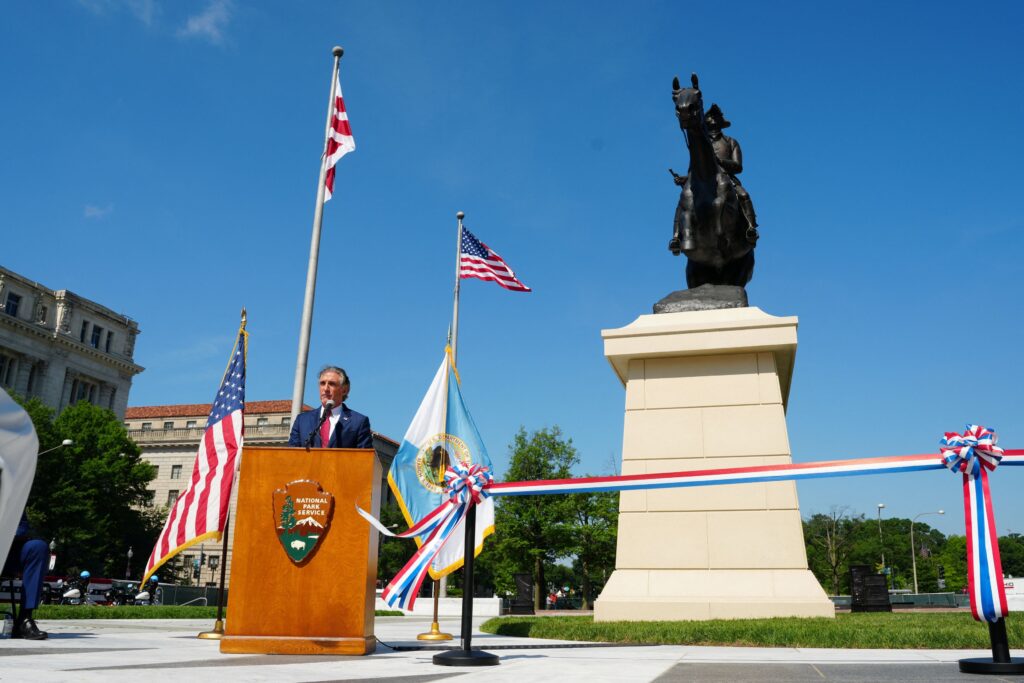
“I like the idea of building new statues to people, to great people, people that have done something. And I think that’s okay,” Trump said in June 2020. “But you don’t want to take away our heritage, and our history and the beauty.”
Two people who spoke on the condition of anonymity to discuss private conversations said Trump — who has faced his own share of protests — has in the past privately said he identified with figures such as Columbus, who was hailed for centuries as a great explorer before his role in colonization and enslavement made him controversial.
Several satiric statues have appeared around Washington mocking Trump before being swiftly removed.
Lundeen, who sculpted the Jefferson statue and whose work is displayed in museums, on campuses and in capitals throughout the country, has also sculpted Trump himself. Last year, he met the president when installing a 7-foot bronze behemoth at his golf club in West Palm Beach. In the sculpture, Trump holds a MAGA hat in one hand. His other is raised in a fist, inspired by his “fight, fight, fight” stance following the assassination attempt in Butler, Pennsylvania.
In the run-up to the country’s 250th anniversary, Lundeen said his friend Steven Barber, a filmmaker, facilitated communication with the administration in the hopes of getting one of his Jefferson statues to the White House.
Lundeen, who has worked with his brother Mark to sculpt prominent statues, such as three Apollo 11 crew members for the Kennedy Space Center to celebrate the 50th anniversary of the first human moon landing, said he was delighted to receive the thank-you voicemail from Trump, which the president left on July Fourth.
“When you’re a farm boy from the middle of Nebraska, it’s kind of neat to get a call from the president,” said Lundeen, 77. “You get a call like that, and you don’t know if it is one of your buddies playing a trick on you. If it’s a hoax, it’s a really good one.”
The White House did not immediately respond to questions about Trump’s call to Lundeen. The New York Post first reported plans to install the Jefferson statue in the Rose Garden.
The arrival of Lundeen’s Jefferson statue follows Trump’s decision to take a George Washington statue that was displayed at the Washington Monument and place it in the Rose Garden last year. The Hamilton and Franklin statues subsequently arrived in the Rose Garden in March, on loan from Crow.
“Unbelievable statues,” Trump told reporters that month as he walked through the Rose Garden. He has also shown off the Rose Garden statues to foreign dignitaries and U.S. lawmakers.
“Freedom’s Charge” — a sculpture by Chas Fagan, who Trump appointed to the Commission of Fine Arts during his first term, and is on loan from Crow — also now sits in the Rose Garden. The sculpture features two life-size figures of American soldiers who fought during the Revolutionary War.
Crow, a billionaire real estate mogul who has donated to a wide array of Republican politicians and been linked to conservative figures such as Supreme Court Justice Clarence Thomas, had previously distanced himself from Trump. In a lengthy piece in the Atlantic in 2023, Crow said he had self-diagnosed with “Trump Derangement Syndrome,” and he supported Trump’s rival Nikki Haley in the 2024 presidential campaign.
Crow’s collection of outdoor sculptures in Dallas — which included a portion he once dubbed “The Garden of Evil” — drew national attention in 2023 for Crow’s selection of deposed dictators and other tyrants.
Read more Republicans don’t want to go there again on Trump’s 2020 election fraud claims