In today’s edition … Is AI in health care the next major political issue? … We ask you about the vibes … but first …
Read more Loomer’s Ukraine reversal deepens split in Trump’s ‘America First’ movement
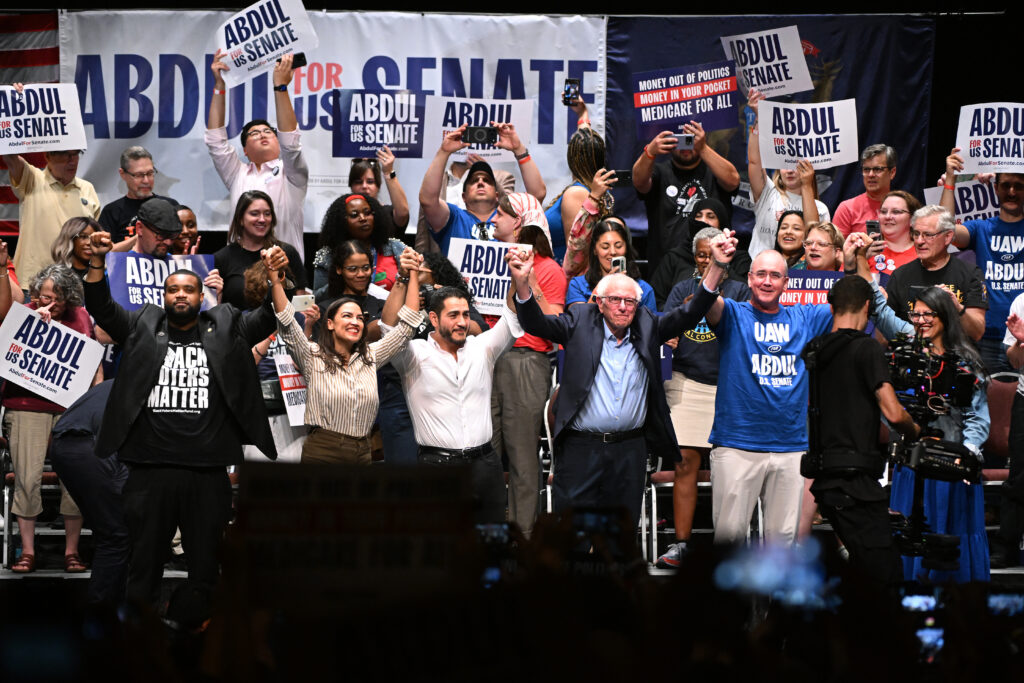
I find myself thinking a lot about vibes while covering politics.
Vibes are a hard thing to describe, but I generally view them as how voters broadly feel about their lives, despite any data that may contradict those feelings. Vibes have been critical in recent elections.
In 2020, the vibes around then-President Donald Trump were all bad — Covid was raging, the economy was deeply impacted, and the president did little to turn around the feeling that America was in chaos. A similar level of gloom surrounded President Joe Biden in 2024: Democrats regularly pointed to economic data that showed the economy and prices were improving, but polls and conversations with voters made clear that the vast majority of Americans weren’t feeling it.
Which brings me to 2026. The vibes around the economy are bad — polls and focus groups show voters feel like they are getting screwed at the gas pump and at the grocery store, jobs feel harder to come by, and the rise of technology like artificial intelligence is injecting considerable uncertainty into the future. Trump and Republicans routinely point to data showing voters have a dim view of the Democratic Party and prices aren’t increasing as fast as they once were, but, given Trump’s approval rating, it doesn’t appear to be connecting with voters.
So is the cake baked? It’s a question I ask myself regularly — and forgive the baking analogy, my guilty pleasure is clearly Prue Leith and “The Great British Baking Show.” But is the mood of voters likely to change dramatically in the three months left before Election Day?
We put this thinking to top officials at both the Democratic Congressional Campaign Committee and the National Republican Campaign Committee: Are the vibes in this election set? Or is there something that either side could do to shift them?
The short answer is it depends on who you ask.
Suzan DelBene, the chair of the House Democrats’ campaign arm, argued that the cake is, in fact, largely baked.
“We absolutely have seen consistently the biggest issues that American families are struggling with,” DelBene told us, referring to the economy, prices, the Iran war and the feeling that the federal government is out of control. “Those continue and will continue to be the top issues.”
DelBene said she thinks about this issue too, particularly around whether Republicans are going to shift their strategy on certain issues ahead of the election to try to change the narrative. She not only doesn’t think that will happen, but she points to Trump focusing on issues like the refurbishment of the Reflecting Pool and his White House ballroom as indications that the president’s mind is elsewhere.
“It’s really clear, at this point, there’s not much that they are going to do about it,” said the Washington state Democrat. “And they don’t even seem at all interested in doing anything about it.”
Republicans are less certain that the vibes are fixed.
While some Republican operatives we talked to over the summer have argued that gas prices need to come down and the war with Iran needs to end by the end of the summer if Republicans are going to have any chance at keeping the House, those working for House Republicans’ campaign arm believe the cake is far from baked.
“Democrats built their 2026 strategy around an environment and a map that’s moved against them since day one,” said Will Kiley, the top spokesperson for the Republican committee. “Democrats are strapped for cash, nominating unelectable candidates in key districts, and Republicans are squarely on offense.”
He added: “Nothing about this cycle is settled less than 100 days out.”
There is some truth to this. Kiley is correct that the Republican ecosystem enjoys far more money than their Democratic opponents, even if Democratic campaigns are raising serious money. And there is always a so-called October surprise before elections, and the roughly three months to Election Day is a lifetime in politics — the war could end, gas prices could fall and views about the economy could improve.
But that has not been the case in recent elections. In 2018, for example, Republicans tried to shift the vibes around Trump’s chaotic first two years in office and their attempts to repeal the Affordable Care Act by talking more about the economic growth happening and the tax cuts they had implemented.
It didn’t work, and Republicans lost the House that November.
It’s unclear if 2026 will be another 2018. Democrats needed to net 23 seats that year to win back the House, and they did it by winning 235 seats in the 435-person chamber. This cycle, Democrats only need to net four seats from a midterm map that has been significantly narrowed due to mid-decade redistricting.
But John Della Volpe, the director of polling at the Harvard Kennedy School’s Institute of Politics, argues the “vibes” around this election are highly unlikely to change.
“People are pretty well set. And one of the reasons is it’s just not one thing. It is a stack of things that have been growing and adding a real anxiety to voters for years now. Because of that … it’s hard to imagine a 180 or much of a shift,” said Della Volpe. “Some of the pressure could cool, but the vibes are pretty well set.”
The pollster put it this way: Vibes are often how people feel about their own lives, and “are people’s lives really going to shift in the next 90-something days?”
How candidates talk about artificial intelligence, particularly fears around the technology, could be the most underrated question of the 2026 midterms.
Read more Amid a democratic socialist surge, the DSA asks itself: What’s next?
And Guy Cecil, the head of the newly announced American Horizon Project, is looking to answer that question.
The research project, which Cecil said has an eight-figure budget, will aim to shape messaging on what it calls quality-of-life issues impacting a broad swath of Americans, like the implementation of artificial intelligence.
Cecil hopes this research — which includes polling, message testing and direct conversations with voters — will help campaigns better understand how to make topics like artificial intelligence more relatable to voters. And his first piece of advice is for candidates to focus on how businesses, like health insurance companies, are using artificial intelligence to deny patient claims.
“Any time you are talking about AI, you need to be talking about the human impact, not in generalities, but with specificity,” said Cecil, who has worked on top Democratic campaigns since the 1990s.
Private health insurers are using AI to determine whether a patient’s claim should be covered. Some states have regulated the practice, but the federal government has been clear that it is eager to implement AI into aspects of government health insurance.
Cecil’s group found voters are deeply skeptical about the practice — and it analyzed two ads on the topic that he said “tested off the charts” with key voters.
“Should a machine have more say than your own doctor if your health care gets covered?” asks the narrator in one of the ads, before pivoting to an attack on a hypothetical candidate. “Rich Johnson thinks so. … You decide. Stop Rich Johnson from ripping us off.”
Cecil said most Americans “already feel like they are getting screwed by insurance companies, and this is just another proof point in this argument.” With artificial intelligence becoming a more politically salient issue, he argued that applying the technology to these kinds of decisions is how candidates can win on the issue.
“When you put people at the center of the AI discussion, and you are clear in human language what the consequences are, you begin to see people have an ‘aha’ moment,” Cecil said of this focus on AI in health care. “It is this confluence of, ‘I am getting screwed, I have less control, prices are rising, and government and corporations are making all the decisions for me.’”
Colorado Newsline: The United States’ 250th isn’t the only major anniversary in the country this year. “Don’t forget us, it’s also our birthday,” said Colorado Gov. Jared Polis at a celebration of his state’s 150 years of statehood yesterday.
Times of San Diego: The San Diego Anti-Hate Coalition says the region has seen a sharp increase in hate crimes documented by the city attorney’s office over the last two months. The spike comes in the aftermath of a shooting at the Islamic Center of San Diego, which has left the city reeling.
Maryland Matters: Thirty-eight people have died from heat-related causes in Maryland so far this year. It’s the second-most in the last 15 years, with two more months of high temperatures expected.
We asked about family replacing family in Congress — in reference to Sen. Lindsey Graham’s sister running to replace him in Congress — and many of you were clear you do not support the practice.
“While it may not be articulated as a reason the public has such a low opinion of our elected officials, people resent those who are given a leg up anywhere in life based solely on their surname,” wrote Paul Gutermann. “It reinforces the impression that, in a phrase the President would understand, ‘the game is rigged.’”
“I think that, given how close the general election is, it was probably okay for Graham’s sister to be appointed to replace him — for the interim. It makes absolutely no sense for her to be put forth as the party’s nominee to fill his position in Congress,” wrote Doris B. Mabrey. “If she had ever shown any interest in such a position, it would be different.”
And Pat Fogg, a reader in Maine, said family replacing family is another example of corruption in politics.
“Youth, intelligence, and integrity seem to be what the American people are demanding. New blood — new ideas,” Fogg added. “Nepotism ignores all of that and gives total control to someone likely to be unknown, untested, and he or she hasn’t lifted a finger to earn it.”
We wrote today about how many recent elections have been all about one thing: Vibes. And how difficult it is for those vibes to shift in mere months — look at both Trump’s loss in 2020 and Harris’ loss in 2024. How much do you think the “vibes” of a moment impact who wins an election? What informs those vibes, and do you agree that they are difficult to shift quickly? Let us and your fellow Early Brief readers know at [email protected].
Read more DC Open finals postponed to Monday due to thunderstorms
Thanks for reading. You can follow Dan on X at @merica.