The White House credited a “Trump effect” for the decline, but data released by the FBI shows crime was falling well before the president took office again.
Read more Democrats abandon deep-red state Senate races, boosting independents
Violent crime and murder rates across the United States fell sharply between 2024 and 2025, according to FBI data, the largest year-to-year decrease since the federal government began tracking nationwide crime rates in 1936.
The 2025 murder rate of 4.1 killings per 100,000 residents is the lowest the country has seen since the mid-1950s, the agency said.
The FBI released those figures Friday as part of its annual national crime statistics analysis, known as the Uniform Crime Report, which amasses data from more than 17,000 law enforcement agencies across the country to paint a holistic picture of public safety trends in the U.S.
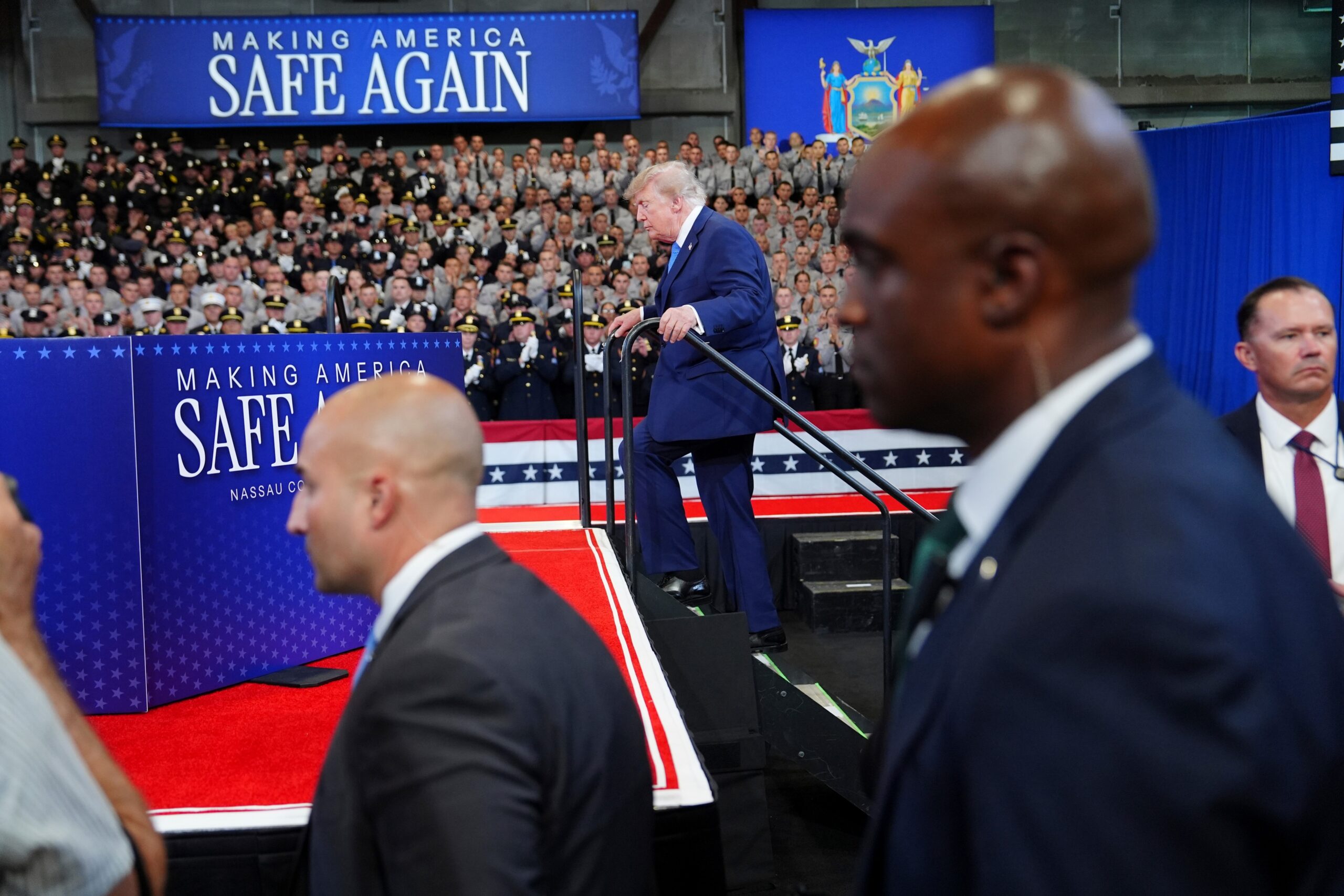
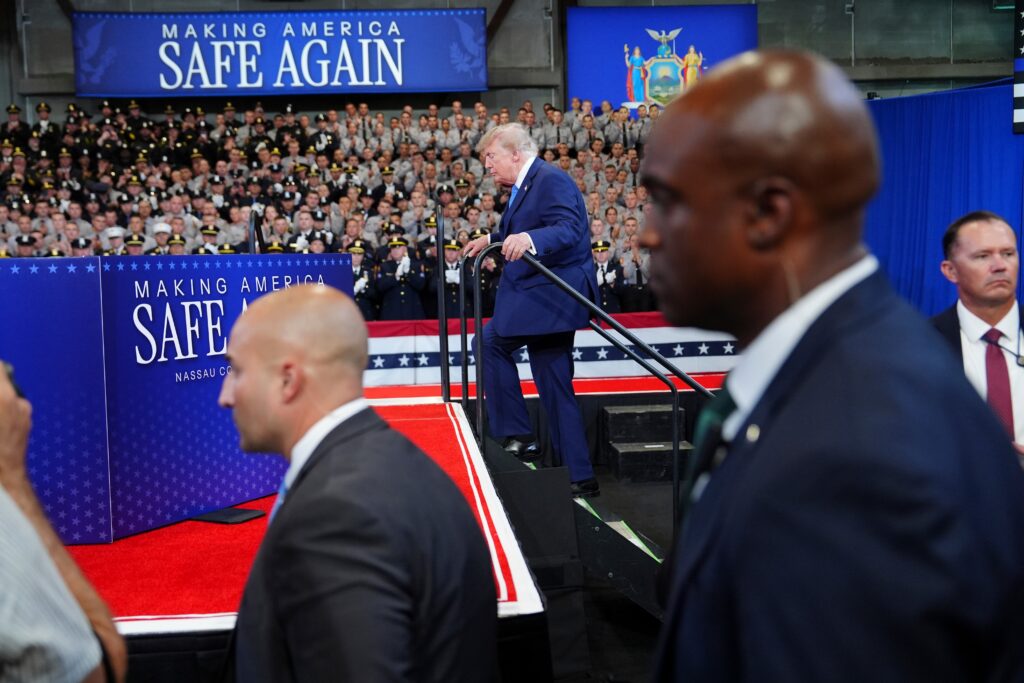
The unveiling of this year’s report, though, was unconventional. Instead of the announcement originating from the FBI or the Justice Department, it came from President Donald Trump, who broke the news during a visit to the New York police academy on Long Island on Friday.
“Today, I’m thrilled to announce that the FBI has just released the new Uniform Crime Report, showing that in 2025 we achieved the single largest reduction in violent crime in American history,” Trump said to applause. “Together, we’re showing what is possible when you finally have a president in the White House who supports our police, who lets you do your jobs, and who always backs the blue.”
Many criminal justice experts take issue with that analysis, at least in part, since violent crime began falling well before Trump took office.
FBI Director Kash Patel and newly confirmed Attorney General Todd Blanche joined Trump, who was visiting Long Island to campaign for Bruce Blakeman, New York’s Republican gubernatorial candidate and the current Nassau county executive.
The arrival of the FBI’s annual crime report came about a year since the Trump administration began ramping up his tough-on-crime messaging and deploying troops to some of America’s streets — sending the National Guard, dispatching federal task forces, increasing immigration enforcement and taking temporary control of the D.C. police department.
The president has credited those decisions for the crime declines in 2025, which include an 18.1 percent drop in murder and nonnegligent manslaughter, an 18.5 percent drop in robberies, and a 12.4 percent drop on property crimes, according to the FBI report. The White House has touted it as the “Trump effect.”
But the FBI’s data shows that, after a spike during the coronavirus pandemic, nationwide violent crime began plummeting in 2023 when President Joe Biden was still in office. By January 2025, when Trump returned to the White House for his second term, homicides had already fallen significantly.
That trend continued throughout 2025, according to the FBI figures and other independent analysis by various policing and criminal justice policy organizations. Criminologists and law enforcement experts broadly agree that it is difficult to assign credit — or blame — for the ebbs and flows of national crime rates.
“Lots of places are having historic decreases right now,” said crime data analyst Jeff Asher. “And the feds aren’t everywhere.”
An accurate understanding of the numbers is critical, experts said, so that police and policymakers can operate from a shared set of facts when making choices about public safety.
“There’s a saying: ‘There’s lies, there’s damn lies, and there’s statistics,’” said Matthew Cavedon, director of the Cato Institute’s Project on Criminal Justice. “The numbers don’t tell you the human story. They can tell you correlation all day long, but they aren’t going to tell you causation. It’s a tricky one.”
Read more Who will make the Commanders’ roster? Here’s the outlook with preseason underway.
Those who study crime trends tend to avoid drawing conclusions based on a one- or two-year change in the data, Cavedon said, because the fuller story plays out over decades.
“As with every edition with these kind of reports, the feeding frenzy begins to take credit,” Cavedon said. “Everybody wants to be able to go to the public and the voters and say, ‘This is exactly what did it.’ It’s a bit of a fool’s errand to even try.”
The White House public safety narrative, he said, deserves skepticism, especially the claim that U.S. cities were out of control until Trump deployed the National Guard and began deporting undocumented immigrants.
“That’s too simple of a story,” Cavedon said, pointing to Canada, where crime rates have also been dropping but where U.S. law enforcement policy is irrelevant.
After the Council on Criminal Justice, a nonpartisan think tank, released its semiannual crime report last month, Executive Director Adam Gelb said the consistency of the downward trend nationwide means that “macro-level forces are playing a major role.”
“We are seeing changes in criminal justice policy and strategy, advances in technology and surveillance, and broad shifts in society and culture, all happening at the same time,” Gelb said last month. “Crime is falling across too many different kinds of cities to credit any one policy, party or program.”
That analysis has not deterred Trump in recent weeks from claiming credit — especially for declines in D.C., where he declared a crime emergency last August.
“I’ll tell you, because D.C. is very personal for me … it was so bad when I got there a year and a half ago,” Trump said in Long Island. “Can you imagine our nation’s capital? One of the most dangerous cities in the country. We’ve taken it to one of the safest cities of the country.”
Trump said that crime in the District had dropped by 81 percent, but in recent appearances with reporters he has also referred to drops of 88 or 92 percent. When asked to clarify Trump’s remarks about D.C. crime drops, White House officials pointed to arson incidents, which dropped from four in 2025 to one in 2026.
The White House also cited the District’s homicide rate, which has fallen significantly in recent years, but not by the rates cited by Trump.
At Friday’s rally in Long Island, the law enforcement facility had been transformed into a MAGA rally filled with hundreds of his supporters. A pair of police cars were parked inside the building under a “thin blue line” flag. Trump spoke from beneath a “Making America Safe Again” banner, flanked by law enforcement officials in uniform who stood behind him on risers.
He praised the work of Patel and Blanche and pledged to continue pumping federal tax dollars into police departments and law enforcement efforts nationwide.
“Is there anybody that’s in favor of defunding the police in this particular room?” Trump said.
Read more Trump stumps in N.Y. suburbs, highlighting a dilemma for his party
“No!” the crowd yelled in unison.
Ben Conarck and Cat Zakrzewski contributed to this report.