The case could set up a landmark clash over the separation of church and state.
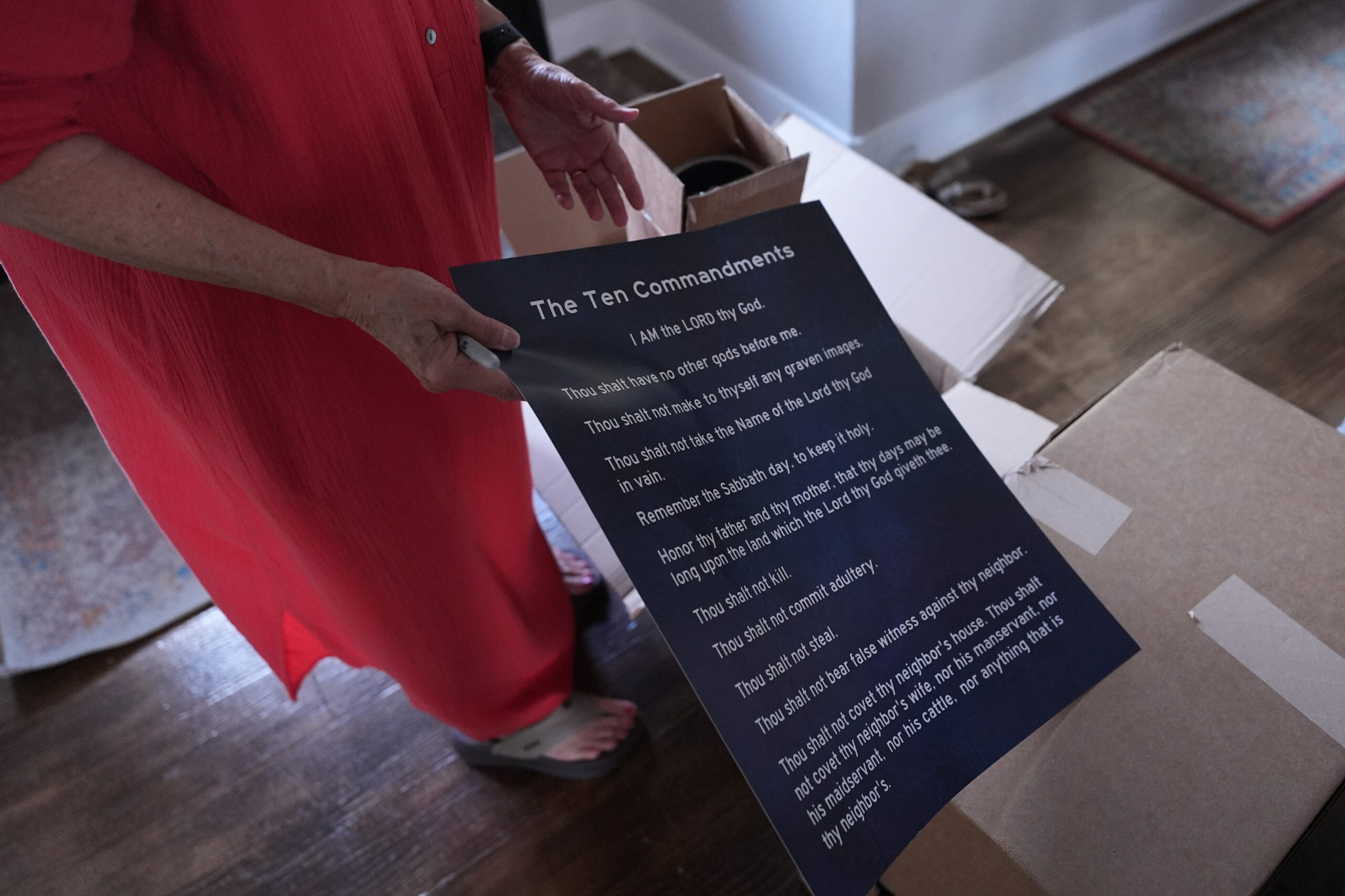
Civil liberties groups on Monday asked the Supreme Court to hear their challenge of a Texas law requiring that all public school classrooms display the Ten Commandments, potentially setting up a landmark clash over the separation of church and state.
Read more Supreme Court rebuffs Trump’s bid to overturn $5 million verdict in Carroll case
The justices are expected to decide in coming months whether to take up the case, which is being closely watched as conservatives in Texas and elsewhere work to expand religious rights in public spaces and opponents battle them in court. In April, a conservative appeals court upheld the law in a narrowly divided opinion.
The case would be one of the most significant dealing with religion in public schools since an ideologically divided Supreme Court ruled in 2022 that a former public high school football coach’s on-field prayers were protected under the First Amendment’s right to free speech.
In the current case, the U.S. Court of Appeals for the 5th Circuit in New Orleans upheld the Texas law on a 9-8 vote, overturning a lower-court ruling that found the measure unconstitutional.
More than a dozen Texas families of multiple faiths sued to block the law after it was signed by Gov. Greg Abbott (R) last year. They argued the statute violates the First Amendment ban on the government establishing religion, known as the establishment clause, and improperly forced the Christian faith onto students.
The families are being represented by the American Civil Liberties Union, the ACLU of Texas, and Americans United, a group that advocates for the separation of church and state.
“If the permanent, unavoidable imposition of biblical scripture in public-school classrooms does not interfere with, or threaten to undermine, parents’ ability to direct their children’s religious education and to instill particular religious beliefs and practices, it is difficult to imagine what would,” the groups wrote in their petition to the Supreme Court.
Texas has argued that simply posting the Ten Commandments in classrooms does not pressure students into a “formal religious exercise” so the law does not run afoul of the establishment clause.
“This is a major victory for Texas and our moral values,” Texas Attorney General Ken Paxton said in a post on X after the appeals court ruling in April. “The Ten Commandments have had a profound impact on our nation, and it’s important that students learn from them every single day.”
Read more Trump blames vandals for dead grass on lawn where he held Fourth of July event
The appeals court majority pointed to the 2022 Supreme Court ruling in favor of the high school football coach as guiding its decision. The judges explained that the case established a historical test: Would people at the time of America’s founding consider Texas’s law a violation of the Constitution’s establishment clause? They answered no.
“It does not tell churches or synagogues or mosques what to believe or how to worship or whom to employ as priests, rabbis, or imams,” the appeals court wrote of Texas’s law. “It punishes no one who rejects the Ten Commandments, no matter the reason. It levies no taxes to support any clergy. It does not co-opt churches to perform civic functions.”
Three Houston mothers filed a separate lawsuit over the Texas Ten Commandments law in July, arguing it violates the state’s religious freedom law and a state parental rights amendment.
Arkansas and Louisiana have also passed laws requiring the Ten Commandments be displayed in classrooms, but the Arkansas law has been blocked by a judge. Other states have established Bible-influenced school curriculums and tapped chaplains to serve as counselors. The Trump administration issued guidance in February allowing prayer time in schools.
The 6-3 conservative majority on the Supreme Court has greatly expanded the rights of the religious in recent terms. In March, the justices ruled a Colorado ban on “conversion therapy” for LGBTQ+ children probably violates the free speech rights of a religious counselor.
Last year, the justices ruled religious parents could remove students from public school lessons involving LGBTQ+ books that conflicted with their faith. The high court has also ruled that states must allow religious schools to participate in school voucher programs if secular schools are allowed to take part.
One notable loss came last term when the justices deadlocked over the creation of the nation’s first religious public charter school in Oklahoma. After Justice Amy Coney Barrett recused herself, a 4-4 tie allowed a lower-court ruling blocking the school to stand.
A Jewish group has started a fresh legal fight to try to establish another religious public charter school in Oklahoma, potentially setting up a test of the same law that could wend its way back to the Supreme Court.
Read more Cassidy on Trump’s vaccine overhaul: ‘Crazy, stupid thing’