Plus: Why people are drinking less, and whose best friend is a chatbot?
This week’s newsletter looks at why people are drinking less alcohol, how the world judges America and how many people use chatbots like a friend. But first …
Read more Judge blocks Trump’s latest attempt to limit birthright citizenship
A record-high 45 percent of Americans identified as political independents in Gallup polls last year, but that statistic carries a huge asterisk.
Decades of surveys show most independents lean Democratic or Republican, and those who do look a lot like partisans in their political views and how they vote. Political scientists and media have dubbed some independents “Undercover Partisans,” “Republican Lookalikes” and “Disguised Democrats.”
While few independents fit the ideal of an unbiased swing voter, recent research suggests there’s more to the story:
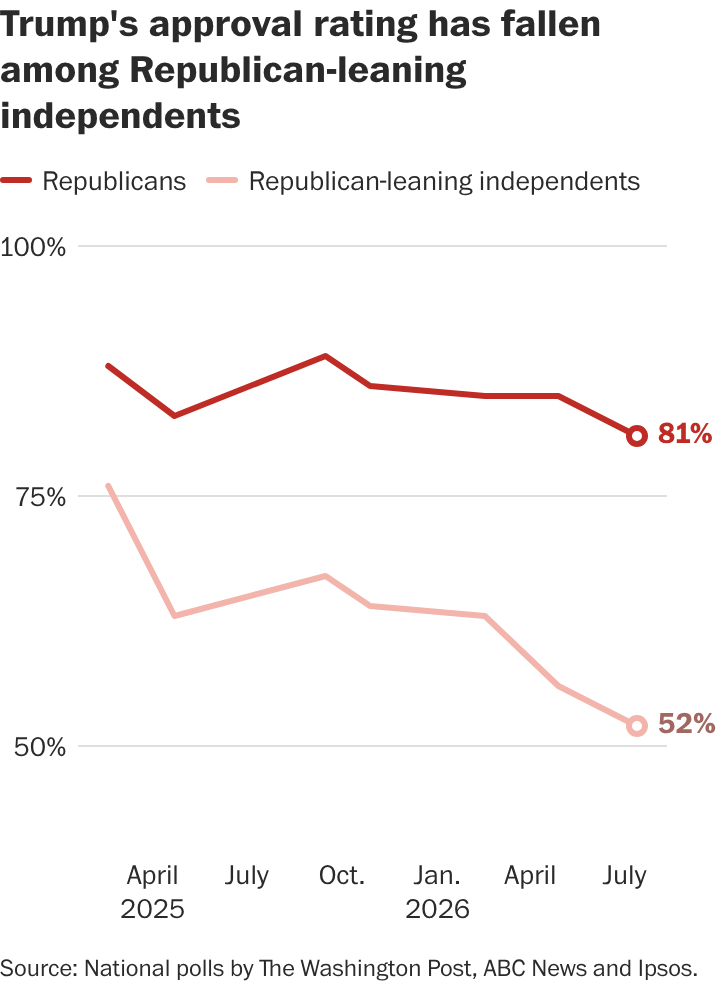
Why does any of this matter? President Donald Trump’s weakness among political independents — particularly independents who lean Republican — is a key factor behind his low approval ratings and the challenges Republicans face this fall.
Washington Post-Ipsos polls show Trump’s approval rating among Republican-leaning independents has fallen from 76 percent in February 2025 to 52 percent in July, even as 81 percent of self-identifying Republicans approved of his job performance this summer. The latest poll also found a big gap in economic perceptions: 50 percent of Republicans said groceries were affordable for them, compared with 32 percent of independents who lean Republican.
One way to think about independents who lean toward a party is a wayward segment of the base that needs extra persuasion to vote. While just 12 percent of “pure” independents were confirmed to vote in the 2022 midterm elections, according to a Pew Research Center study, turnout rose to nearly 4 in 10 among independents who lean Democratic or Republican. By comparison, 53 percent of rank-and-file Democrats and 59 percent of Republicans voted that year.
This year, the Democratic base appears more motivated to vote, a pattern that trickles down to independents who lean toward each party. The July Post-Ipsos poll found 63 percent of Democratic-leaning independent registered voters were certain to vote, slightly higher than 57 percent of independents who lean Republican. More than 6 in 10 Democratic-leaning independents said it is “more important to vote” than previous midterm elections, compared with about 4 in 10 Republicans-leaning independents.
Read more Sonny Styles’s NFL path seemed preordained. But it was his choice to follow it.
The first Pollwatcher newsletter cited Gallup and federal health surveys showing fewer Americans are drinking alcohol. Linda emailed: “This begs the question, why? What explains this trend? Perhaps a follow up poll to see if they have switched to marijuana or mushrooms. Or are they completely abstaining from everything.”
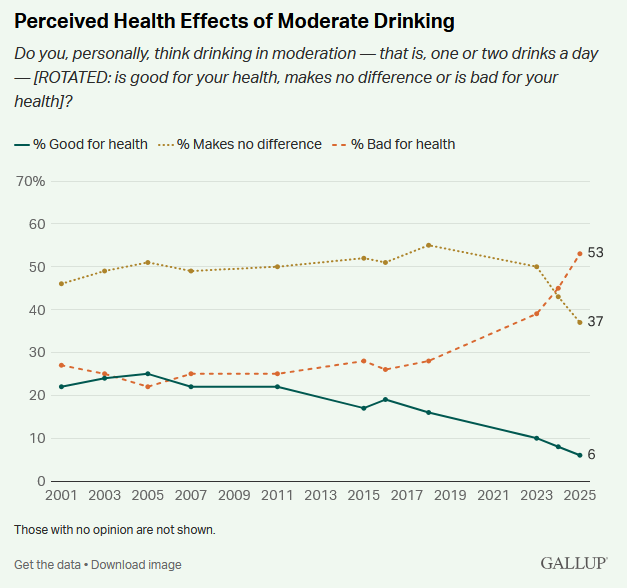
Great question! The Gallup poll itself has part of the answer: More people think moderate drinking is unhealthy. Their 2026 survey found 51 percent saying that “drinking in moderation — that is, one or two drinks a day” is bad for their health, similar to 53 percent in 2025 but up sharply from 28 percent in 2018.
Surveys suggest marijuana use is up, though they disagree on how much. Gallup found 17 percent of adults report smoking marijuana, tying a record high in 2023 and up from 12 percent in surveys from 2017 to 2021. The National Survey of Drug Use and Health (NSDUH) found monthly marijuana use grew from 12.3 percent in 2021 to 14.9 percent in 2025 among adults ages 26 and older, while decreasing slightly among younger adults.
The question of how many people are substituting alcohol with other drugs is harder to answer, as these surveys don’t interview the same people each year. Both datasets find marijuana and alcohol usage tend to overlap. In 2024, the NSDUH found 6 percent of adults used marijuana in the past month but did not drink, 16 percent did both while 32 percent only drank.
Send your questions, comments and ideas to [email protected].
The world now judges America based on Trump
People around the world have yo-yoed in their ratings of U.S. presidents of different parties, giving largely positive ratings for Democrats Barack Obama and Joe Biden and largely negative marks for George W. Bush and Trump. But opinions of the U.S. overall have generally been on a separate track — in 2018 for instance, Pew found a median of 27 percent of people across 25 nations saying they were confident in Trump, but 50 percent had a favorable view of the U.S.
That has shifted, with Pew global surveys finding a spike in the correlation between views of the U.S. and its president since Trump started his second term. Trump’s popularity hasn’t changed much since his first term, but favorable views of the U.S. around the world have dropped to a median of 37 percent this year. “People in many countries now evaluate the U.S. and its president as a ‘package,’ rather than separately,” writes Pew’s Jonathan Schulman.
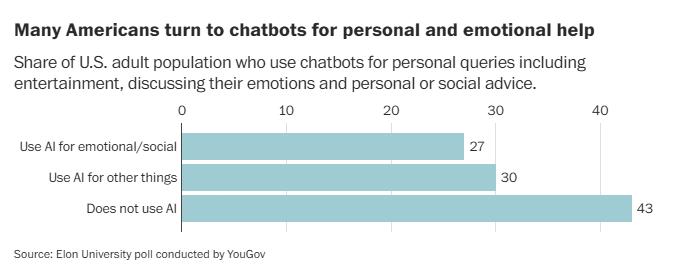
About 1 in 4 Americans use AI chatbots for emotional or social help
“Twenty-seven percent of Americans turn to AI chatbots like OpenAI’s ChatGPT or Google’s Gemini with personal, emotional or social queries, according to a new poll from researchers at Elon University in collaboration with The Washington Post. That category included seeking entertainment, relationship advice, romantic chats, or connection when alone,” write The Post’s Gerrit De Vynck and Jeremy Merrill. Here’s a gift link to the full story.
Read more Republicans fear Trump will keep super PAC money and not spend on the midterms