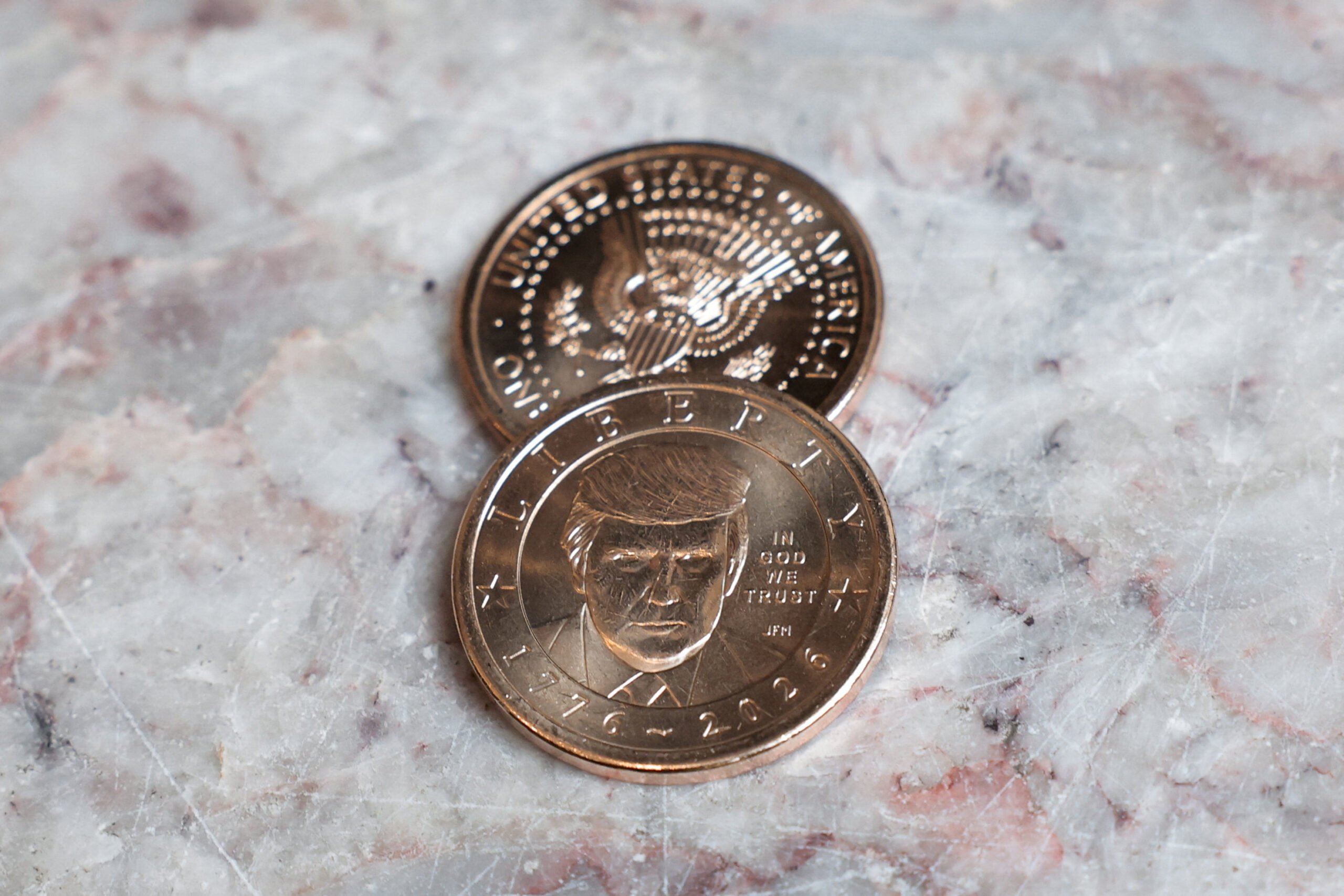
The president is winning the battle to build his ballroom and has his face on a $1 gold coin.
Read more Missouri candidate charged with conspiring to plant drugs on opponent
Here’s what happened this week under President Donald Trump’s administration you may have missed.
The chief justice of the United States has said that Trump’s unpopular White House ballroom is probably illegal because Congress didn’t approve it. Lower courts have blocked its construction for the same reason. But this week, conservative justices on the Supreme Court determined that those who are challenging the ballroom’s construction — historical preservationists — don’t have standing to sue to stop it.
That was probably the last hurdle for Trump to keep building his ballroom on the ruins of the East Wing, The Washington Post’s Dan Diamond and Justin Jouvenal report. “If the National Trust — which was chartered by Congress in 1949 and expressly granted the power to sue — can’t use litigation to vindicate the public’s interests to historic preservation, who can?” Sara Bronin, a George Washington University law professor who chaired the Advisory Council on Historic Preservation during President Joe Biden’s administration, told them, referring to the National Trust for Historic Preservation.
Congress could get involved to stop it, but that’s unlikely, at least while Republicans are in power. Days after the Supreme Court decision, the Trump administration announced it’s starting work on a 250-foot, controversial arch in Washington that is still facing legal challenges.
“We are living in the Golden Age of America, and this Building will be one of the Greatest ever constructed in Washington, D.C.,” Trump posted on social media this week.
The military has been secretly paying conservatives with large social media followings.
Their job descriptions are vague, The Post reports, but these influencers appear to have taken on some of Defense Secretary Pete Hegseth’s culture war issues, including scrutinizing war colleges for “woke” ideology and reviewing how the Biden administration adopted covid vaccine mandates for U.S. troops.
Adam Kinzinger, a former Republican congressman and Air Force veteran, posted that it appears the Pentagon “is using your tax dollars to hire influencers on X to put out partisan talking points.”
The move comes as the military has dramatically limited access to traditional journalists and is even limiting classified information from its own staff. Hegseth is also purging senior military leaders, most recently the head of the Army, Dan Driscoll, who was close to Vice President JD Vance. And the war in Iran drags on.
Read more The legal drama gripping college football hours before the season kicks off
One Senate Republican spoke out this week about Hegseth’s leadership: “I have never witnessed more inept management of the brave men and women who serve our country,” Sen. Thom Tillis (North Carolina), who is retiring, posted on social media.
New $1 gold coins with Trump’s face were released this week. Trump is only the second U.S. president to have his face on coins while still alive. There is a federal law that says only deceased individuals can appear on coins, inspired by the colonial-era rejection of the British monarchy, Amy B Wang and Dan report. The Trump administration claims that celebrating the nation’s 250th birthday is an exception.
Trump has put his face or name on more than a dozen government buildings, items, documents and programs.
ChatGPT — and most other artificial-intelligence models — train themselves by constantly scraping the internet. The New York Times has sued, arguing that OpenAI and Microsoft, which make ChatGPT, relied on millions of its copyrighted articles to create and then sell its product.
That case is seen as a landmark test of how much free use of the internet AI companies have. It’s been ongoing for years. This week, the Justice Department sided with ChatGPT, submitting a court filing that argued the lawsuit will hinder technological advancement and that requiring AI models to pay for news “would disproportionately benefit legacy media outlets.” (The Washington Post has a content partnership with OpenAI.)
It’s the second time in recent months the Trump administration has weighed in on a case for an AI company: This summer it backed a lawsuit arguing that construction of data centers, which house servers used to power AI, should go forward in Mississippi. State lawmakers across the country are racing to put restrictions on the power-hungry facilities.
The Trump administration generally has been friendly and open to AI development, eschewing the need for much of any regulations, said Mark Muro, a senior fellow at the Brookings Institution who studies the AI economy. This week, Trump said those who oppose data centers and AI development want to stay “backwards and poor.”
But there is immense skepticism among voters on all issues related to AI, materializing mostly in opposition to building data centers in communities. “Data centers are a big political issue wherever I look,” Republican campaign strategist Mike DuHaime told me recently.
Amber Phillips writes The 5-Minute Fix newsletter, a quick analysis of the day’s biggest political news. Send her an email here, or ask a question that could be featured in an upcoming newsletter.
Read more Baseball teams are adding canines to the clubhouse — and to social media feeds