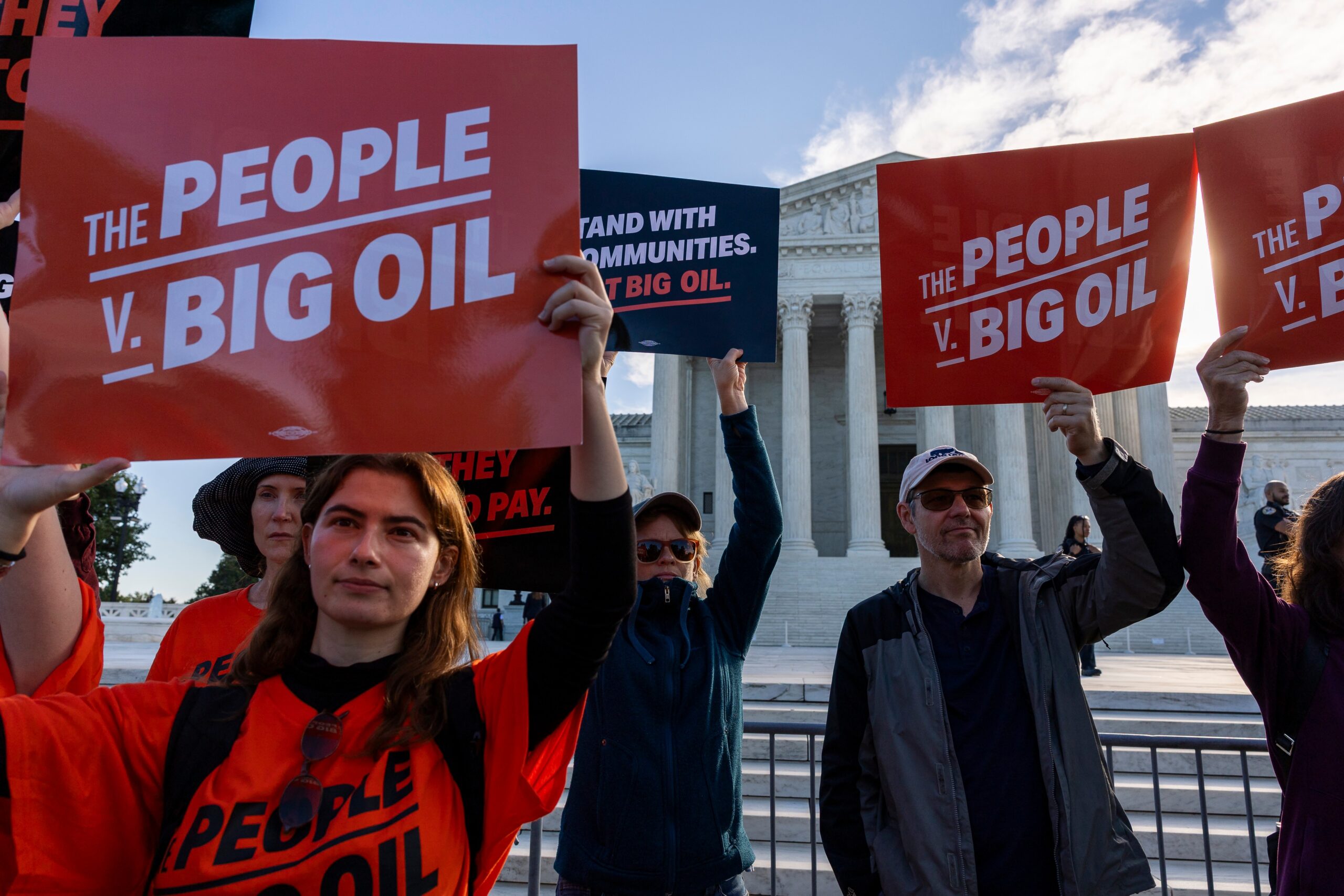
The Supreme Court on Monday grappled with whether to let a novel lawsuit go forward that is seeking to hold two large oil companies liable for the effects of climate change, a decision that will be critical to similar litigation that dozens of states, counties and cities have brought in recent years.
Read more Democrats feature relatives of Virginia Giuffre in Epstein-focused ad
After nearly two hours of argument, it remained unclear how the justices might rule in the first case of the new term and one of the most significant dealing with global warming that the court has handled to date. The justices asked sharp questions of both sides.
The stakes are immense.
The city and county of Boulder, Colorado, are seeking what could amount to billions of dollars from ExxonMobil and Canada’s Suncor Energy, alleging the companies misled the public over the role of fossil fuels in global warming and downplayed the effects of climate change. The oil companies deny wrongdoing.
The lawsuit, if allowed to continue in Colorado state court, could open the door to thousands of similar claims by municipalities nationwide over the impact of climate change on health and infrastructure. The litigation could ultimately result in astronomical settlements and damages that the oil companies warn could bankrupt the industry.
Officials in Boulder, as well as in places including San Francisco, Massachusetts and Hawaii where similar lawsuits have been filed, hope the cases will be the environmental equivalent of landmark litigation that produced major judgments against tobacco companies over cigarettes and drugmakers over opioids.
Justice Elena Kagan told an attorney for ExxonMobil and Suncor on Monday that there was little distinction between Boulder’s case and those earlier rounds of litigation, implying the case should go forward.
“This is the same kind of lawsuit against the same kind of actors,” said Kagan, a liberal.
ExxonMobil and Suncor argue that climate change is inherently a federal issue, since greenhouse gases are produced and spread across state lines. They say state court is not the proper venue for the suit and the case should be tossed out. That argument found some support among the court’s conservatives.
Justice Brett M. Kavanaugh said the court’s rulings in four previous cases made “crystal clear” that Boulder’s claims cannot be brought in state court, a point fellow conservative Amy Coney Barrett said she agreed with as well.
“This court has consistently said air and water pollution are federal enclaves,” Kavanaugh said.
The Supreme Court also asked the parties to brief on whether the case was ripe for the justices to take up. The justices’ questioning Monday indicated some support for ruling it was too soon for the high court to consider the issue and sending the case back to state court to play out.
Read more From Ja’Marr to Lamar, an NFL Sunday filled with scary injuries
“We are really early in this case,” Justice Ketanji Brown Jackson said. “This is kind of premature.”
The case began in 2018, when Boulder city and county sued ExxonMobil and Suncor in state court, seeking damages related to the local effects of climate change on health, infrastructure and extreme drought.
The Colorado Supreme Court allowed the suit to go forward last year, before the oil companies appealed to the U.S. Supreme Court.
ExxonMobil and Suncor argue that the suits are a coordinated effort by environmentalists to impose a carbon tax on the oil industry.
“This is an unprecedented effort to use state law to regulate global conduct,” Kannon Shanmugam, an attorney for the oil companies, told the justices.
Kevin K. Russell, an attorney representing Boulder, said there was lengthy precedent for the suit.
“Since the founding, states have had the authority to bring suits for injuries in court,” Russell said Monday.
Justice Samuel A. Alito Jr. recused himself from the case in September. He did not give a rationale, but his recusal came after environmentalists and court watchdogs said he should step aside because he owned stock in two oil companies that were not parties in the proceeding.
The recusal raises the prospect the case could result in a 4-4 deadlock, allowing the Colorado Supreme Court ruling to stand. A decision is likely to come before the end of the court’s term in June or July.
Boulder’s case and others may ultimately be rendered moot by Congress. The House and the Senate are considering legislation that would immunize oil companies from such state law claims.
Read more Capitals star Alex Ovechkin announces this will be his final NHL season