
Are Democrats overconfident? Republicans too anxious? The Post’s pollster answers questions about polling bias and how to read the midterm surveys.
Read more Trump says ‘we protect our cities’ after suggesting Iran could ‘take out’ L.A. or San Diego

Polls show Democrats are in a strong position less than one month before Election Day.
Democrats lead by about eight percentage points in national support for Congress, above the 3.5-point margin they probably need to win a House majority. Democratic Senate candidates hold at least narrow leads in races for six Republican-held seats, more than the four they need to win control of the chamber.
But is it a mirage? Republicans are hoping that polls are overestimating Democratic support, as they have done in the last three presidential elections.
Republican pollster Patrick Ruffini noted that, on average, from 2018 to 2024, polls at this stage overestimated support for Democratic Senate candidates by 6.2 percentage points in Iowa, Michigan and Ohio, all states that have competitive Senate races this year. Separately, State Navigate pollster Chaz Nuttycombe said rural Republicans didn’t respond to their survey in an Iowa legislative district, saying it could be a “Canary in the Cornfields for Iowa polling this year.”
It’s impossible to know whether polls will overestimate Democrats or Republicans before any election, but understanding why polls missed in recent years, how pollsters have adapted and what the data shows this year can help set expectations for this fall.
All polls have random error signified by the margin of sampling error, but in an ideal world they should overestimate each party about equally in a given election. In reality, polls have systematically overestimated either Democrats or Republicans by an average of two percentage points across the past 14 federal and gubernatorial election cycles, according to a Silver Bulletin analysis.
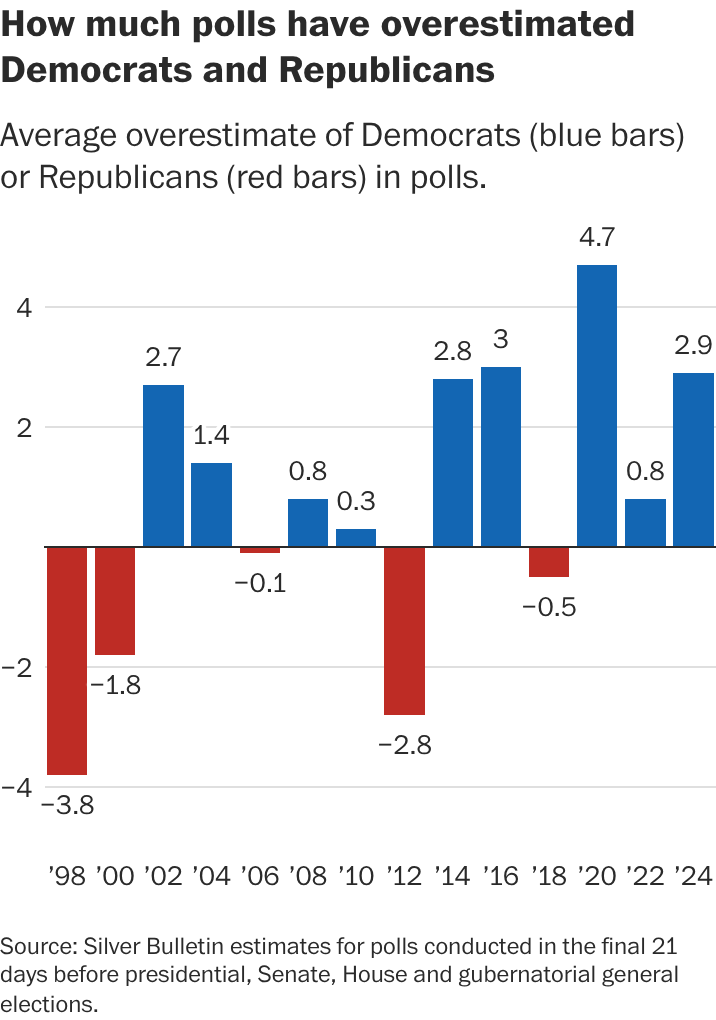
The worst cycle was 2020, when polls overestimated Democratic candidates by 4.7 percentage points on average, higher than the three-point miss in 2016 and the 2.9 point error in 2024. Election surveys were relatively accurate in President Donald Trump’s first midterms in 2018 and President Joe Biden’s midterms in 2022, with systematic error less than one point.
The most likely cause of polling errors in these elections is nonresponse bias. When one party’s supporters are less likely to participate in polls than the other party’s supporters — and the pollster cannot detect the pattern and correct for it — the poll will underestimate support for that candidate.
Trump, who rails against polls as part of a “rigged” establishment, has posed particular challenges for polls because of his unique appeal among voters with lower levels of formal education, civic engagement and social trust. These groups are less likely to participate in surveys. And while pollsters can weight samples by education, that has not always been sufficient.
Pollsters have also theorized that the covid pandemic played a role in making the 2020 polls particularly inaccurate. Democrats were far more concerned about infections and likely to stay home, possibly making them more available to answer an election poll.
Many pollsters have made changes to combat nonresponse bias in recent years. A growing number of pollsters (including The Washington Post) use voter files to draw survey samples. These are built from official registered voter databases and include reliable indicators of partisanship in most states.
In addition, many pollsters weight samples using demographic attributes, party identification, turnout and vote choice in the most recent presidential election. These changes have been a clear effort to correct for underrepresentation of Trump voters in polls.
Weighting by past presidential voting and other political variables has been widely credited with reducing polling error from 2020 to 2024, including in a postmortem by the American Association for Public Opinion Research (a report I co-authored). In The Post’s state election polls, weighting to past presidential vote reduced bias by 1.6 points on average.
Read more Takeaways from the Maine Senate debate between Susan Collins, Troy Jackson
The increasing use of voter-file sampling has also allowed pollsters to better monitor response rates by different groups and to test additional ways to improve accuracy.
Polls don’t typically report data on response rates by groups, but a Washington Post-Schar School poll of Michigan voters in September offers a window into how patterns have changed.
This year, voters identified as Democrats on the voter-file were less likely to be contacted successfully for the poll than Republicans, regardless of whether they were contacted by a text-message or live phone interviewer.
But among voters who were successfully contacted, Democrats were more likely to complete the interview. And compared with a similar poll in 2024, Democratic completion rates are up this year, while they were stable for Republicans.
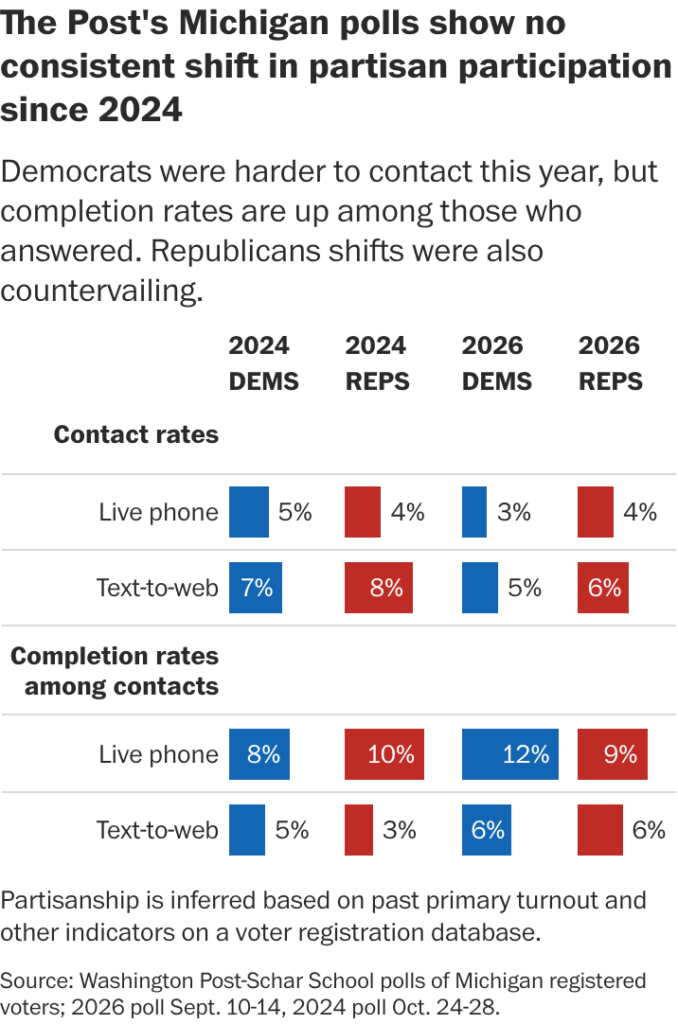
Democrats’ higher completion rates could be a sign that they are more interested in voting this year. While The Post’s surveys are weighted to correct for any differences in response rate by partisanship, the polls use past turnout and a survey question asking voters the chances they will vote to produce likely voter estimates.
Pollsters have made a number of changes to combat nonresponse bias that have likely reduced the risk of a big polling error this year, but it’s impossible to rule out. Polling could be more or less accurate in different regions, as Republican pollster Ruffini suggests. There’s also no guarantee that polls will overestimate Democrats: If turnout among Trump voters plummets this fall, polls that ensure the electorate matches the 2024 vote count could underestimate Democrats.
One strategy when interpreting poll results is to imagine what the outcome would be if Democrats or Republicans were overestimated by three percentage points. If polls overestimated Democrats by that margin they would likely still win the House but lose the Senate. If polls overestimated Republicans by that amount, Democrats might experience a tsunami.
Hispanic voters are shifting left in Texas — Two years after exit polls showed Trump won 55 percent of Hispanic voters in Texas, new data shows Hispanic voters could fuel Democratic wins in the House and Senate.
A survey of Texas Hispanic voters by the Cook Political Report and TelevisaUnivision found Democratic Senate candidate James Talarico leading Republican Ken Paxton by 63 percent to 30 percent among Hispanic voters who are likely to vote. Separate polls by the New York Times/Siena College and Fox News found the Democrat leading by about 30 points.
The Cook-TelevisaUnivision poll also found Hispanic voters favoring Democratic House candidates by 14 points across three key congressional districts in South Texas. The Post’s Teo Armus and Federica Cocco talked to Hispanic voters from the region who voted for Trump but were frustrated with the economic impact of deportations.
Young adults are down on life — A Gallup poll of more than 15,000 U.S. adults finds young adults are far more pessimistic about their lives than in 2019, reversing a post-pandemic rebound. The survey classified people as “thriving” if they rated their current lives as at least 7 out of 10 and predicted their lives in five years would be at least 8 out of 10.
Gallup found 44 percent of 18-29 year-olds are “thriving” this year. The share of young adults who are thriving was unchanged from 2025 but down from 51 percent in 2023 and 57 percent in 2019. Since the pandemic, Gallup finds more young adults downbeat on their personal relationships, on feeling active and on feeling satisfied with their standard of living.
Read more As Daniels nears return, Mariota is sidelined with another MCL sprain
Send your questions, comments and ideas to [email protected].