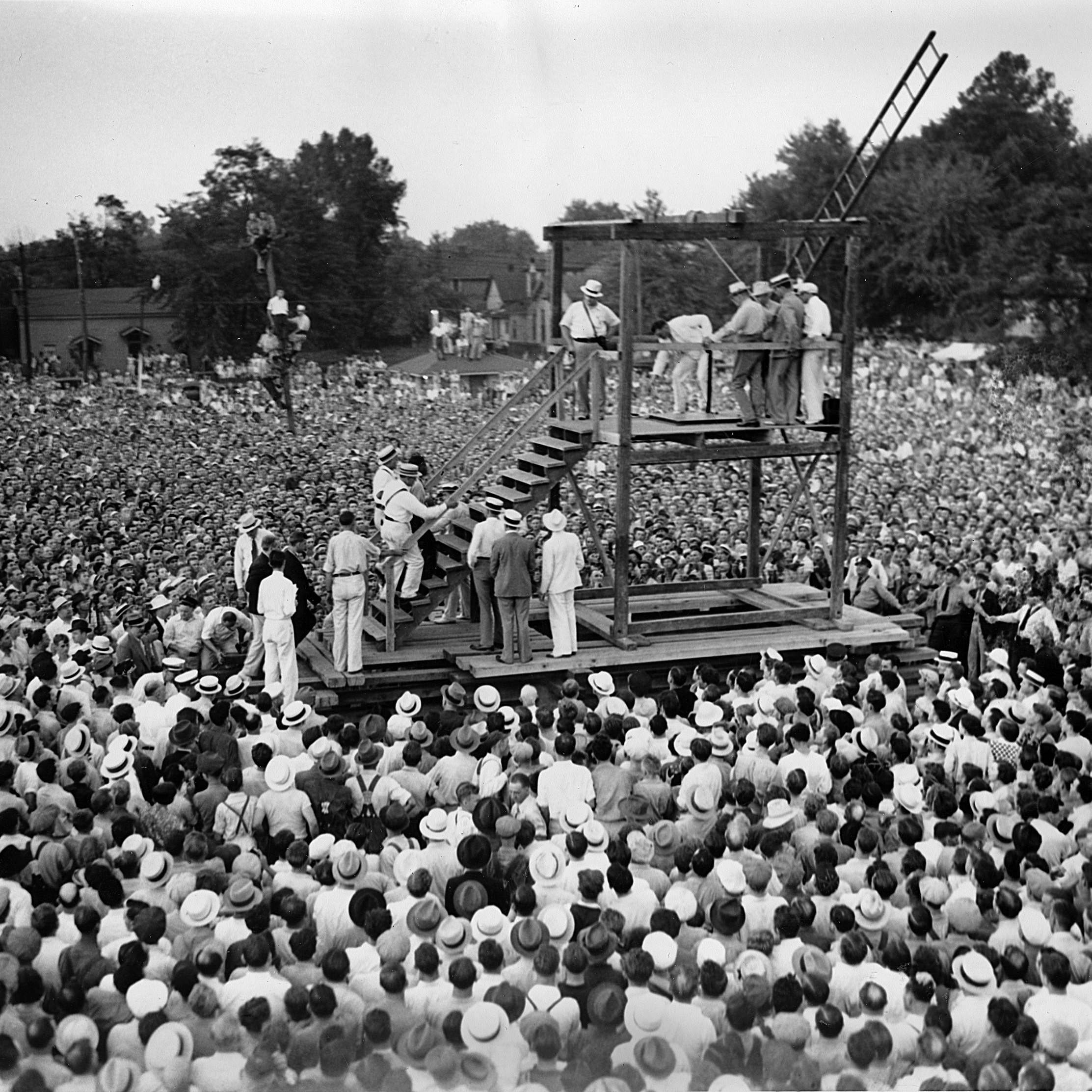
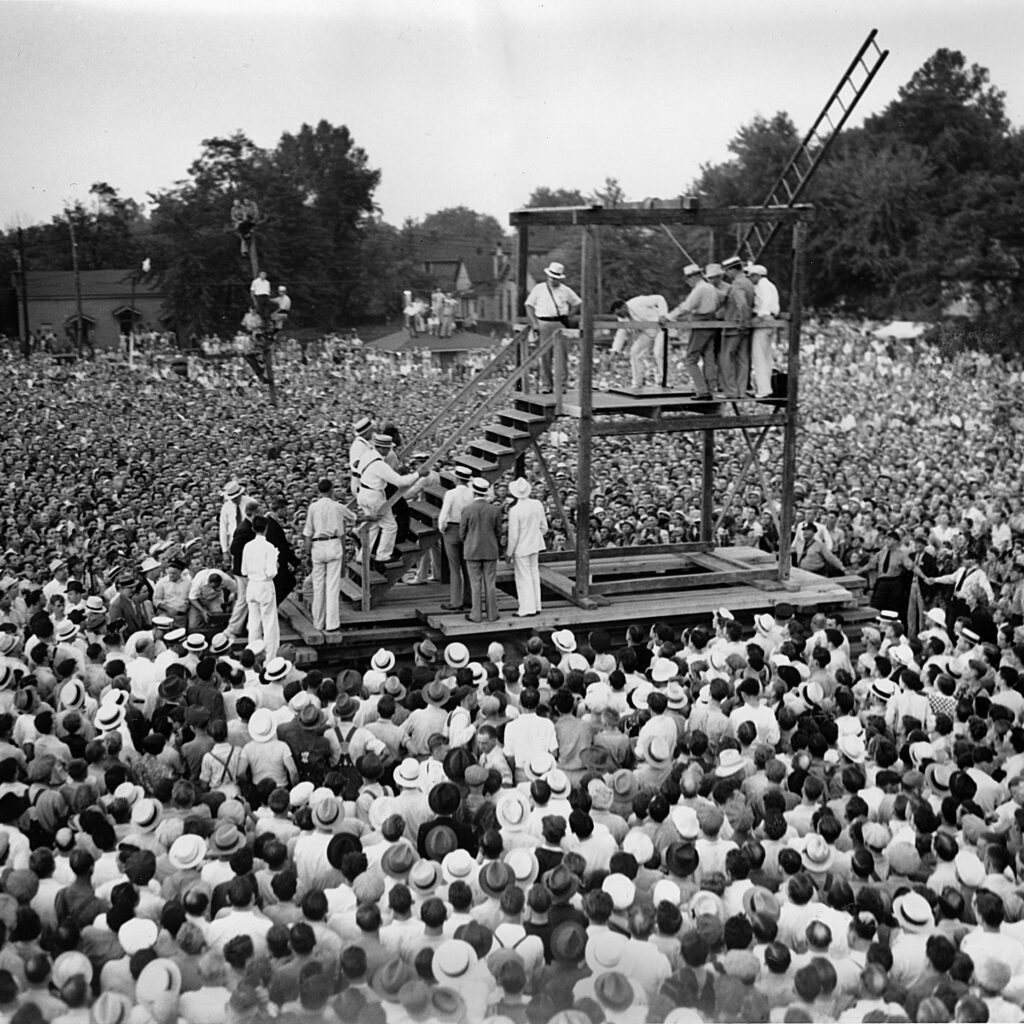
The 1936 Kentucky hanging of a Black man in his 20s convicted of raping a 70-year-old White woman is widely considered to be one of the last high-profile public executions in the United States.
Read more Democratic group substantially increases fundraising to seize state legislatures
Rainey Bethea was publicly hanged after being sentenced to death for the rape of Lischia Edwards in Owensboro, Kentucky. Bethea confessed to raping Edwards and fatally strangling her.
Remembrances of Bethea’s case reemerged last week after the Pentagon announced plans to live-stream the execution of Nidal Malik Hasan, a U.S. Army psychiatrist who shot and killed 13 colleagues at Fort Hood, Texas, in 2009.
On Thursday, President Donald Trump reversed course and said the U.S. government would not publicly broadcast the event.
Bethea, who had previously been convicted of grand larceny, as well as drunk and disorderly conduct, confessed to the crime five times, all without the presence of legal counsel.
Despite his confessions to killing Edwards, Kentucky chose not to prosecute Bethea for murder, a conviction that carried a sentence of death by electric chair. Instead, it pursued the rape charge, a crime that at the time was punishable by hanging. A grand jury returned an indictment on Bethea after one hour and 40 minutes, charging him with rape. Bethea pleaded guilty.
Bethea’s subsequent trial lasted three hours. He was sentenced to death by an all-White jury for the rape after it had deliberated for less than five minutes.
Contemporaneous news reports and witness accounts of Bethea’s execution on Aug. 14, 1936, describe some 20,000 people gathering at the gallows to watch a man die, turning the morning event into a community spectacle.
“The crowd came in automobiles, wagons and by the hundreds on freight trains,” said an Associated Press report from that day. “About half of those who fought and shoved to get closer to the inclosure were women, young girls and children. Babies in arms and toddlers by the score clung to their mothers.”
Bethea was brought onto a platform, his limbs bound together and a black hood placed over his head. A noose was placed around his neck, and when a trapdoor on the platform fell, he dropped. “Bethea hung rigid, without twitching, his body swaying slightly in the river breeze,” the AP wrote.
According to news reports and witness accounts, the event included food vendors and commemorative postcards. The AP report also describes how, after Bethea was hanged, onlookers pulled off fragments of the hood over his head as doctors tried to determine whether he showed signs of life.
One doctor expressed surprise that Bethea’s heartbeat “continued 16 ½ minutes” after the hanging, according to the AP.
Sonya Lea, an Owensboro native and author of “American Bloodlines: Reckoning With Lynch Culture,” a book examining Bethea’s case through archival records and her own family’s history, referred to Bethea’s execution as a “legal lynching” in an interview.
Read more The midterms map is shifting as Republicans triage one-time battlegrounds
She noted that prosecutors dropped the murder charge against him to enable a sentence of public execution.
In her research, Lea said she uncovered concerning details about the case, including that the attorneys appointed to represent Bethea included the son of the presiding circuit court judge.
“There was a lot around who this young man was that seemed to indicate to me that he was confused by the statements that he was being asked,” Lea said. “He was very young, in his early 20s. He was an orphan. He was new to Owensboro, Kentucky.”
Lea said “Owensboro was, in effect, humiliated in the national press” over the public spectacle of Bethea’s execution. In 1938, Kentucky abolished hangings.
Corinna Lain, the George E. Allen chair inlaw at the University of Richmond School of Law, said public executions in the U.S. largely “phased out in the 1800s” and moved “inside the prison walls.”
“Part of the reason for that is they would draw huge crowds, and in some ways they were coarsening events,” Lain said. “People would be rowdy. The more elite and educated class thought that this was actually quite unseemly, … and there were also some very public botched executions, and that created an immediate backlash.”
The Death Penalty Information Center identifies the 1937 hanging of Roscoe “Red” Jackson in Missouri as the last documented public execution in the U.S.
An AP report at the time said about 500 people watched the hanging of Jackson, 36, who was White and convicted in the murder of Pearl Bozarth, a “well-to-do poultry and feed man” from Indiana.
The report describes how, in his final moments alive during the early morning hours of May 21, 1937, Jackson “spoke briefly asking forgiveness for his deed, after reciting a litany with a Catholic priest.” His final words were, “Well, good luck to you all.”
“About half” of the witnesses “turned their heads” when Jackson was executed while “others strained forward eagerly” to watch. One man “fainted when he heard the trap fall.”
While children were forbidden from admission to the execution, the report said they subsequently “entered the enclosure to gaze in awe at the scaffold” where Jackson had been hanged.
Read more D.C. United hangs on to beat Red Bulls for first win in over a month
Victoria Craw contributed to this report.