In today’s edition … Democrats are worried about a shared name in Nevada … Do you believe presidential contenders when they say they don’t want to run? … but first …
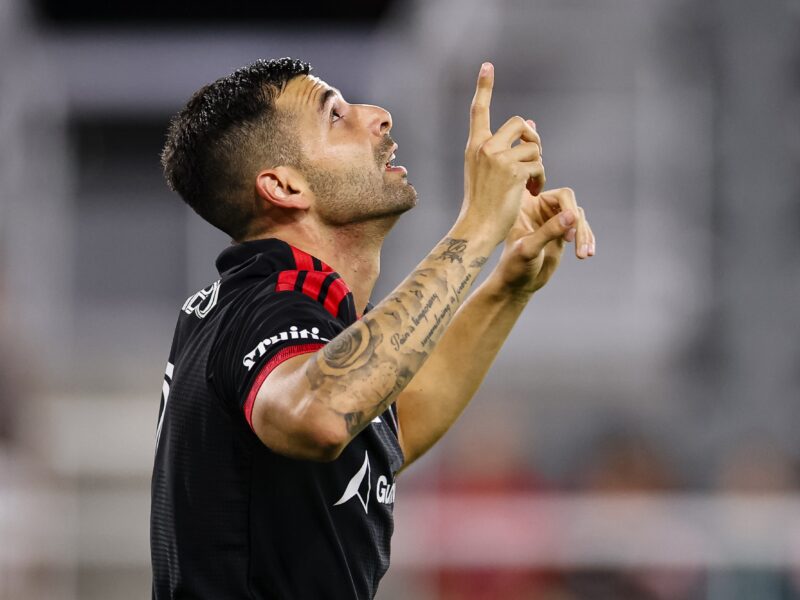
Read more D.C. United hangs on to beat Red Bulls for first win in over a month
The midterms map is changing.
Republicans, facing an increasingly hostile electorate and President Donald Trump’s slumping poll numbers, are pulling money from contests once seen as critical battlegrounds and redeploying it to other races, reshaping the midterms three weeks before Election Day.
The strategy is a sign that races once seen as competitive have moved so clearly toward Democrats that Republican groups don’t think their money advantage is enough to win. It also highlights how races once seen as favoring Republicans are becoming prime battlegrounds.
We documented the changes Republicans are making by looking at North Carolina’s Senate race, where the GOP seems to have lost hope in its candidate and pulled millions in spending. Georgia’s Senate race appears headed that way, too.
Republicans say money from those races is better spent in states like Kansas, Texas and Iowa, all of which now have surprisingly close races, especially considering they’re three states Trump romped just two years ago.
The shifts in House races have been equally notable. Republican outside groups, according to ad tracker AdImpact and other reporting, have started to pull money from onetime battleground House contests to spend in traditionally GOP districts. The clearest shifts are coming from Congressional Leadership Fund, the top super PAC focused on keeping the House in Republican control, and MAGA Inc., Trump’s super PAC:
Democrats, of course, are loving this.
“With these moves, Republicans are in full retreat and are facing the grim reality that their agenda is toxic with the American people,” said CJ Warnke, spokesperson for House Majority PAC, Democrats’ primary outside super PAC focused on the House. “With less than three weeks until Election Day, Democrats are on offense.”
Republican operatives, however, caution against reading too much into these moves, arguing that spending at this point in an election is extremely fluid and the map will keep changing.
“Just because CLF or MAGA Inc. is moving money out doesn’t mean money isn’t continuing to go into those same districts,” said a Republican operative working on House races. “And a lot of these candidates are still fully funded all the way through to Election Day from their own campaigns.”
Republican operatives told us some of the money pulled from these races is being funneled to other contests in states like California, Colorado, Iowa, Maine, New Mexico, Florida, South Carolina, Virginia and Wisconsin.
But that redeployment also tells us something. By shifting money from onetime battlegrounds to protect Republican incumbents — like Rep. David Valadao in California’s 22nd Congressional District, Rep. Gabe Evans in Colorado’s 8th Congressional District, Rep. Jennifer Kiggans in Virginia’s 2nd Congressional District and Rep. Bryan Steil in Wisconsin’s 1st Congressional District — these groups are acknowledging a need to focus on defending Republican-held seats, rather than offensive opportunities.
In fact, most districts the Congressional Leadership Fund is moving money into after moving money out of battleground districts are currently represented in Congress by Republicans.
What’s in a name?
Democrats in Nevada are growing increasingly worried that the answer is a lot.
Three gubernatorial candidates will be on the Nevada ballot this year: Joe Lombardo, the Republican incumbent; Aaron Ford, the Democratic nominee and state attorney general; and Danielle Ford, an independent candidate and member of the Nevada State Board of Education.
Polls show the race is close, making Nevada the best chance Democrats have to unseat an incumbent Republican governor. But a few public polls and some internal surveys, Democratic operatives said, show Danielle Ford with notable single-digit support, leading them to worry the independent could play a spoiler, in part because she shares the same last name as the Democratic nominee.
Read more Alex Tuch scores twice to buoy Capitals’ 5-4 win over the Canadiens
It has Democrats getting a little conspiratorial.
“It’s hard to believe it’s a coincidence that there are two candidates with the same last name on the ballot — and in a state like Nevada where races are decided on razor-thin margins, that has the potential to be a real issue,” said a national Democratic operative.
Republicans face a somewhat similar issue in Alaska, where two Dan Sullivans will be on the ballot — something that has drawn considerable consternation and attention this year.
This is obviously different. The candidates have different first names, so voting for Danielle Ford when you intend to vote for Aaron Ford is a stretch. But in a close race, even narrow margins will matter.
Santa Fe New Mexican: Politics can be downright scary. But this is a new level. New Mexico Democrats have unveiled a Halloween-themed campaign website that paints Republican Gregg Hull as a vampire, calling the gubernatorial candidate “a true horror show” for health care if elected.
Iowa Capital District: No Republican has tried to break with Trump more than Iowa Senate candidate Ashley Hinson (R). It’s a tough move, given how much Hinson has backed Trump throughout the year, but she’s done what other Republicans have tried not to do: create distance from the unpopular president.
Oregon Public Broadcasting: Oregon Gov. Tina Kotek (D) is in a surprisingly tough reelection campaign. She has already barred data center construction on public lands. But this week she expanded her state moratorium, seizing on an issue that has drawn bipartisan anger.
Many of our Democratic readers are worried that polls are inflating Democrats’ advantage in these midterm elections, a concern that echoes a Republican argument that the polls are undersampling Trump voters.
“I am 85 yrs old. I have never missed voting in local and National elections,” wrote Vince Clary. “I have NEVER been contacted by any polling group. As a Democrat, I certainly do worry about the accuracy of polls.”
“I do worry that polls undercount Republicans, so I always mentally add a few points to the GOP and subtract a few from the Dems when I read about polls,” said Janice Oakley. “That’s why I don’t think we Dems will do as well as everyone thinks we will do.”
“I’m a registered Democrat, and yes, I don’t trust the polls. Primarily because of the 2016 election,” added Jodell Boughton.
That feeling extends to non-Democrats, too.
“I haven’t been called for a poll since 2012, and I think that was on a landline. I’m not a Democrat, but I suspect the polls are wrong, just because that’s been their history lately,” wrote Tony Harrison.
My colleague Scott Clement wrote about this dynamic earlier this month in his newsletter, “Pollwatcher.” It’s worth your time.
Sen. Jon Ossoff (D-Georgia) said again this week that he has “zero interest” in running for president. These denials are often not worth the paper they are printed on. But I wanted to know what you think: Do you believe politicians when they say they aren’t interested in running for higher office? Do you factor a political leader’s future into your vote? If Ossoff does run for president, is this comment a lie? Let me and your fellow Early Brief readers know at [email protected].
Read more Why Democrats will probably win back the House
Thanks for reading. You can follow me on X at @merica.