The administration is facing growing bipartisan calls to be tougher on U.S. chip exports and China.
Read more These are the Senate Democrats backing Schumer and Van Hollen for majority leader
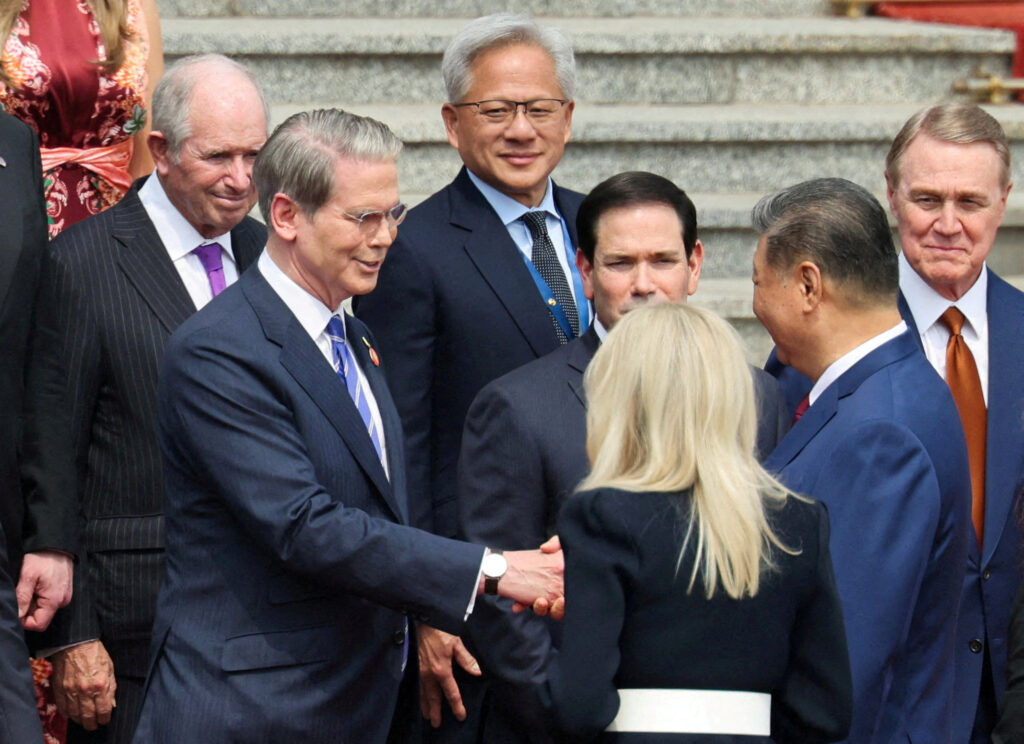
President Donald Trump’s intervention this week to reinstall Jensen Huang as Nvidia’s chief executive delivered a blow to China skeptics in his administration who favor a tough line against Washington’s major geopolitical rival, as the president weighed in on behalf of a business leader who once declared that being a China hawk was “unpatriotic.”
Huang’s restoration to Nvidia’s helm has deepened a policy dilemma within the Trump administration. Although he backed Huang, the president left in place tighter controls on advanced chip exports — a move Huang’s allies had lobbied against for months. Those restrictions were announced in the aftermath of revelations that Huang had an extramarital affair with an executive at a Singaporean company that is being investigated for allegedly shipping top-of-the-line Nvidia chips to China.
Trump has embraced Huang, even suggesting that the scandal could deliver a boost to the embattled executive, since, as the president said, “sex sells.”
The executive branch has wide-ranging powers over how aggressively it enforces restrictions on chip exports. Trump has indicated that he is intensely focused on the state of the stock market, which has been buoyed over his second term by the growth of artificial intelligence.
However, he faces a hardening bipartisan consensus in Congress that Washington needs to be far more aggressive in tightening loopholes that have allowed China access to add to its arsenal of U.S. chip technology.
Huang has been the United States’ most vocal proponent of unfettered sales to China, arguing that if Chinese companies grow dependent on U.S. chips, that will stifle their efforts to develop their own chip industry and give the U.S. the upper hand in the AI competition.
Trump and Commerce Secretary Howard Lutnick have been sympathetic to that argument.
More national security-minded deputies, including Secretary of State Marco Rubio and Treasury Secretary Scott Bessent, have been aligned with the idea that Chinese access to advanced technology might be a concern.
Huang’s restoration was a setback for their point of view, but it doesn’t change the reality of growing support for tighter rules, analysts said.
“Irrespective of Jensen Huang’s reinstatement in this position, the political reality has changed in Washington around export controls,” said Vivek Chilukuri, director of the technology and national security program at the Center for a New American Security, a think tank.
“On the one hand, they say the stakes are existential. On the other hand, they don’t want to rock the boat with China, so they’ve been unwilling to close loopholes, expand controls and crack down on practices like distillation of America’s best models,” Chilukuri said.
“You put all of that together, you end up in a world where we are unwittingly helping China close the gap in AI capabilities with the United States at the very moment that the stakes of that competition have never been higher.”
But he also embraced Chinese President Xi Jinping then and now. In Trump’s second term, he has grown to view the AI buildout as crucial to the health of the U.S. economy. No company has been more central to that effort than Nvidia. And the president has aggressively courted his Chinese counterpart, meeting with him three times this year.
Read more Why the wave election may not end the frenzy to redraw political maps
Trump has tried to boost Nvidia’s chips, selling Xi on the technology by bringing Huang to Beijing in May and seating him at the presidents’ table at a state dinner in Washington in September.
The balancing act is proving to be a challenge. Trump has been sympathetic to Huang in recent weeks even as his administration took actions that hit Nvidia’s business interests in Asia.
“U. S. China policy has sometimes pitted corporate interests or parochial interests against national interest,” said Rush Doshi, who worked on China policy in the Biden White House and is now at the Council on Foreign Relations. “What the Nvidia scandal shows is that corporate interest continues to play a role on some of the most important policy questions.”
Trump last week announced that he would prevent U.S. companies from building data centers abroad, although experts question whether that ban will truly be enforced. And the Commerce Department on Monday added Megaspeed, the Singaporean company at the heart of the scandal, to a blacklist.
Senior White House officials were concerned last week that if Huang wasn’t employed by Nvidia, it was possible he would find employment in a different country, and potentially take some of his former company’s top engineers with him, harming the U.S. advantage in chip and AI development, one person familiar with administration thinking said, speaking on the condition of anonymity to speak frankly about internal discussions.
Even if restoring Huang was an imperfect choice, it was still the best one to minimize turmoil at a company that for now occupies a unique role in the global economy, the person said. Eventually the industry will catch up — making Huang and Nvidia less one-of-a-kind, the person added.
Huang appears unlikely to avoid scrutiny for long. He will face Congress next week, and Republicans on Capitol Hill have pledged to team with Democrats on legislation and investigations that would put pressure on chip sales to China.
Some Republican lawmakers who have been among Trump’s staunchest allies on other issues have indicated they will not be steadfast on this one.
“I have warned the administration from the start about Communist China obtaining our most advanced chips through both smuggling and remote access,” Sen. Tom Cotton (R-Arkansas) wrote Monday on X.
“The controversy with Nvidia and Megaspeed is just the tip of the iceberg, and it’s not resolved because Jensen Huang has his job back. Congress has much to investigate and we will pass overwhelmingly bipartisan chip export-control bills, including my Chip Security Act, one way or the other,” he wrote.
With Trump out of step with much of his party, the confrontation will be a significant test of the extent to which he can keep his administration aligned as Democrats retake control of Congress in January.
“The most striking thing since Jensen’s return has been the bipartisan concern. Both Republicans and Democrats are strongly indicating that his return is not at all diminishing their appetite to ensure that advanced U.S. technology stays out of China’s hands,” said Ben Buchanan, who was a special adviser on AI in the Biden White House and recently wrote a book on AI policy and export controls.
Read more Schumer, Van Hollen add to tallies of supporters for majority leader