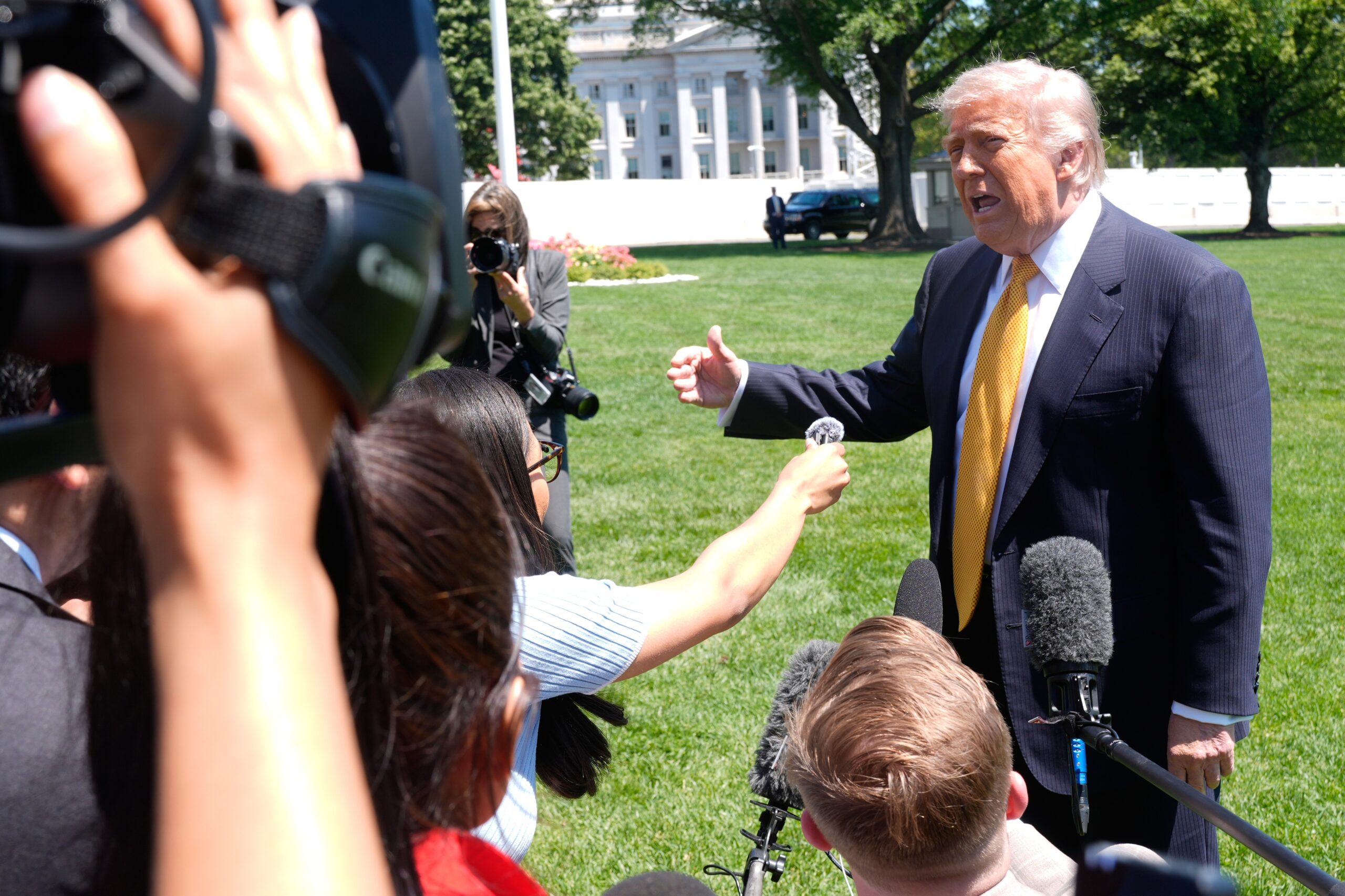
A panel of judges pressed a Justice Department lawyer about the president’s sanctions, meant to target firms that raised his ire.
Read more JD Vance praises Sen. Susan Collins, a GOP moderate and occasional Trump foe
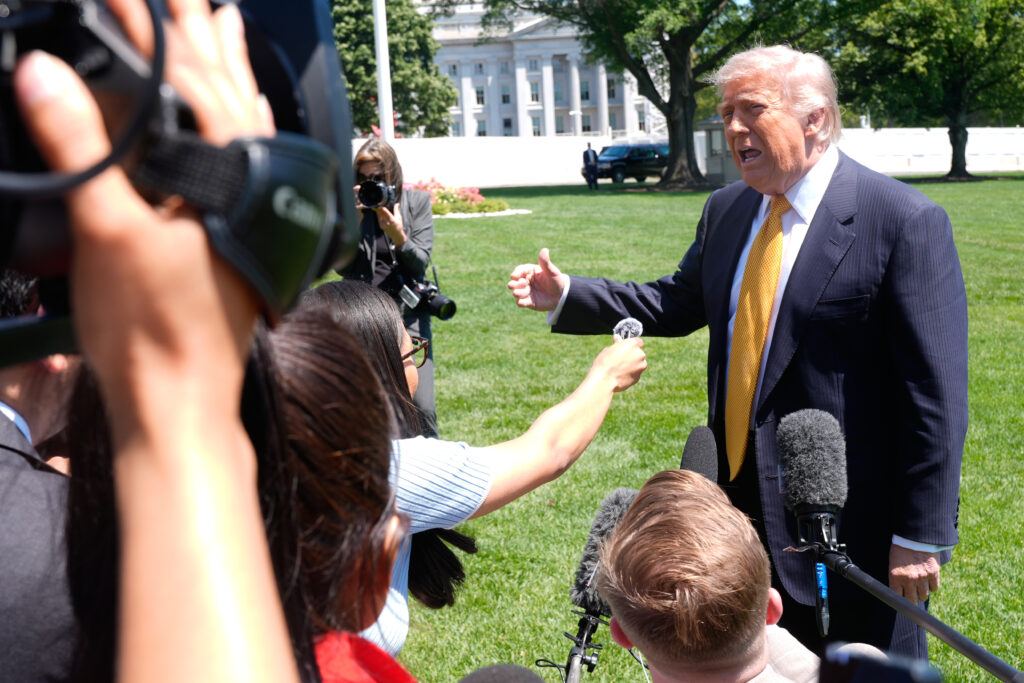
A federal appeals panel in D.C. expressed some skepticism Thursday about President Donald Trump’s effort to punish prominent law firms, pressing a Justice Department lawyer about sanctions that have been blocked by lower courts.
Abhishek Kambli, the Justice Department lawyer, defended Trump’s actions and said the lower courts had overstepped in blocking the punishments. Paul D. Clement, an attorney representing law firms challenging the sanctions, sought to keep the punishments halted, saying they “strike at the heart of the rule of law.”
Trump took aim last year at several law firms that had hired his perceived foes or taken on cases he disliked, issuing a string of executive orders seeking to strip the businesses of government contracts, revoke their lawyers’ security clearances and block them from accessing federal buildings.
These orders, along with agreements that several other firms struck with Trump to avoid similar sanctions, ignited immense outrage across the legal profession.
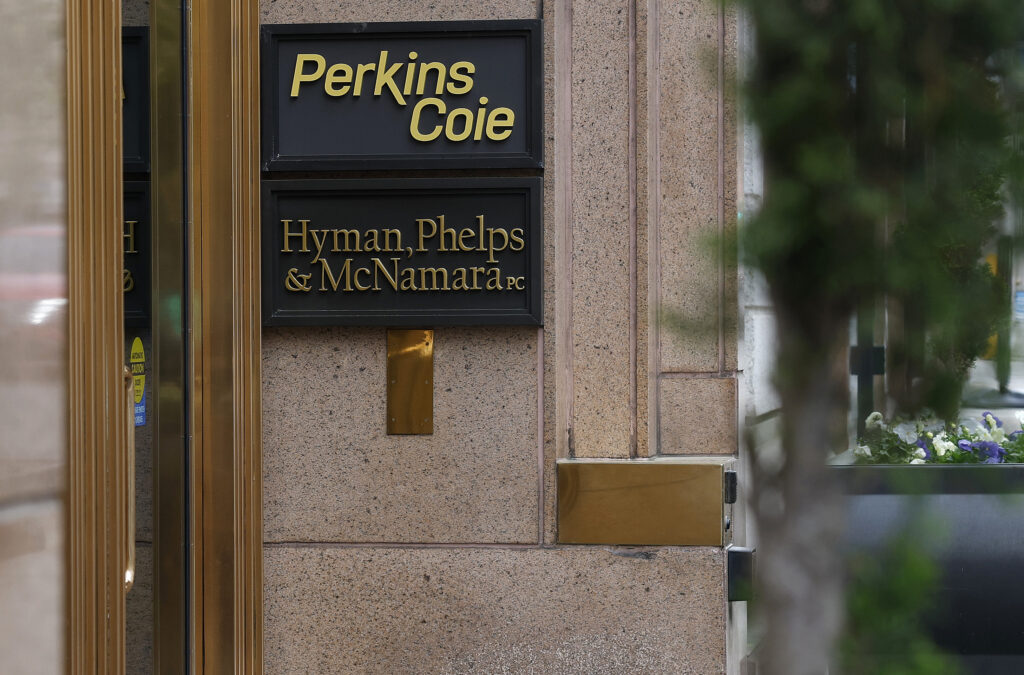
Four of the firms facing sanctions — WilmerHale, Jenner & Block, Perkins Coie and Susman Godfrey — filed separate lawsuits challenging the president’s orders, saying they would be catastrophic for their businesses.
Trump’s orders focusing on those firms were pulverized, legally speaking, in court. Federal judges blocked the four orders, issuing rulings excoriating them as “an unprecedented attack,” “unconstitutional,” “motivated by retaliatory intent” and an attempt “to chill legal representation the administration doesn’t like.”
Trump’s administration then appealed, though not without some seeming internal confusion.
The Justice Department wrote in a March court filing that it wanted to abandon the appeals, effectively admitting defeat, since it would have left the orders blocked. The following day, however, the agency abruptly reversed course, saying it wanted to continue appealing. The Justice Department did not explain its rationale either time.
Soon after, the Justice Department argued in court papers that the lower-court decisions should be reversed, writing that its appeals were about district courts “encroaching on the constitutional power of the president.”
The law firms have continued assailing Trump’s sanctions, saying in court filings this year that they are “a grave abuse of presidential power” and impose “draconian punishments.”
Trump’s sanctions for some firms and deals with others have roiled the legal profession since last year.
After Trump began targeting firms, one of them — Paul Weiss — struck a deal with him, pledging $40 million in pro bono legal work. Eight other firms followed suit, with increasingly large pledges of work on causes Trump said he supports, including assisting veterans. All told, these firms pledged nearly $1 billion in pro bono work.
Leaders at these firms have defended the agreements as necessary, but some of their employees and many other attorneys across the country excoriated their actions. Some lawyers resigned in protest or left firms that made deals to join practices that were fighting Trump’s orders in court.
The issue returned to court Thursday morning, when a three-judge panel with the U.S. Court of Appeals for the D.C. Circuit heard arguments about these sanctions.
Read more Juan Soto returns to lineup for Mets, who also get a positive progress report on Francisco Lindor
Speaking in front of a crowded sixth-floor courtroom in downtown D.C., Kambli, the deputy associate attorney general, said judges had acted improperly in siding with all four firms challenging Trump’s punishments.
“The district courts here rushed to judgment on executive orders that they clearly didn’t like the content of, and in the process, granted relief that they were not authorized to do,” said Kambli, who recently announced his plans to leave the Justice Department at the end of the month.
Much of the oral argument focused on Trump’s attempt to target security clearances held by attorneys at the firms in question. Kambli said that under court precedent, judges could not restore such clearances.
Chief Judge Sri Srinivasan and Judge Cornelia T.L. Pillard, both of whom were appointed by President Barack Obama, quizzed Kambli about clearances and when the courts could weigh in on the issue.
They floated hypotheticals about what would happen if a president blocked clearances based on objections centering on speech, political affiliation, race or religion. Pillard, for instance, asked what would happen if a president said clearances would not be issued to lawyers at firms representing Catholics, Black people or Asian Americans.
Kambli said a president’s decisions in this area could not be reviewed by the courts. He compared it to a president’s ability to grant clemency, saying that “even if it’s for improper motives, it is still ultimately unreviewable.”
While the Justice Department has sought to have the executive orders restored in their entirety, the agency has also signaled a willingness to accept a partial victory. In a March filing, the department suggested that if certain penalties are deemed lawful, the appeals court could allow some of Trump’s sanctions to take effect while leaving others blocked.
Clement, who has been representing WilmerHale in its case and was U.S. solicitor general under President George W. Bush, has sharply pushed back against the idea of separating out parts of the orders. He wrote in a March filing that the order targeting WilmerHale “is a single, unified act of impermissible retaliation” and “was plainly designed to operate as a unified whole.”
In court Thursday, Clement said the law firms “were singled out because they represented clients or associated with attorneys who raised the president’s ire.” The orders, he said, were “about maximizing punishment” for the firms.
“It is as if they looked around and said, ‘All right, law firms don’t have that many touch points with the federal government, there’s not that many places we can hurt them,’” he said. “‘But let’s hurt them everywhere we can.’”
Judge Neomi Rao, who was appointed by Trump during his first term, seemed more open to the administration’s case than her colleagues, questioning Clement about clearances and demonstrating unease at the idea of “district courts monitoring [security clearance] revocation decisions in perpetuity.”
The appeals court panel did not say when it would rule.
Following the law firm arguments, the panel turned its attention to a Trump executive order aimed at stripping a security clearance from Mark Zaid, an attorney who often represents whistleblowers.
Zaid’s attorneys have argued in court papers that Trump’s order gave him no way to appeal the decision and immediately blocked him from working on active cases involving classified material.
The Justice Department said that a lower court, in siding with Zaid, had judicially usurped Trump’s ability to determine who can access classified information, creating “serious harms to national security and the President’s constitutional authority as Commander in Chief.”
Read more Mapping where the redistricting fight stands and where it’s headed