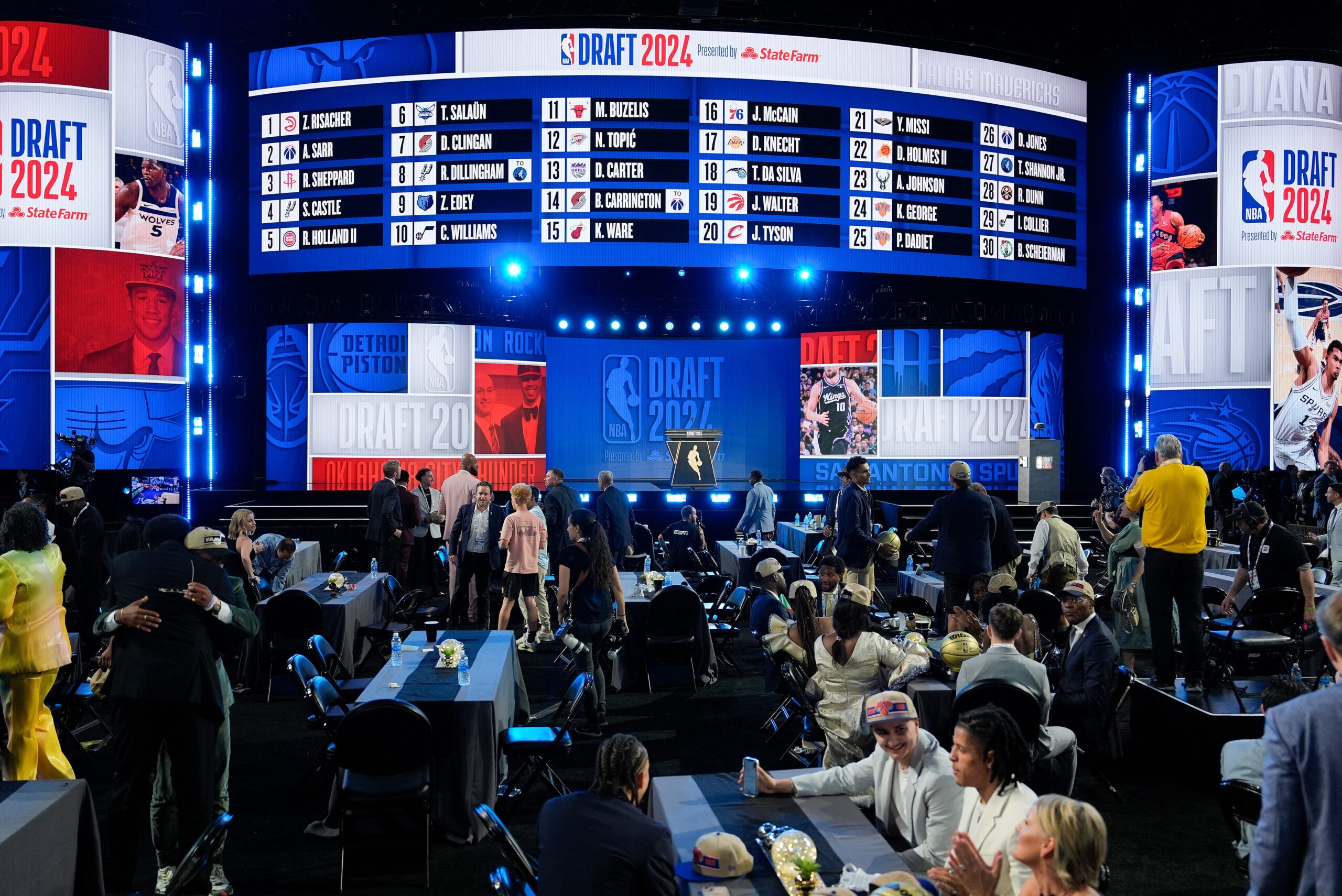
Washington could consider sliding down in the 2026 NBA draft. But not every pick is created equal.
Read more DOJ issued, then withdrew subpoenas to force Post, WSJ reporters to testify
Outside Capital One Arena on Sunday, near the entrance to the Gallery Place Metro, a man held a piece of paper with a singular message: “Don’t trade it.”
“Trade what?” another man shouted while riding down the escalator.
“The pick!” replied the one-man picket line. “The Wizards better not trade that pick. I want AJ [Dybantsa].”
The Wizards’ choice seems simple: keep their No. 1 selection in the NBA draft, a chance at their next John Wall and a dose of city-inspiring hope.
But in the NBA, picks dance around as much as the lottery balls that assign them.
Last year, teams made six draft-night trades, and the top selection has exchanged hands near or on draft night seven times in NBA history. The most recent such swap came in 2017, when the Philadelphia 76ers moved up to get Markelle Fultz, while the Boston Celtics were happy to slide down to No. 3 and scoop up Jayson Tatum.
And now rumors have circulated that Washington could explore a similar move down one or two spots, depending on the package it would receive. Fans, some within reach of paper and a Sharpie, are concerned about losing out on a decade-defining talent. But how much of a difference does each draft slot actually provide?
The Washington Post looked at the career outcomes of all 80 players selected with the top five picks of each NBA draft from 2007 through 2022, omitting the past three years to avoid players whose careers are still in question. We measured individual success through the number of all-star appearances each player earned. And because fans care more about what a selection accomplished for his original franchise, we measured team success via the number of playoff runs (two series) in which each draftee averaged 15-plus minutes for the team that drafted him. That simple formula produced a metric by which we compared the players of each draft slot.
Our aim: to determine whether the Wizards could draw a similarly valuable prospect a minute or two after their current slot.
Here are the results.
Since 2007, 15 players drafted in the top five have subsequently played in eight All-Star Games, contributed during eight playoff runs for the team that selected them or done some combination of both. Those players, to the eye of the draft-night fan, would be whom we consider stars — definitively successful picks. And six of them have arrived from the top slot, which is tied for the most of any single pick.
Among the most notable are Anthony Edwards, Anthony Davis and Kyrie Irving — not to mention Wall, who barely scraped into this group. The hope when selecting atop the board is to find someone who quickly blossoms into an all-NBA-level contributor. To that point, No. 1 picks also typically take the shortest amount of time to reach their first All-Star Game, which most often comes during the fourth year.
NBA evaluators lean on more metrics to evaluate any given 19-year-old than ever before, so top selections are becoming safer from a talent perspective. Front offices know about their knee issues and back spasms just as much as their high school crushes. Still, flare-ups persist, with the tales of Greg Odom, Anthony Bennett and Fultz sending shivers through the spines of executives staring at their charts each June.
But the all-star turnout rate at No. 1 is significantly higher than any other slot. No top pick has failed to make an All-Star Game in his first four seasons since Deandre Ayton in 2018. That’s especially notable compared with the fourth and fifth picks, where fewer than a third earn an all-star nod at any point in their careers.
Read more Former Olympic walking champion Alex Schwazer faces third doping ban
For a franchise such as Washington, mired in a five-year playoff drought, a sure thing — or as close as one can get — might not be worth passing on for better value and more picks. Most draft classes end up having one or two all-NBA-level stars.
Yet this draft, according to college basketball experts, might have a deeper pool.
The value of a selection declines astronomically from the third to fourth pick, depending on talent dispersions year-over-year, so no team wants to fall out of that top echelon. Even then, the past two decades’ worth of production suggests teams can find similar value in the slots immediately below the top pick. In the Wizards’ case, that would mean trading back with the Utah Jazz at No. 2 or the Memphis Grizzlies at No. 3.
The Jazz could offer Ace Bailey, whom Washington was reportedly interested in at No. 6 last year before Utah took him at No. 5. Other offers probably would include a cemented all-star or at least three first-round selections. With Washington’s front office having explicitly suggested it wants to build through the draft, more picks may be enticing, especially when they would require a drop of just one or two spots in the order.
The third pick has matched (or outperformed) the top pick in a handful of recent drafts. Six No. 3s have become stars — think Jaylen Brown, Tatum and Luka Doncic — and their teams also have frequently turned the corner with their ascension.
The Post spoke with experts who couldn’t definitively explain why the third pick might be more valuable than the second, though most suggested it may lean on the underlying quality of the selecting team. In multiple instances, playoff squads earned the No. 3 pick via a previous trade. At that point, these draftees can avoid being a focal point early in their careers, freeing them to develop under less pressure.
Regardless of where the Wizards pick, their selection won’t have that luxury. A trade back, though, could allow Washington to accumulate draft capital while still securing a similar caliber of player. In this class, Dybantsa, Darryn Peterson and Cameron Boozer are all largely regarded as top-tier options, and at least one will be available at No. 3.
Of course, risk increases notably the further one rolls down the board. While only four No. 1 picks from this 16-year range would fall into the pool considered “busts,” 23 fourth and fifth picks would. A list of names you may not remember: Thomas Robinson, Alex Len, Mario Hezonja, Dragan Bender — all guys who were once top-five picks.
Washington’s 2013 selection, Otto Porter Jr., represents the group that sits somewhere in the middle: mere contributors.
Having failed to win 20 games each of the past three years, the Wizards can field arguments from all sides. And, if the lottery balls bounce their way for future drafts, they could even benefit from trading down.
What leans on one end of this scale, though, is the necessity of a star in Washington, someone who can help infuse energy into the NBA’s most hapless product as of late. There, the immeasurable comes to life.
Read more World Cup what to know: Cristiano Ronaldo aiming to get on track after disappointing start
The No. 1 pick may provide more security in that hope.