In two ideologically split rulings that could affect millions, justices say the administration can deport some migrants and turn others away at the border.
Read more After wins by democratic socialists, centrist Democrats unite to push back
The Supreme Court gave President Donald Trump’s efforts to curtail immigration a major boost Thursday, handing down a ruling that could allow the administration to deport millions of immigrants who have been living the United States lawfully. It also ruled that the administration can revive a policy blocking migrants from entering the United States to seek asylum.
The rulings are the latest in a series of opinions by the court’s conservative majority that have largely ratified Trump’s aggressive moves to restrict border crossings and strip migrants of protections that have been at the heart of his second-term agenda.
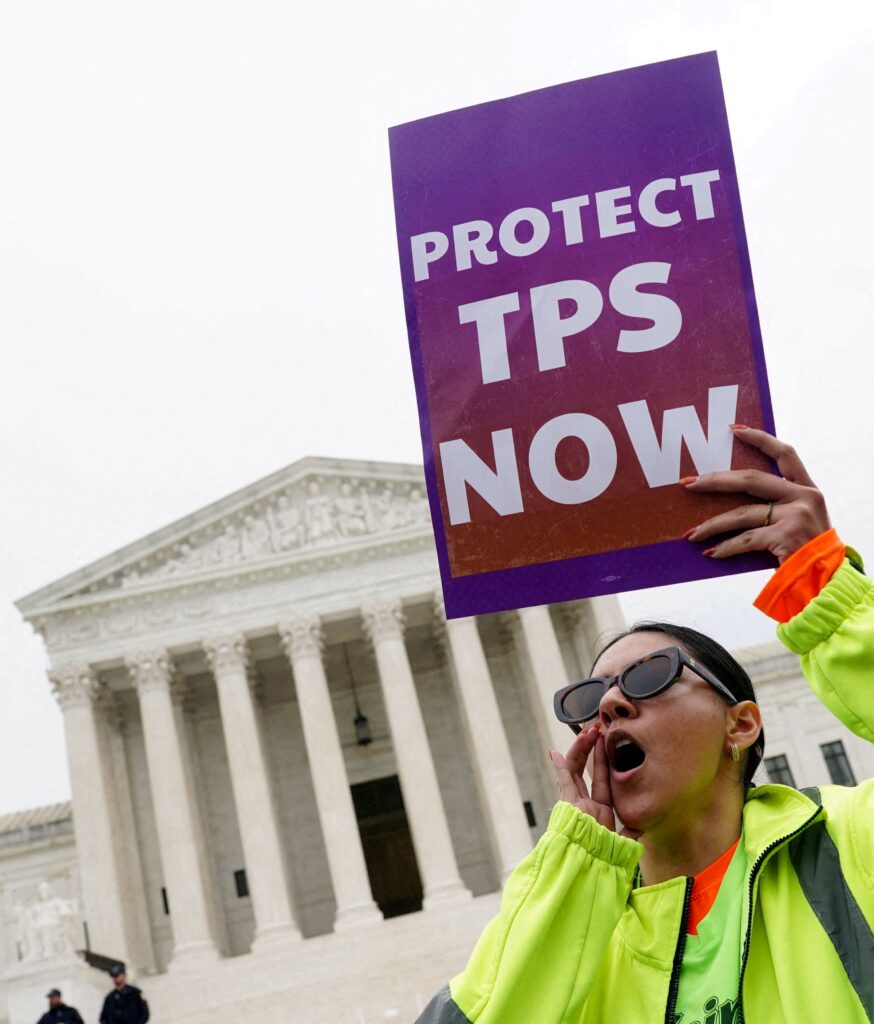
In an ideologically split 6-3 ruling, the justices cleared the way for Trump to lift temporary humanitarian protections that allow hundreds of thousands of Haitian and Syrian migrants to remain in the United States because conditions in their countries are deemed too dangerous for them to return.
The decision is expected to reverberate beyond those two communities, affecting approximately 1.3 million immigrants from 17 countries who hold what is known as temporary protected status, or TPS. Last year, the Supreme Court allowed the administration to revoke the status for Venezuelans.
In the other immigration ruling Thursday, also split along ideological lines, the justices found that migrants arriving at the U.S.-Mexico border are not entitled to apply for asylum until they cross into this country, meaning border agents can turn migrants back at the border.
The ruling prompted Justice Sonia Sotomayor, a liberal, to read a dissent from the bench, indicating she strongly disagreed with the majority. Many of the court’s immigration cases have divided the justices along political fault lines.
Expected within days is the court’s ruling on “birthright citizenship,” the principle that almost everyone born in the U.S. is automatically an American citizen. Birthright citizenship has long been regarded as guaranteed by the Constitution, but Trump issued an executive order on the first day of his term seeking to overturn it.
Earlier in the week, the court also cleared the way for the administration to deny green-card holders entry into the United States.
Administration officials and other supporters of stricter immigration controls were ebullient Thursday.
“These three rulings are all victories for the rule of law and common sense,” said James Percival, general counsel of the Department of Homeland Security. “Thanks to these decisions, we now have several more important tools to continue securing our borders.”
“*TEMPORARY* Protected Status *is* Temporary. Every district court asserting jurisdiction over these cases (19! adverse orders) was wrong,” Eric Wessan, the solicitor general in the Iowa attorney general’s office, wrote on the social platform X, echoing the argument that temporary protected status often lasts too long. Iowa, along with 21 other Republican-led states, filed an amicus brief in the case supporting the end of the protections.
This follows other wins by the Trump administration at the high court. The Supreme Court in September removed restrictions on immigration raids in Southern California. Last year, it permitted the administration on a temporary basis to deport noncitizens to third countries that are not their homelands.
Taken together, the court’s opinions over the past two terms have validated much of Trump’s aggressive approach to keeping out would-be immigrants and deporting them once they are here, policies that make up a central element of his agenda.
But the justices have also pushed back on occasion, for example requiring officials to “facilitate” the return Maryland resident Kilmar Abrego García to the United States after he was deported to El Salvador and held in a notorious prison.
The court also temporarily halted the administration’s effort to deport a group of Venezuelans using a controversial wartime power.
The Supreme Court’s TPS ruling sent shock waves through immigrant communities in New York, Florida and across the United States, where many had hoped the courts would serve as a check on the Trump administration’s actions.
Some immigrants, including those have lived in the United States for years, were distraught as they imagined losing their jobs, houses and security. Dahlia Doe, a Syrian TPS holder and lead plaintiff in one of the lawsuits, has lived in the United States since she arrived in 2015 on a student visa and received a scholarship to pursue a dual degree in business and political science. Her sister, a physician, is a U.S. citizen, and her parents have green cards.
Read more Top draft pick AJ Dybantsa arrives in Washington, ready to work on turning the Wizards around
“We are real people whose futures now hang in the balance,” she said. “This is not simply a legal outcome, for us it is the loss of stability, the fear of separation from our families, and the uncertainty of what comes next.”
The Supreme Court’s conservative majority did not focus on the potential ramifications of its rulings. They instead emphasized the black-and-white letter of the laws the high court was asked to interpret.
Justice Samuel A. Alito Jr., who wrote the majority opinion on the TPS ruling, acknowledged that “Haitians have made many positive contributions to the United States from the very beginning, and they continue to do so today.”
But he added there was no getting around clear language in the law authorizing TPS, which says there is “no judicial review” of the DHS secretary’s determinations to terminate TPS designations — meaning the Haitian and Syrian immigrants could not ask courts for relief.
“This text is clear, and its plain meaning is very broad,” he wrote.
Alito also said the Haitian immigrants did not prove that the Trump administration’s decision to send them home was racially motivated. Among other things, the Haitian plaintiffs had pointed to Trump’s false claims during the last presidential campaign that Haitian residents in Springfield, Ohio, were killing and eating their neighbors’ pets.
“Political discourse by prominent public figures is increasingly couched in terms that would have scandalized the public just a short time ago,” Alito wrote. He added, “But whatever one may think of the cited statements, they are insufficient to show that the termination of Haiti’s TPS designation was based on the race of the Haitian people.”
Justice Elena Kagan sharply disagreed in a dissent joined by fellow liberal justices Sotomayor and Ketanji Brown Jackson.
“It is hard to imagine the statements being made today of any White community,” Kagan wrote. “The statements fairly shout, in their racial undertones and overtones alike, that race entered into the President’s resolve to remove Haitians from this country.”
Ohio Gov. Mike DeWine (R), who rejected Trump’s claims about his state’s Haitian residents during the campaign, said that whatever the legal merits of Thursday’s TPS decision, returning Haitians to their native country makes little sense as a policy.
“The situation in Haiti could hardly be much worse,” DeWine said. “The violent gangs run most of the country. The government barely functions. And the economy is in shambles.”
A similar contrast of views played out in the border asylum decision. The case hinged on how to interpret immigration laws that say any noncitizen who “arrives in” the U.S. must be allowed to apply for asylum. A group of asylum seekers argued that the statutes intended to allow any migrant approaching a port of entry into the U.S. to apply for asylum.
But the majority, also led by Alito, sided with the Trump administration’s interpretation that the plain words of the statute mean that a migrant must step past the border to receive the opportunity to apply.
“In ordinary speech, no one would say that a person ‘arrives in’ a place — for example, a house, a city, or a country — before the person enters that place,” Alito wrote.
In dissent, Sotomayor said the law should not be read that simply. She recalled an incident during World War II in which 900 Jewish refugees tried to flee Nazi Germany aboard the MS St. Louis, which sailed to the Miami coastline but was turned away by U.S. officials. Canada and Cuba similarly turned the ship away, so it returned to Europe, where many of the passengers died in Nazi death camps.
She said that incident and similar ones during the war led to the modern U.S. asylum system, and that similar situations could play out under the majority’s reading of the law.
“The consequences of today’s decision are predictable. More people will die,” she wrote. “More people will attempt to cross the border illegally, and some will make it while others will not.”
Read more Chicago Cubs acquire left-hander David Peterson in a trade with the New York Mets