In today’s edition … Is Colorado the next state to show anti-incumbent agita among Democrats? … The Supreme Court delivers Trump a mixed bag of results … but first …
Read more As teens, they saw a U.S. World Cup dream fail. As men, they’re reviving it.
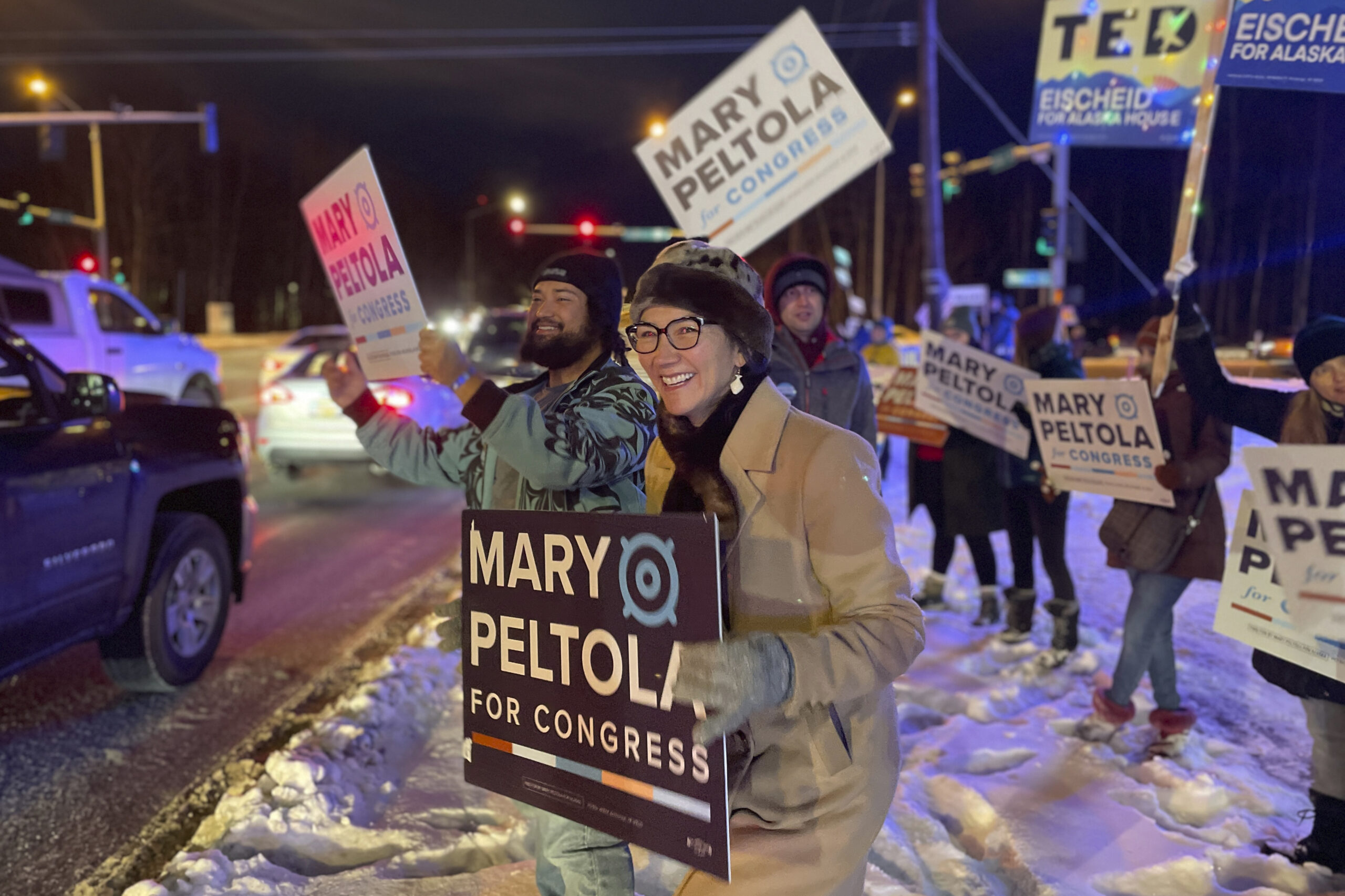
Yasmin Radjy isn’t used to canvassing while armed with bear spray.
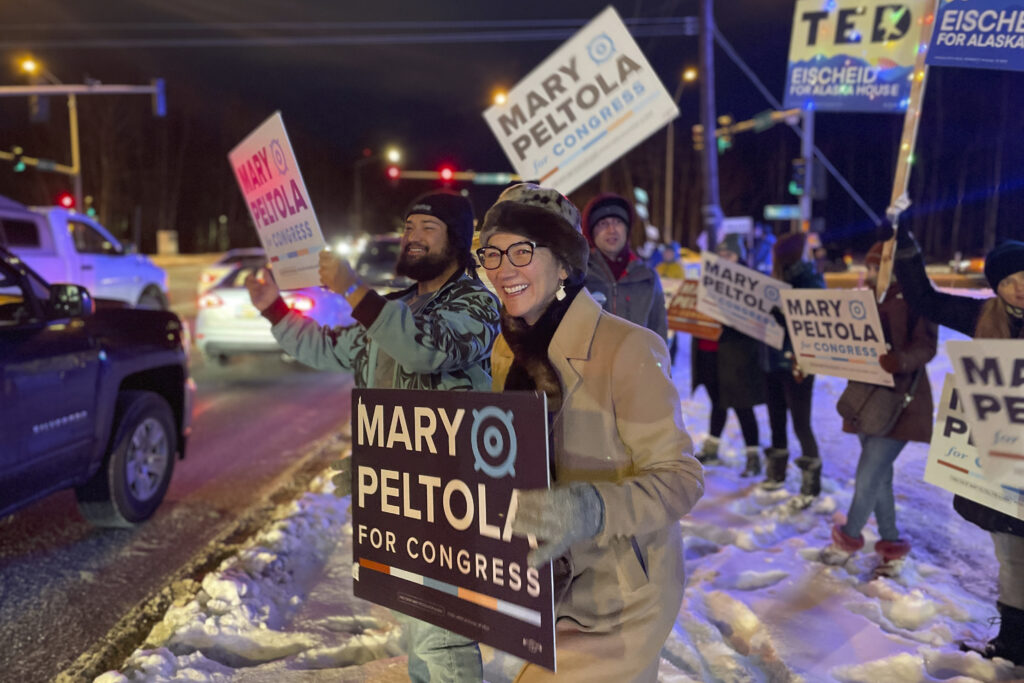
But that is life in Alaska, where Radjy, the executive director of the liberal grassroots organization Swing Left, found herself last week, implementing a novel organizing technique to help former congresswoman Mary Peltola oust Republican incumbent Sen. Dan Sullivan in November.
Alaska presents myriad challenges to political organizers. While the state has a small population (around 740,000 people), more than half (405,000) live around Anchorage, leaving a large rural population in a state where only 20 percent of the land is accessible by road. Traditional political door-knocking is nearly impossible in most of the state, both because of the vast distances between homes and the harsh weather for much of the year.
That is why Radjy and Swing Left added Alaska to their “Ground Truth” canvassing program. The new take on political door-knocking focuses on speaking with all voters, not just Democrats; doing more listening than talking and using new technology like voice-to-text notes and artificial intelligence-powered analysis to help Peltola’s campaign and other Democrats use the information to determine who they target, what messaging is working and the best kind of outreach to use.
The program was a response to broader Democratic criticism of door-knocking. Traditional door-knocking by political campaigns focuses on going door-to-door in a neighborhood, often using the same script to persuade voters to support a candidate or party. But this program trains people to connect with potential voters everywhere, do more listening than talking, get more information about what is motivating a voter and then provide that information to a campaign to better inform how a campaign reaches that person.
“We see Alaska as some of the most fertile ground for Ground Truth because the only way that you can win in Alaska is by talking to everybody,” said Radjy, noting that there are only 70,000 registered Democrats in the state. “It is very ripe for organizing that is adaptable to sort of idiosyncratic local conditions.”
The other limit to traditional campaigning in Alaska? Money spent on TV ads, which are nearly ubiquitous in more densely populated parts of the country, only goes so far. There are only three media markets in the state, and they are all relatively inexpensive. So while another campaign may raise money specifically to blanket TVs, Peltola’s campaign will likely be limited in how much it can feasibly spend on television, leaving it to spend money in other ways, like voter contact and organizing.
Radjy said Democrats in Alaska were among the first to ask about implementing Ground Truth when the organization rolled it out earlier this year — which is why she and other Democrats held a site-based canvassing event at a Speedway gas station 45 miles south of Anchorage, speaking with voters as they filled up their cars along the Seward Highway.
“This is a race that is very likely to come down to a few thousand votes,” Radjy said. “So you can’t just organize Anchorage. … If you want to talk to people in a state where over 80 percent of the state is literally not road accessible, and you can only get there on a tiny little plane or a tiny little boat, you have to empower local people to talk to their neighbors, both the neighbors they know and the neighbors that they don’t know.”
Peltola’s race could be critical for Democrats, who maintain a longshot chance at retaking the Senate next year. Peltola, the first Alaska Native elected to Congress, lost her reelection bid in 2024 to Rep. Nick Begich III (R). But Democrats are hopeful that in a better year for the party, and as voters sour on President Donald Trump’s handling of the economy, the race could be winnable.
Republicans are openly skeptical of this thinking. “No amount of pro-Peltola door knocking can erase her ineffective record in Congress or her career cashing in as a Lower 48 lobbyist,” said Bernadette Breslin, a spokesperson for Senate Republicans’ campaign arm. But Republicans clearly consider the race a risk — the Senate Leadership Fund announced earlier this year they would spend $15 million on the race, something they wouldn’t do unless it was competitive.
“We cannot win the U.S. Senate without winning this Senate seat,” Radjy said. “It is a tough seat that is a must-win. It is not an optional race to win.”
The implementation of this kind of program also speaks to a willingness to try something in a state that has been difficult for Democrats over the last decade. Radjy observed that “smaller, redder states” are often among the most interested in novel organizing techniques because they “know that you have to talk to people across differences.”
Jenny-Marie Stryker, executive director of the Alaska Democratic Party, said these tools are part of a broader campaign “by Alaskans, for Alaskans,” where Democrats are going to “work from now until Election Day to ensure our Alaska first message reaches voters of any affiliation, whether their homebase is Kotzebue or Ketchikan.”
The Supreme Court delivered Trump a mixed bag of decisions on Monday.
While the justices struck down a precedent that allowed Congress to insulate agencies from political influence, the court did not go as far as Trump had hoped, our colleague Justin Jouvenal reported, stopping short of giving the president the same power over the Federal Reserve.
The court also let a $5 million civil judgment against Trump stand, declining to invalidate a jury’s 2023 decision that found the president liable for allegedly sexually assaulting and defaming journalist E. Jean Carroll.
And they upheld a Mississippi law that allowed officials to count mail-in ballots postmarked by Election Day but arriving later, Justin reported. The ruling cuts into Trump’s long-held false claims that mail-in voting is rife with fraud.
Colorado’s primaries are today, and we’re keeping an extra close eye on the state’s 8th Congressional District.
Read more Iran’s leverage over Strait of Hormuz snarls Trump’s push for a deal
Democrats think they have a real chance to flip the seat, currently held by Rep. Gabe Evans (R), as they push to win a House majority in the midterms. Evans narrowly won the district in 2024, beating incumbent Yadira Caraveo by 0.8 percentage points, and Trump has been making it hard to be a Republican in Colorado lately.
The Trump administration’s sharp cut in federal funding to Colorado and high-profile removal of the U.S. Space Command’s headquarters from the state have put Trump front and center in races across Colorado this year. (And those are just the Colorado-centric issues – the war with Iran, inflation and all the other issues that are spurring anger toward Trump nationwide are absolutely present in Colorado, too.)
State Rep. Manny Rutinel and former state representative Shannon Bird are vying to challenge Evans. Rutinel is a self-described progressive, worrying some Democrats who think the district will be harder to flip if he wins. Bird has leaned into that perception and is positioning herself as the more pragmatic candidate. The Democratic Congressional Campaign Committee has backed Bird, giving her the establishment stamp of approval. But we will be watching to see if this — along with a possible upset of Rep. Diana DeGette in Denver — are the latest examples of anti-establishment sentiment roiling the Democratic electorate.
A similar dynamic is playing out in the Democratic gubernatorial primary, in which Colorado Attorney General Phil Weiser’s staunch anti-Trump rhetoric and bona fides have made him a serious challenger to Sen. Michael Bennet.
Bennet looked to be the heavy favorite when he announced his campaign last year, with greater name recognition than any other candidate and a list of major endorsements. But Weiser has succeeded in selling himself as a fighter — he has already sued Trump 66 times as attorney general — and now the sense in the state is the race is neck-and-neck.
Portland Press Herald (Maine): Maine’s key Senate race remains neck-and-neck, with Democrat Graham Platner holding a slight lead over Republican Sen. Susan Collins, but it’s within the margin of error.
Variety (California): Comcast is spinning off NBCUniversal into two distinct companies, one with its cable and tech businesses and the other housing NBCUniversal and Sky. The spinoff is the latest shake-up of a major media company in recent years.
Miami Herald: Venezuelan opposition leader María Corina Machado may soon return to the nation that has been devastated by a deadly earthquake. “It is my duty to accompany my people. We need to be together, to embrace, to grieve and mourn together,” Machado said.
You all had lots of thoughts about Vice President JD Vance saying, “If Watergate happened tomorrow, it would be like a 12-hour news story.”
“I think the VP’s attitude regarding Watergate being no big deal is primarily driven by the fact that he knows that many of the illegal things Trump has gotten away with make Watergate look like child’s play,” wrote Bo Thomas.
“As a 73 year old who well remembers Watergate, I’m appalled at Vance’s recent comments about Watergate,” added B. Joyce Baird. “I pray to see arc of justice bend in the right direction before I exit stage left.”
Ken Burleson, a reader in Delaware, said that Vance’s comments are “short-sighted” and an “attempt to rewrite or change history.”
“Unfortunately, attempts to change our past (good and bad) has and is currently happening today,” Burleson wrote. “Watergate was a bellwether occurrence of the possibilities a governing body will be willing to take to undermine the legal process and to fabricate issues before the American public.”
And Paul Gutermann added that the “crucial difference” between Trump and former president Richard M. Nixon, who resigned over Watergate, is that “the former has a certain charisma (albeit lost on me) that engenders a strong attachment from his base while the latter had absolutely none.”
Time for another World Cup check-in. Sorry, but at least Dan is a bit obsessed. What has been your favorite storyline of the tournament? We highlighted the relationship between Lawrence, Kansas and Algeria. But there are many more. What resonated with you the most? Let us and your fellow Early Brief readers know at [email protected].
Thanks for reading. You can follow Dan and Matthew on X: @merica and @matthewichoi.
Read more Soccer fans clash with police in The Hague after Morocco stuns the Netherlands at the World Cup
Additional analysis by Alec Dent.