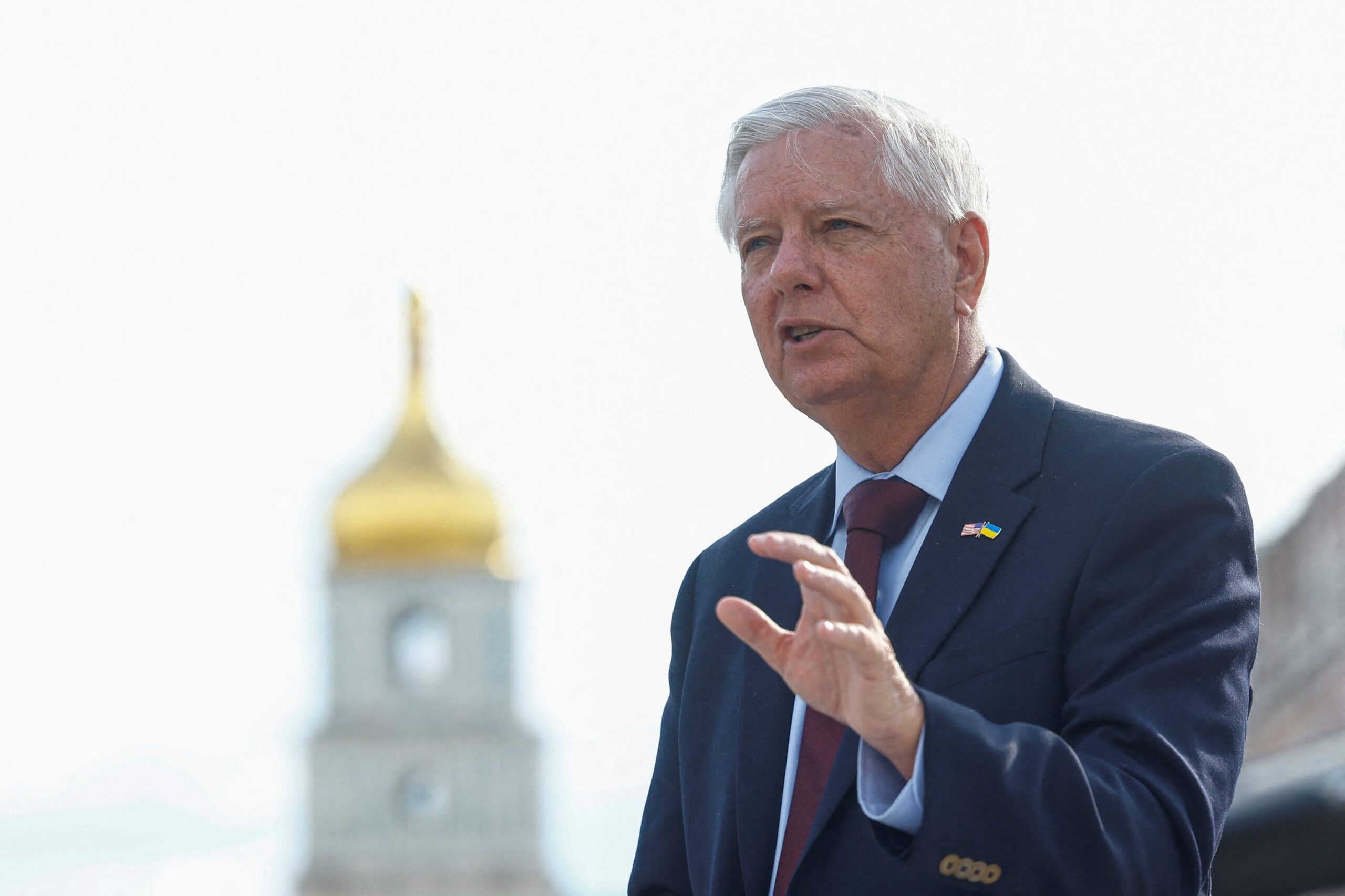
The internet’s reactionary machinery is churning at full force after Lindsey Graham’s sudden death and Mitch McConnell’s illness.
Read more Blanche to face GOP critics after judge’s scathing criticism
Not long after Lindsey Graham’s heart stopped late Saturday night and the swell of bipartisan tributes honoring his decades of public service began to pour in, an undercurrent of suspicion stirred as well.
“Was he poisoned by a foreign adversary either abroad or upon returning to the US?” far-right political activist Laura Loomer asked her millions of X followers one hour after Graham’s office issued a statement that the 71-year-old senator from South Carolina had died after a “brief and sudden illness.”
Former congressman George Santos chimed in: “I believe foul play could have been at play here.” And FBI Director Kash Patel seemed to further speculation when he concluded his tribute to Graham: “The FBI is assisting local authorities and has made every necessary resource available.”
By that point, Loomer had already posted a dozen times to X about her suspicions of the potential involvement of a foreign adversary and, she told The Washington Post, shared her concerns in overnight calls with Trump administration officials and members of Congress. “It’s not like I’m just making random claims,” Loomer said in an interview. “I don’t understand why everybody wants to call it a conspiracy. I think there is more than enough evidence there for probable cause.”
In the days since Graham’s death, our era of paranoid politics has produced a string of theories online: He died in Kyiv. He was taken out by Israel. He was poisoned by Iran. He was blown up by Russia.
In a statement, Graham’s office said Sunday that preliminary findings from the D.C. medical examiner’s office found he suffered an aortic dissection. A death certificate remains pending. Authorities have not indicated foul play.
Still, an algorithm-fueled online ecosystem is once again abuzz, the internet’s reactionary machinery churning at full force with suspicions about the health of not one but two prominent senators and the forces shielding the American people from the truth.
Sen. Mitch McConnell’s office on Sunday released a statement that his hospitalization last month was caused by a fall, providing the first detailed update after weeks of silence.
A photograph of the Kentucky Republican accompanied the statement, showing him sitting in a hospital bed, a smile stretched across his face, his wife at his bedside. In his hand, a copy of that day’s Washington Post sports section. That did nothing to dissuade the online commentariat.
“Why does the text on the newspaper McConnell’s staff claim he’s holding look AI generated?” Loomer posted on X.
One X account shared, without evidence, that the picture was actually from 2023 in a post that has since amassed some 5.1 million views in less than 24 hours.
Other accounts began asking X’s Grok chatbot to analyze the photo for inconsistencies. “Appears to be a genuine photo,” the bot replied to one such query. To another, however, it fanned skepticism of the original photo: “The ‘proof of life’ claim doesn’t hold up here.”
On Monday, The Post examined that metadata from the photo and it did indeed appear to have been taken on Sunday, and an digital forensics expert told the paper he saw no evidence of AI or other manipulation.
Read more RFK Jr. faces Hatch Act complaint after intervening in congressional races
Joseph Uscinski, a political scientist at the University of Miami and leading researcher of public opinion and conspiracy theories, has found scant evidence that beliefs in conspiracy theories are increasing in the current era. “Things aren’t getting worse. That’s the good news,” he said. “The bad news is things have always been pretty bad. We just weren’t paying attention.”
But what’s changed in our online age is that conspiracy theorists are both better mobilized and more tightly woven into the fabric of our current political apparatus. Views that once would have been confined by the hard material reality of spreading information by pamphlet or radio broadcast are now encountered within seconds by any and everyone thanks to social media.
In Trump’s Washington, the chasm between the parallel universes of verified facts and of disproved theories can collapse. The president, for example, centered his early political career around baseless claims about Barack Obama’s place of birth and has continued to espouse falsehoods that the 2020 election was stolen.
“Mixed within these online conspiracy theories are also people who want and deserve the truth,” said Joan Donovan, a Boston University professor who has extensively studied misinformation and media manipulation. “And unfortunately, the government hasn’t earned enough of the public trust to be the final arbiters of that.”
Asked Monday about those who doubt the official explanations of Graham’s death and McConnell’s extended absence from the Capitol Hill, Senate Majority Leader John Thune (R-South Dakota) said “there’s so much noise in the world today.” He continued: “I hope that people can calm down and just mourn the loss.”
A stanch defender of Ukraine, Graham died hours after returning from his 10th wartime trip to the country since Russia’s 2022 invasion. Skeptics, right-wing provocateurs and others that were quick to point out the timeline. After all, Russia under Vladimir Putin has a well-documented history of killing political “dissidents” at home and abroad.
Overseas, Russian state media pundits and propagandists have met the news of Graham’s death with a mix of vitriol and conspiracy theories that linking his passing to his advocacy for Ukraine. A Russian tabloid published a piece titled “The Kiss of Death: Senator Graham’s Death Linked to Zelensky,” in which a political analyst promoted a conspiracy that “many officials” who come into contact with Zelensky either resign or die.
Last Monday, five days before his death, Graham shared footage online from Ali Khamenei’s recent funeral in Tehran of people caring signs with his face, along with others including Trump’s and Loomer’s. “At least they used a good photo of me. Judge me by my enemies,” Graham shared on X.
In the footage, the signs displayed Graham’s and the others with a target on their forehead and the text: “Sooner or later, your heads will roll.”
“Why would someone not take those threats seriously?” Loomer said to The Post.
Patel, the FBI director, hasn’t posted on X about Graham since Sunday. D.C. police are the law enforcement department that leads death investigations in the District, and a department spokesperson on Monday declined to say whether D.C. police had requested extra assistance from the FBI. A spokesperson for the FBI declined to clarify the scope of the agency’s involvement.
But on Monday afternoon, NBC News reported that officers from the FBI were spotted at Graham’s D.C. residence on Monday. It didn’t take long for Loomer to update her online base. “I didn’t realize 20 FBI agents were needed to convince everyone that Lindsey Graham died from an Aortic Dissection,” she posted on X. “Did the toxicology report come back? 2 things can be true at once.”
Mary Ilyushina, Theodoric Meyer, Matthew Choi and Luke Connors contributed to this report.
Read more House GOP races to advance party-line bill to fund Pentagon, encourage voting restrictions