In today’s edition … Trump backs down from Hormuz toll … We ask you about how you judge the economy … but first …
Read more Pennsylvania Republicans won on lowering prices. Then came the Iran war.
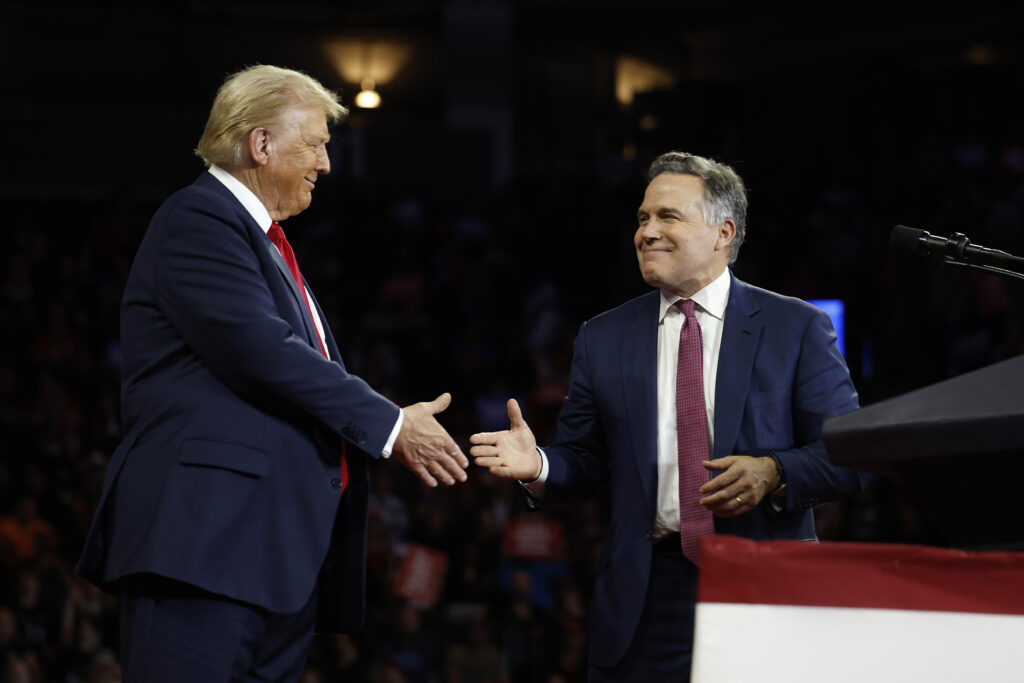
When Pennsylvania Democratic strategist J.J. Abbott thinks about the 2024 election, he vividly recalls one sign: “Trump Low Prices” atop “Kamala High Prices” in big block letters.
“They were not subtle about this in 2024,” said Abbott, recalling how the signs were “all over Pennsylvania.”
Two years later, that messaging — which successfully delivered Pennsylvania to President Donald Trump and helped Republicans flip two critical House seats in the eastern sweep of the state — is coming home to roost.
I wrote about this dynamic today with Cat Zakrzewski, ahead of a speech Trump will give in Pennsylvania. Republicans were undoubtedly successful in making prices the issue of the 2024 election, but 18 months later, prices remain stubbornly high — because of everything from Trump’s trade wars to the ongoing shooting war with Iran — and Republicans who ran on lowering prices two years ago are having to grapple with how to deal with the issue.
“It is pretty damning,” Abbott said of what this dynamic presents to Republicans in Pennsylvania. “They have created for themselves this permission structure to have to own all the prices for themselves.”
We homed in on the two Republicans who flipped Pennsylvania seats in 2024 — Rob Bresnahan and Ryan Mackenzie. Both face challenging reelections in 2026 that could determine control of Congress in the last two years of Trump’s presidency.
Bresnahan, ahead of his election, told a radio host that Democrats were “gaslighting” voters by arguing that grocery prices were not surging. “We’re fed up with paying too much at the grocery store. We’re fed up paying too much for groceries. We’re fed up paying too much for rent. We’re fed up paying for utilities that are out of this world,” Bresnahan said on the conservative “Bob Cordaro Show” a week before Election Day in 2024.
The messaging worked. He defeated incumbent Democrat Matt Cartwright by just over 6,000 votes in a hotly contested Northeast Pennsylvania district.
Now, Bresnahan is both arguing that prices are coming down — as he did around Thanksgiving 2025 — and acknowledging that grocery prices are still too high.
“Grocery receipts are getting shorter, but the price keeps going up,” Bresnahan says in a straight-to-camera ad that is running in his district.
This has become a campaign issue for Bresnahan. Scranton Mayor Paige Cognetti, the Democrat challenging Bresnahan, has repeatedly accused him of violating his promise to lower costs by backing the president’s war and other policies. “Instead of focusing on lowering costs, Rob Bresnahan is sending our tax dollars overseas while our prices keep rising at home,” she posted on June 4.
Samantha Bullock, a campaign spokeswoman for Bresnahan, blamed Democrats for continuing economic troubles.
The messaging also worked for Mackenzie, who ousted Rep. Susan Wild (D-Pennsylvania) in 2024 by promising “real change” on inflation and blaming Democrats for ignoring it. In interviews, he said people were having to “change their lifestyle just to put food on the table,” and that “the Democrats and the mainstream media want to gloss over that and tell you how great things are.”
While Mackenzie often notes that “more work remains” on bringing prices down, he has argued that inflation and prices are falling. “After four years of uncontrolled inflation, American families are finally seeing price stability,” he wrote on X in 2025.
Mackenzie told us in a statement that he has made reducing the cost of living his top priority and blamed former president Joe Biden’s administration for the “hole” families are currently digging out of.
“As I have done from the beginning, I’ll keep working to deliver on the affordability priorities of the American people,” he said.
The issue here for both lawmakers is that they have to figure out a way to tie themselves to Trump — he likely won’t tolerate any criticism of his record — without doing exactly what Bresnahan blamed Democrats for doing in 2024: gaslighting.
“Voters have said resoundingly over the years, ‘Yes, it does matter, and we don’t care about whose fault it is, we don’t like it,’” said Christopher Nicholas, a Republican strategist in Pennsylvania. “And voters tend to take it out on the party in power.”
Read more England coach Thomas Tuchel has a recipe for handling World Cup stress. It includes ice cream
Republicans got a sliver of good news this week when the Labor Department’s monthly inflation report reflected a drop in energy prices following the mid-June agreement that extended a tentative ceasefire with Iran.
“That means prices are coming way down, and we’re doing a great job,” Trump said on Tuesday. “And remember that. Remember that for the midterms.”
But Trump himself has said this month that the ceasefire is over, and energy prices spiked in recent days due to the resumed fighting in Iran.
“Ryan Mackenzie and Rob Bresnahan were elected because voters wanted real leaders focused on lowering costs and getting the economy back on track instead of out-of-touch nonsense,” said Mike Marinella, a spokesperson for the House Republicans’ campaign arm. “That’s exactly why President Trump and House Republicans have been delivering on historic tax relief, lower energy costs, and pro-growth policies.”
You can read our full report here.
Well, that was quick.
Trump backed away from his plan to charge a 20 percent fee on all ships passing through the Strait of Hormuz on Tuesday, giving those who subscribe to the TACO (Trump Always Chickens Out) theory of the presidency a win after the president declares the strait “is open to ALL Ship traffic except for Iran.”
Our colleagues Victoria Craw, Suzan Haidamous and Maegan Vazquez reported Tuesday that Trump’s initial promise of a levy to move through the strait sent European markets tumbling and oil prices climbing.
The president wrote that he would replace a “20% United States Reimbursement Fee with Trade and Investment Deals that the various Gulf States will be making into the United States.”
This brief moment where the United States was going to do the very thing they criticized Iran for doing highlights how tenuous this entire foray into Iran is for the president. He has said, time and again, that he has no problem continuing the war with Iran, noting that the Vietnam War lasted 19 years, a pittance compared with this five-month conflict.
But backing away from this plan, which experts argued would have sent prices soaring, highlights the political pressure on the president, whose political fortunes this November — as we established earlier in this newsletter — will be directly tied to his ability to bring prices down and quell broader economic concerns from restive voters.
Southern Maryland Chronicle: Recriminations and lawsuits press on after millions of gallons of untreated sewage spilled into the Potomac River five months ago.
LAist: The Department of Health and Human Services will not move forward with a plan to block federal funding to hospitals that provide pediatric gender-affirming care to people under 18.
San Antonio Current: A new report finds that the growth of data centers around San Antonio will require enough power to energize 3 million homes.
Access to the White House is a sensitive subject for those who live in Washington, D.C., and the millions of people each year who visit.
As we noted in yesterday’s newsletter, critics of the president have accused him of fortifying the White House, restricting access far beyond the original gates of the federal mansion, and Trump officials are now proposing further fencing off public spaces outside the building. Others will note, however, that Trump has been the target of multiple assassination attempts.
“As I have lived in Washington nearly all my life, I have seen access to the White House slowly being limited. I remember driving right in front of it and behind it. At one point, you could walk between the Treasury and the East Wing,” wrote Robert Hanawalt. “Trump is making a White House Versailles at the expense of the American taxpayer and he needs to explain how he is paying for it aside from robbing budgets that have lawfully been allocated by the Congress to do so.”
“Barricades and fencing? What is Trump so afraid of? And why,” asked Jane Sinner.
“The biggest effect, I think, is psychological and mostly subconscious. The fences communicate that there is danger afoot and signal that extreme measures are needed to keep us safe,” wrote Ann Stanton, who said the scenes remind her of the military presence in El Salvador when she spent time there while in the Peace Corps.
We wrote about about how Trump is — metaphorically — fenced in by gas and grocery prices, hamstringing what he may want to do in Iran. How much is your view of the economy driven by prices you see at the pump and grocery store? What also drives your view of the economy? Let us and your fellow Early Brief readers know at [email protected].
Read more Europe league, expansion, Kawhi probe, second apron all topics at NBA’s board of governors meeting
Thanks for reading. You can follow Dan on X at @merica.