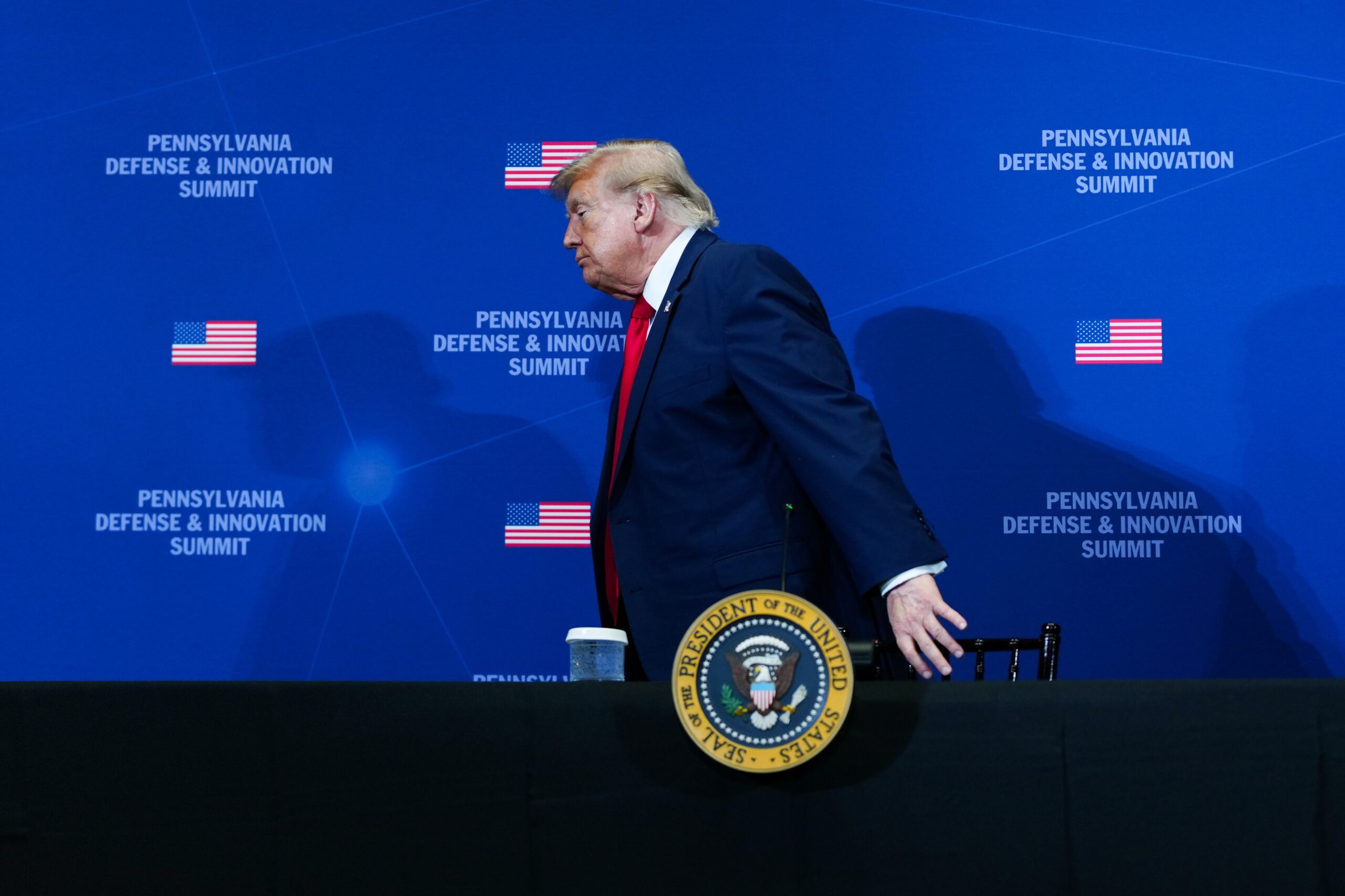
He dramatically shrank two national monuments in Utah.
Here’s what happened under President Donald Trump this week that you may have missed.
Read more Despite expectations, Georgia never came up in Trump’s prime-time speech
The Reflecting Pool that Trump recently remodeled has been drained for repairs, which his administration says could cost tens of thousands of dollars. It’s been leaking badly and covered with algae blooms (which are more common in a warming world).
The White House is doubling down on blaming “deranged individuals” for creating “gashes” in the pool on the National Mall. The Washington Post examined detailed images of the repairs and found that it’s likely the leaks were caused by application flaws. There’s evidence the whole project was rushed.
While racing to get this done before the nation’s 250th birthday this month, the Trump administration awarded the repairs to a contractor without allowing others to bid for it. That contractor earned an inflated profit margin, the New York Times reported.
“There were no missteps during the initial repairs to the pool,” said White House spokeswoman Taylor Rogers. “Unfortunately, deranged individuals made several gashes in the side of the pool and destroyed over 300 feet of the pool’s siding. Once the necessary repairs to fix the vandalism are complete, the Reflecting Pool will be restored to all its glory.”
Federal officials are prohibited from using their position to try to influence elections. The rules are laid out in a law called the Hatch Act, which covers every federal employee, from Cabinet members down to civil servants — except the president. (The president, inherently a political job, is exempt.) The rationale for the law is that you can’t use your taxpayer-funded office to advocate for your political beliefs.
In Trump’s first term, administration officials were repeatedly accused of violating the act. This time, Health and Human Services Secretary Robert F. Kennedy Jr. is facing a complaint that he violated it by intervening in a congressional race in Iowa. The Washington Post obtained audio of him calling a congressional candidate and urging him to drop out so that Republicans could win the race and try to keep control of Congress. In the audio, Kennedy appears to know he’s encroaching on the law: “I can’t go into specifics because there’s legal prohibitions about that,” he says.
But enforcement is hard: It’s up to the administration to investigate a potential violation and recommend someone lose their job for it. It would be up to the president to fire them. Trump mocked the Hatch Act in his first term rather than fire aide Kellyanne Conway over alleged violations.
Read more Luis García Jr. is enjoying a career year a decade in the making
Trump issued an order to shrink two well-known national monuments in Utah to a fraction of their size to open up the land for potential drilling for oil, gas and minerals. Each shrank by more than a million acres.
It’s not clear whether presidents can reduce the size of monuments, reports The Post’s Jake Spring. A more than century-old law signed by Theodore Roosevelt says presidents can create monuments but is vague about what else they can do. Trump is the first president in decades to try to shrink them rather than create them.
Jake reports that environmentalists are expected to fight this in court.
The Supreme Court has had a contentious year, issuing decisions that upset Trump and his allies (including striking down his tariffs and attempt to end birthright citizenship) and decisions that upset Democrats (including greatly expanding presidential power over the federal government).
This week, two Supreme Court justices offered rare testimony in front of Congress, asking for more money to defend them against threats. It’s been a tumultuous year in that regard: A Californian was sentenced to eight years in prison for attempting to assassinate Justice Brett M. Kavanaugh at his home. Chief Justice John G. Roberts Jr. also warned that “personally directed hostility is dangerous and has got to stop.” He did not mention Trump by name in his remarks, though they came shortly after the president said the justices and their families should be ashamed after they ruled against his tariffs.
Liberal-leaning justice Elena Kagan and conservative-leaning justice Amy Coney Barrett appeared side-by-side at the hearing, sharing their stories of threats. As The Post’s Julian Mark reports: Barrett described being caught off guard a few years ago when having to explain to her son what a bulletproof vest was.
Julian reports that Congress also asked whether the Supreme Court would consider adopting more stringent ethics codes to maintain impartiality (right now it’s up to the justices to enforce themselves). Kagan was open to it, and Barrett was skeptical.
Amber Phillips writes The 5-Minute Fix newsletter, a quick analysis of the day’s biggest political news. Send her an email here, or ask a question that could be featured in an upcoming newsletter.
Read more Maine Democratic Senate candidates unite behind abolishing ICE after shooting