President Donald Trump’s pressure on federal prosecutors to charge noncitizens with voting illegally has produced just a handful of cases, with others falling away as investigators find innocent explanations or struggle to prove bad intent, according to current and former officials.
Read more House passes measure to restrain Trump on Iran
Prosecutors typically assume a jury would not convict someone if they accidentally or mistakenly cast a ballot. That raises the bar for bringing charges even in the relatively rare instances when noncitizens do vote, such as in Tuesday’s announcement that a software error in New Jersey’s motor vehicle system incorrectly registered 6,600 people, about 400 of whom went on to cast ballots.
The Justice Department has investigated and then declined to prosecute cases in which noncitizens mistakenly registered because they did not speak English well or understand the law, according to a person familiar with the investigations. In at least one instance, a noncitizen with Alzheimer’s disease registered to vote, complicating the prospects of charging that case, the person said. In multiple cases brought to investigators, prosecutors determined that the noncitizens didn’t realize they were registered to vote.
The people familiar with the cases spoke on the condition of anonymity because the law enforcement investigations are sensitive and not public.
In one case, evidence that a noncitizen knew he shouldn’t have voted came when he tried to correct the error by canceling his registration. David Neewilly, 73, of New Jersey went to his local election office in August 2025 to remove himself from the voter roll. The FBI obtained records showing he first registered in 2003 and voted in 2020 and 2024.
Prosecutors charged Neewilly in April with voting illegally and perjury related to his citizenship status. According to public court records, prosecutors have not yet filed a grand jury indictment against Neewilly and are still working on a plea deal. Neewilly and his lawyer did not respond to requests for comment.
The acknowledgment by prosecutors of the difficulty of charging voter fraud contrasts with the Trump administration’s public emphasis. In a prime-time address to the nation last week, Trump portrayed noncitizens illegally registering to vote as rampant, implying that the scofflaws were a threat to democracy. The president said the administration found 278,000 noncitizens registered to vote, but officials and experts said that figure was wildly overstated based on people with similar names and outdated information.
“President Trump is committed to ensuring that Americans have full confidence in the administration of elections, and that includes totally accurate and up-to-date voter rolls free of errors and unlawfully registered non-citizen voters,” White House spokeswoman Abigail Jackson said, pointing to Trump’s calls for Congress to pass new requirements for voter ID and proof of citizenship.
“American voters deserve to have confidence that our elections are safe and secure — President Trump will never stop fighting to make that happen and all patriotic Americans should join in his effort.”
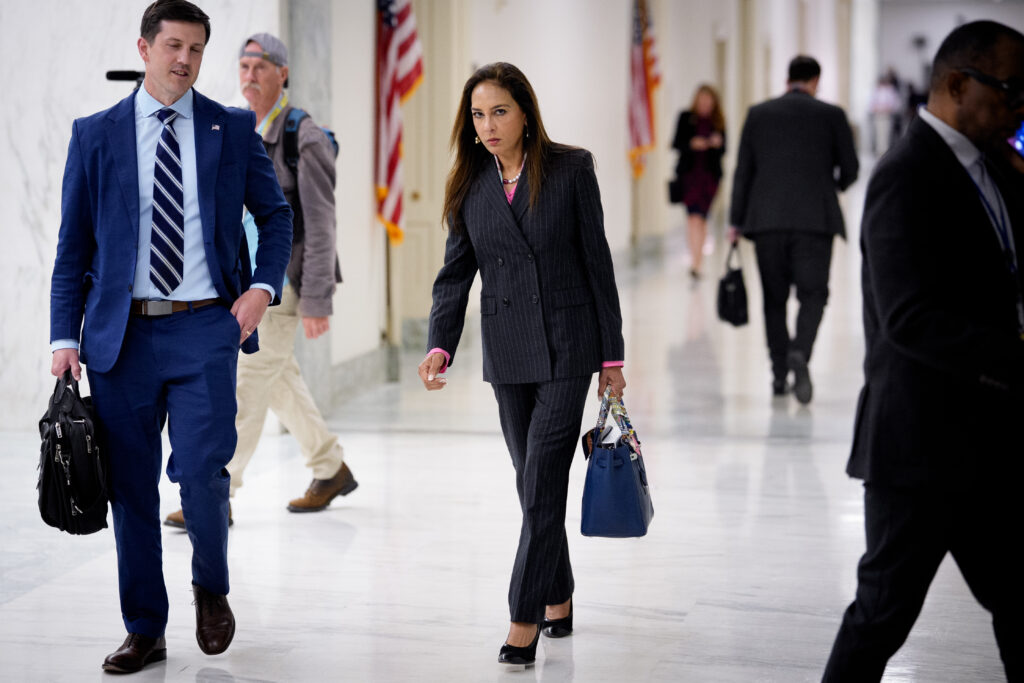
Harmeet K. Dhillon — the head of the Justice Department’s Civil Rights Division, which is tasked with protecting voting rights — has used her social media accounts to amplify isolated incidents of voter fraud, telling her followers that Democrats are lying to the public when they say that voter fraud is not an issue.
“It is illegal for any noncitizen to vote in a federal election, and every unlawful vote dilutes the voice of American citizens,” a Justice Department spokesperson said in a statement. “Whether or not a case is prosecutable doesn’t change the fact that the wrongful vote happened — DHS found over 250,000 likely noncitizens on voter rolls nationwide, and New Jersey’s own Governor confirmed 400 noncitizens voted there this week.”
A noncitizen illegally casting a vote is considered a misdemeanor, punishable by up to one year in prison. Under Justice Department guidance that applies to all federal crimes, prosecutors are advised to bring only those cases in which they believe they can convince jurors of guilt beyond a reasonable doubt.
Prosecutors do not have to prove intent in cases accusing a person of voting illegally, but they are wary of prosecuting without evidence of intent because the defendants are generally sympathetic, making it hard to persuade juries to convict, said Paul Butler, a Georgetown law professor and former federal prosecutor in the Justice Department’s Public Integrity Section.
Noncitizens who cast ballots often do so because they mistakenly thought they were eligible or an election official wrongly told them they could, Butler said.
“If a jury hears that — even if it’s not technically a defense — it should be a case that a prosecutor is reluctant to bring because it doesn’t have a lot of jury appeal,” Butler said.
Prosecutors can charge noncitizens with felonies if they misrepresent themselves as citizens on government forms. Such misrepresentations could occur, for example, on DMV and voter registration forms. But those cases do require prosecutors to prove intent to win a conviction.
Read more Trump adds condition to nuclear deal with Saudi Arabia, throwing pact into doubt
Overall, legal experts said, there are few prosecutions of noncitizens who register or vote because the cases are tricky to prosecute and the crime itself is so rare.
“It’s the opposite of a perfect crime,” said Justin Levitt, a Loyola Law School professor who advised the Biden White House on voting rights. “It’s the least perfect crime. It’s leaving a paper trail for the crime.”
Prosecutors around the country have brought a handful of cases.
The U.S. attorney in Philadelphia, David Metcalf, announced charges in September against a Filipino citizen accused of voting in the 2020 election, a U.S. citizen accused of voting once in Pennsylvania and a second time in Florida, and another U.S. citizen with voting in both New Jersey and Pennsylvania. In March the office charged an undocumented immigrant under a deportation order with voting in the 2024 election.
Texas Attorney General Ken Paxton’s office scrubbed the state’s voter rolls using federal citizenship data, leading to at least two cases. A British green card holder in the Houston area admitted to voting illegally because he thought he was eligible after living in the U.S. for 10 years. The U.S. attorney in Houston also indicted a woman who voted in Fort Bend County, Texas, despite not being a citizen.
A property manager in eastern Washington state returned multiple absentee ballots in her tenants’ names, some of which were counted. In Colorado, the secretary of state reported 60 ballots with similar signatures from an adult care center. Local prosecutors decided not to pursue charges.
Other leads didn’t turn up any fraud. Prosecutors looked into a single internet address that was used to request multiple ballots online, but interviews with the voters yielded no evidence that the requests had come from the same person. A community group reported an employee who was submitting fraudulent voter registration forms, but no ballots were cast. A polling center recorded 36 more votes than people signed in electronically, but only because the electronic poll book wasn’t working so voters used a paper backup.
The Justice Department and Department of Homeland Security have worked together closely to try to match voter rolls with citizenship lists to see whether they can identify noncitizens who voted. Representatives from the two agencies have met frequently, often with a White House official in attendance.
Some U.S. attorneys have sent urgent missives to their offices, saying they will be dedicating more resources to prosecuting voter fraud.
At the same time, top Justice Department officials have dismantled the department’s Public Integrity section, which had long been tasked with advising U.S. attorney offices on cases involving election integrity. The Public Integrity section has historically been led and staffed with career prosecutors, with the aim of removing politics from some of the Justice Department’s most sensitive cases.
Instead, political appointees within the Justice Department have been tasked with handling election fraud cases. And in some cases, these prosecutors are loyal Trump allies who have pushed conspiracy theories about elections.
For example in Nevada, the state’s top federal prosecutor, Sigal Chattah, asked the FBI last summer to investigate false Republican claims about rampant noncitizen voting in the 2020 election, Reuters reported at the time. Chattah has repeated Trump’s claim of a stolen 2020 election and, as a defense attorney, represented a fake elector in Nevada.
Each of the 93 U.S. attorneys is supposed to have a designated prosecutor serving as District Election Officer. That person is trained and responsible for Election Day complaints around voter intimidation, interference and fraud.
These designees have remained during the second Trump administration. But training for the District Election Officers this year focused on preventing people from voting who are not legally able to do so, according to an official familiar with the training. That’s a sharp departure from past training that broadly addressed other types of Election Day occurrences, including interference and intimidation.
While it has long been illegal for noncitizens to vote in federal elections, it wasn’t until 1996 that the federal government imposed hefty penalties for noncitizens who register to vote or cast a ballot, including fines, jail time and deportation. Since then, the Justice Department has charged a relatively few number of cases against noncitizens who voted, according to a review of federal court records.
Read more The hottest market on Kalshi is one the NBA doesn’t think should exist
Jeremy Roebuck contributed to this report.