In Tuesday’s contest between Abdul El-Sayed and Haley Stevens, Democrats weigh whether to remake the political system or work within it.
Read more Is the midterm cake baked?
PONTIAC, Mich. — Michael Sutton, 18, is new to politics, but he says he’s convinced they’re broken.
Sutton walked this working-class neighborhood of bungalows near Detroit last week armed with literature, trying to sell his elders on Abdul El-Sayed, the surging progressive in Michigan’s intensely competitive Senate race.
Sutton, a young canvasser trying to build up the coalition of progressive Black voters, said he believes a candidate like El-Sayed will disrupt politics for the better.
He asked Barbara Lawton, 51, as she pulled into her driveway, “Do you know who you’re voting for in the Senate race?”
Lawton glanced at the flier.
“Not that dude,” she replied.
She later said her gut told her political disruptions usually make things worse.
Michigan’s bruising Senate primary has laid bare the Democratic Party’s divisions, and it could chart a course to what it might become in a post-President Donald Trump world.
Black voters like Lawton and Sutton will be crucial to defining that trajectory. In doing so, they will either hand progressives their biggest win of the election cycle or fortify a Democratic establishment that has been on the defensive.
When they cast their ballots in Tuesday’s primary election, Michigan Democrats will choose between the liberal El-Sayed, who has caught fire in recent polling, and Rep. Haley Stevens, a moderate three-term congresswoman with a record of flipping red districts.
The winner will face Republican Mike Rogers, the former congressman who narrowly lost his first Senate bid two years ago. The Michigan race could be crucial to which party controls the Senate.
El-Sayed, a former public health official, has built a broad grassroots coalition and campaigned in communities that turned to Trump in the face of economic stress. Stevens is the establishment pick who has sought to build deep ties with churchgoers as she courts Black voters.
Polling by the Detroit News in early July showed Stevens with an edge among Black voters and older voters, while El-Sayed had support from younger and college-educated voters, regardless of race.
Heavy-hitters from the progressive wing — Rep. Alexandria Ocasio-Cortez (D-New York) and Sens. Bernie Sanders (I-Vermont), Elizabeth Warren (D-Massachusetts) and Chris Van Hollen (D-Maryland) — have stumped for El-Sayed, a podcaster whose platform focuses on economic populism and ending corporate funding in politics.

They have urged supporters to help send “reinforcements” to their caucus in Washington and cast the race as one between El-Sayed and self-interested billionaires strangling progress for working people. The stakes are particularly high for their broader mission: a progressive primary win in a swing state — not just Democratic strongholds like this year’s wins in New York or Denver — holds potential to accelerate the movement.
While some younger, progressive members of the Congressional Black Caucus in D.C. are with El-Sayed, powerhouses in the Black political establishment have sided with Stevens.
Rep. James E. Clyburn (D-South Carolina) and the Congressional Black Caucus, along with a roster of establishment Democrats in Michigan, endorsed her. A super PAC funded by the pro-Israel lobby American Israel Public Affairs Committee has spent more than $30 million boosting Stevens — its most ubiquitous ad highlights her ties to former President Barack Obama during the Great Recession, when she led an auto rescue critical to the state’s workforce.
Though Obama has not publicly weighed in on the race, the ads have left the impression Obama endorsed Stevens.
It’s one of the reasons Lawton was not interested in Sutton’s pitch for El-Sayed. She said she thinks the moment calls for the sort of unity Obama represents, not a fight within the Democratic Party.
“We don’t have time for that s—,” she said on her porch a few minutes after Sutton moved on to knocking other doors. “Picking the right candidate is hard enough, but the monkey wrench that El-Sayed is throwing into the mix is irritating me to high heaven.”
The progressive movement turns her off, Lawton said, not because she disagrees with its policy goals but because the timing feels wrong. She said she fears it’s more likely to end in defeat to Republicans than better lives for her community.
“I’m not a Bernie fan. I’m not into AOC,” she said. “Stevens has been here. The message of shaking up the system we’ve been fighting for since I’ve been voting? No. I don’t really see anything wrong with Haley’s flow.”

Later, El-Sayed said in an interview he could probably win over Lawton in 15 minutes if she would hear him out.
“If she thinks Obama supports Haley, then what she’s received is the cynicism of that style of politics,” he said. “Unfortunately, it’s effective. Because it tells people that anyone who’s going to try to fix it definitely doesn’t have a plan, and it’s better at least that you stop it from getting worse than you actually try to make the difference.”
Sutton had smiled when Lawton shut him down, and as he continued down the block he said he knew what he was up against. People are used to dysfunction, he said.
“Since it’s been like this for so long, they think it’ll just be like this. They’ve lost hope. That’s what I can try to work on,” he said.
Sutton attends Oakland Community College, where Lawton, coincidentally, works as a job coordinator. He said he hopes to find his way into the Air National Guard. In separate interviews, Sutton and Lawton both said they worried about the country’s future and the economy’s health.
Sutton said he connected to the El-Sayed campaign through his church. He was sold on the message that ridding corporate money from politics was crucial to forcing politicians to focus on solutions, he said.
He offered a door hanger to a man walking down the sidewalk.
“He doesn’t want corporations buying out politicians,” he said, referring to El-Sayed.
Read more Loomer’s Ukraine reversal deepens split in Trump’s ‘America First’ movement
At a rally for volunteers before Sutton went canvassing, Pontiac City Councilman Mikal Goodman, the former chair of the Detroit chapter of the Democratic Socialists of America, told the crowd El-Sayed understood the ways Black people in Pontiac have been fighting for dignity and resources.
El-Sayed said he doesn’t consider himself a democratic socialist. Yet members of that movement embrace him and his calls for Medicare-for-all and taxing billionaires.
“There is nothing that I’m compromising on to vote for that man, and that is what makes me so excited,” Goodman said. When he goes to vote, “I will not be carrying a barf bag. At least for that race.”
Spending in the primary has broken records and climbed above $80 million, with El-Sayed outspent 8 to 1 on television, according to the political tracking firm AdImpact.

His supporters said the money — much of it from super PACs spent on attack ads — has been fueled by desperation from an establishment fearful El-Sayed could spark a strong progressive movement in a swing state, activating voters who start swaying other elections, the way New York Mayor Zohran Mamdani’s victory did.
“If we can make that happen here, it’ll change our whole state,” said Chris Gilmer-Hill, a Detroit-area activist and legislative candidate supporting El-Sayed.
But some Black voters are skeptical that El-Sayed’s “money out of politics, money in your pocket, Medicare-for-all” slogan would materially change their lives, or attract enough general election voters for Democrats to win.
Appealing to that sentiment, Stevens casts herself as a pragmatist.
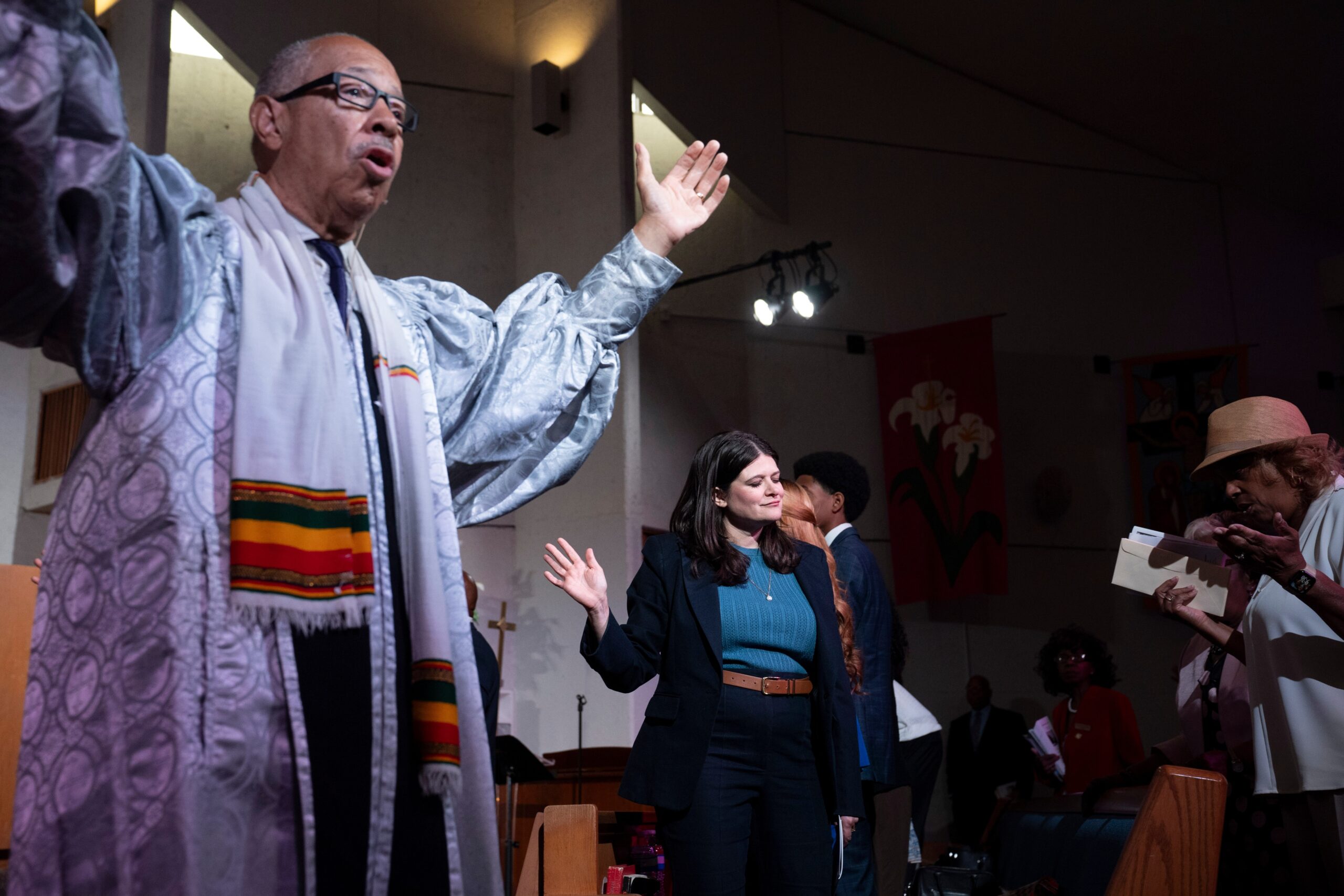
”I’m not offering slogans or false promises. I’m offering a path to win,” Stevens said outside Plymouth United Church, a Black congregation in Detroit where she sang hymnals and danced.
“We can’t just be fighting for the sake of fighting,” she said.
From a pew in the back, business owner Jai-Lee Dearing, 53, said the economy and politics are “the worst I’ve ever seen it.”
“There’s a sense of hopelessness. There’s no way out. We have a president who cares more about himself and his family than mine,” Dearing said, adding he had no issues with El-Sayed but wanted a senator who had already learned how Washington works, and he liked Stevens’ record of accomplishment.
“We just need to have someone who can hit the ground running,” he said.
Georgia Johnson, 75, stopped Haley outside the church to tell her “every time we see your face, I know there is hope.” Johnson said her choice was simple: “I’ve heard nothing but good about her on television, especially from President Obama. He is the stamp of approval for my vote.”
Detroit Councilman Scott Benson, who described himself as an “unapologetically centrist, moderate Democrat” backing Stevens, stopped Thoris Marie Walton, 82, after the service to ask who she’d picked.
”Who did you think I voted for?” Walton retorted, saying she picked Stevens. “I didn’t need anyone to tell me. I’ve been watching.”
Benson said the progressives’ message they want to upend or reform or burn down the system is frustrating to a lot of Black people who see the critique as coming “from a place of privilege.”
“It’s easy to yell and scream and fight,” he said. “My community, the system has never favored us. And we found a way to make opportunity within it.”
At an El-Sayed event later that afternoon, Detroit Councilman Denzel McCampbell called that an outdated perception.
“The system is irreparable, and I would rather be in a place where our folks don’t have to fight day in, day out,” McCampbell said. “We are tired of fighting. We are tired of asking for what we already expect from our government.”
Stevens has rolled out a policy plan aimed at investing in Black communities and said she’s attuned to voters, having seen people break down in grocery stores over the cost of food.
“Voters have every right to feel frustrated,” Stevens said. “Things that should have changed, haven’t.”
After a recent El-Sayed rally in Ferndale, Elouise Sirleaf, a Black community organizer with Michigan United, said she gets annoyed every time she hears Stevens talk about her work on the auto rescue, which saved 200,000 auto jobs but did not stem the foreclosure crisis.
“I lost my house. We lost entire neighborhoods, but the corporations were bailed out,” Sirleaf said. “This is what we’re looking for in candidates today: where’s the humanity versus the corporation?”
Leslie Mathews, who works with Sirleaf, interjected: “Please tell me, and I’m being kind: What has Haley done for the African American community?” Mathews said. “Has Haley Stevens talked about money in politics? She hasn’t said a mumbling word.”
Mathews said she met El-Sayed during his failed bid for governor in 2018, when he asked for her support.
“I said, ‘Absolutely not. I don’t know you,’” Mathews said. But he also asked her to take a walk with him and discussed his views about economic insecurity and the need for healing in politics. (He wrote a 2020 book “Healing Politics” that elaborates on those themes.)
“If Abdul doesn’t get in, Michigan loses,” she said, adding she would never vote for Stevens, even against a Republican.
Read more Amid a democratic socialist surge, the DSA asks itself: What’s next?