Ninety percent of his nominations have gone to political supporters rather than career diplomats, even as dozens of embassies lack envoys, The Post found.
Read more Senate Democrats probe Korean firm’s $2 million payment to Trump company
The position of U.S. ambassador to Egypt has been held by a career diplomat for decades. But in June the Trump administration proposed a change, nominating a political donor and lawyer who provided legal representation to rioters who attacked the U.S. Capitol on Jan. 6, 2021.
Nick Oberheiden, 48, has no formal diplomatic experience. Born in Germany, he has no public link to Egypt, either. However, his law firm has defended clients aligned with the administration, and he has donated roughly $1.3 million to political committees that have supported President Donald Trump’s reelection, according to a Washington Post analysis of ambassador nominations and campaign finance data.
The nomination illustrates how Trump — more than any president in recent history — is relying on wealthy donors and political loyalists to fill ambassadorships at U.S. embassies worldwide, The Post’s analysis showed. It comes as the president has overseen a broader shake-up at the State Department, marking a shift away from apolitical norms that have guided American foreign policy for decades, former diplomats and other observers say.
Oberheiden did not respond to a request for comment, and as of Wednesday the State Department had not published a certificate of competency for him. Such documents are provided to Congress to explain an individual’s suitability for the role to which they’ve been nominated.
The Dallas-based lawyer, whose clients often are involved in federal investigations, told D Magazine last year that he would “love to serve as a diplomat and make a difference in peace negotiations.” He’s made deep connections in Republican politics: Mike Pompeo, secretary of state in Trump’s first administration, is listed as an affiliated lawyer on the website of Oberheiden’s firm, and his social media pages show him interacting with the president, his family and other senior administration officials.
When asked about Trump’s turn toward political donors for jobs typically held by career diplomats, Anna Kelly, a White House spokeswoman, praised the president’s foreign policy team and asserted in a written statement that “all of his Ambassadors are extraordinarily well-qualified and [have] played an important role in advancing the America First agenda.”
Kelly did not address specific questions about Oberheiden or other donors nominated for ambassadorships.
Dating to his first term as president, Trump has taken a disruptive approach to managing America’s global interests and viewed some career diplomats as part of an adversarial “deep state” bent on impeding his foreign policy goals, observers say. He has relied heavily on friends and family, such as real estate magnate Steve Witkoff and son-in-law Jared Kushner, to advance his agenda in the second term.
While presidents of both parties have rewarded some campaign donors with diplomatic postings, often reserving coveted slots for them in Western Europe or the Caribbean, Trump has named far more political nominees to posts traditionally held by career diplomats, The Post’s analysis showed.
John Dinkelman, the AFSA’s president, said that while many political appointees perform well, government personnel with diplomatic experience are being passed over for candidates with political or financial ties to the president.
“There’s a place for the benefactor on the hospital board. The problem comes when the benefactors outnumber the surgeons in the operating room,” said Dinkelman, a former Foreign Service officer who served in Republican and Democratic administrations. He was among hundreds of career diplomats forced out by the Trump administration last year.
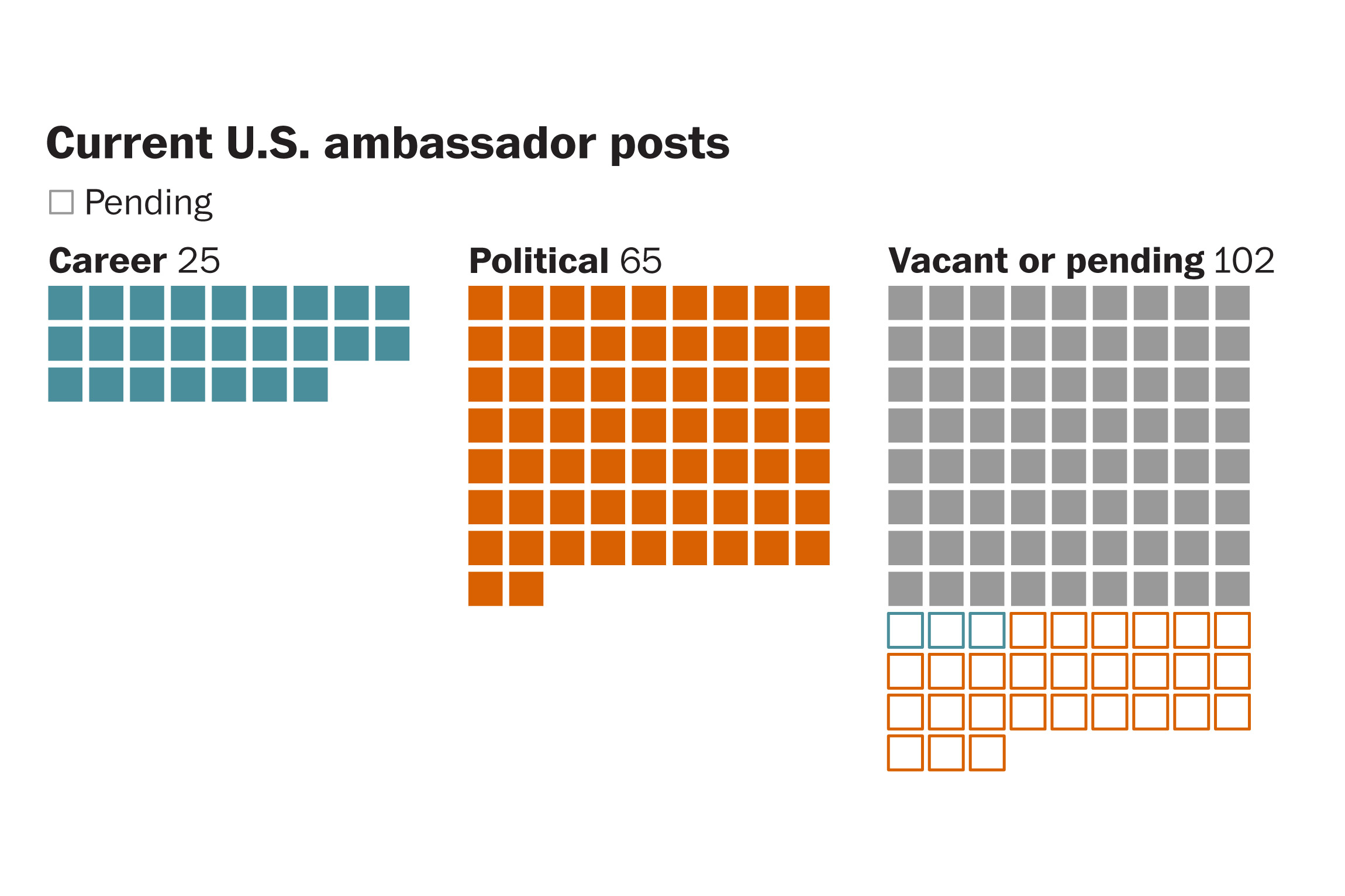
Of the 102 nominees put forward by the administration to fill ambassador positions as of Wednesday, 90 percent are political nominees, according to The Post’s analysis of the AFSA’s data. It’s a significant break with recent precedent. In each administration since President Gerald Ford’s, more than half of all ambassadorships went to career Foreign Service officers.
Under President Joe Biden, career officials accounted for 60 percent of ambassador nominees at this stage of his presidency.
Of about 90 ambassadors now in office, less than a third — 25 — are career diplomats, most left over from the Biden administration, the data showed.
A State Department spokesman, Tommy Pigott, confirmed that the Trump administration is “well on track” to have more political nominations confirmed in its first two years than the Biden administration had in the same period.
If Oberheiden is confirmed for the Egypt post, he would join other donors sent to an embassy long led by career diplomats.
In the Philippines, for instance, the U.S. ambassador is Lee Lipton, owner of Benny’s on the Beach, a restaurant in Palm Beach, Florida. Lipton, a friend of the president and member of his Mar-a-Lago Club, donated roughly $10,000 to Trump-supporting political committees ahead of the 2024 election, The Post’s analysis of campaign finance data showed.
Bernie Navarro, the U.S. ambassador to Peru, is a real estate investment firm executive from Florida who is a friend of and long-standing donor to Secretary of State Marco Rubio.
Navarro, who donated tens of thousands of dollars to other Republican causes during the last election cycle, also made a $1 million donation to Trump’s inaugural committee after his reelection, according to records Navarro provided to Congress.
Read more Justice Department’s $3 billion ‘BIDEN’ grants come with an immigration catch
Manila and Lima have not hosted politically appointed U.S. ambassadors in decades. The last one in Egypt was Richard H. Nolte, a Middle East academic who was nominated by President Lyndon B. Johnson but served only a few weeks before his tenure was cut short by the 1967 war.
Lipton and Navarro did not respond to requests for comment.
While the State Department is required to publish competency certificates for its candidates, critics argue they have become “almost meaningless” in the second Trump administration because the documents “often lack information about the nominee’s relevant experience and instead boast of the person’s business success,” said Kedric Payne, senior director for ethics at the advocacy group Campaign Legal Center.
In response to questions about the competency certifications, the State Department said it was “engaged with the Senate on what they may need to consider nominations.”
Supporters of political appointees say that in some cases, host nations prefer them. Trump has appointed trusted allies such as Tom Barrack and Sergio Gor to key posts in Ankara, Turkey, and New Delhi, respectively, where both have gained reputations for having considerable sway in Washington.
The administration also has said that the business experience of its nominees is a strength.
All ambassadors undergo training before assuming their posts. However, some career diplomats say that this does not compare to decades of expertise and deep knowledge of a nation’s language and society.
“When a coup breaks out or an earthquake hits at 2 a.m., that experience is the difference between a coordinated American response and an improvised one,” Dinkelman said.
In recent years, several donors-turned-ambassadors have been criticized by the State Department’s Office of Inspector General, which has examined allegations of impropriety that range from making insensitive comments and improper spending to damaging relations with their host country.
Sen. Jeanne Shaheen (New Hampshire), the Senate Foreign Relations Committee’s top Democrat, accused the administration of retreating from the world stage by leaving ambassadorial postings vacant. “China has ambassadors in nearly every country it has diplomatic relationships with, advancing its interests at the expense of America’s,” she said in a statement.
A senior State Department official, speaking on the condition of anonymity to discuss internal planning, said the administration intends to amend rules governing senior-level appointments that would allow for the faster promotion of “qualified,” though potentially more junior, career officials.
This change and others would “result in more career ambassadors,” the official said.
Under Rubio, the State Department has laid off hundreds of career officials and dismantled entire offices. Key managerial positions at the agency’s headquarters in Washington are now headed by political appointees with no prior foreign policy experience, some still in their 20s.
But the different approach to America’s ambassadorial positions may be the most public example of how the Trump administration has changed the face of American diplomacy.
About a third of Trump’s noncareer nominees have donated to committees aligned with him since 2023, according to The Post’s analysis. This is similar to the Biden and first Trump administrations, but donors up for ambassadorships now have given far more money — about $35 million total, or more than double the combined donations to Biden and Trump previously, the analysis showed.
More than a dozen appointees have donated at least $1 million since 2023 to committees aligned with Trump, compared with just one during Biden’s presidency and one during Trump’s first term, according to The Post’s analysis. Arkansas businessman Warren Stephens, who was confirmed as ambassador to Britain last year, donated more than $9 million alone to committees supporting Trump in that time frame, the analysis showed.
Other significant donors named to countries that have long been held by career diplomats include real estate mogul and philanthropist Melissa Argyros, who gave more than $2 million to pro-Trump committees, according to The Post’s analysis of federal campaign data. Argyros now serves as U.S. ambassador to Latvia, the first political appointee there since the George W. Bush administration.
Pigott, the State Department spokesman, called any suggestion that Trump has awarded ambassadorships based on political donations “a lazy, recycled narrative.”
“Unlike the politicians of the past, he isn’t bought by anyone,” Pigott said.
The oversize role of campaign funding in the United States makes it unlikely that Congress will challenge the issue, said Scoville, the Marquette professor. “At least in some of these cases, the very individuals who are making donations to the president are also making donations to senators,” he said.
About the data
Data on ambassador nominations comes from the American Foreign Service Association, a nonpartisan professional organization and labor union, and includes information spanning the last 10 presidential administrations. The Post’s analysis also includes contributions data reported to the Federal Election Commission by political committees and inaugural committees. Contribution dates range from Jan. 1 of the year before a president’s election until June 30 of that president’s midterm year. The Post hand-verified FEC contributions from ambassador nominees by cross-referencing occupations and addresses.
Read more Trump tells donors, ‘We need to elect JD,’ as vice president weighs his future