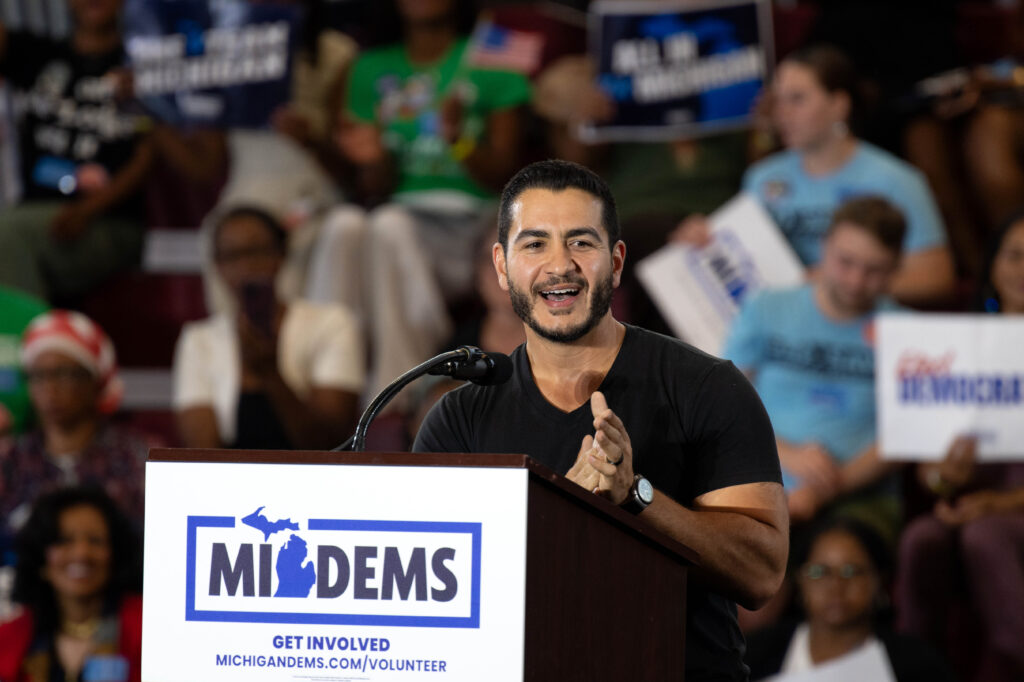
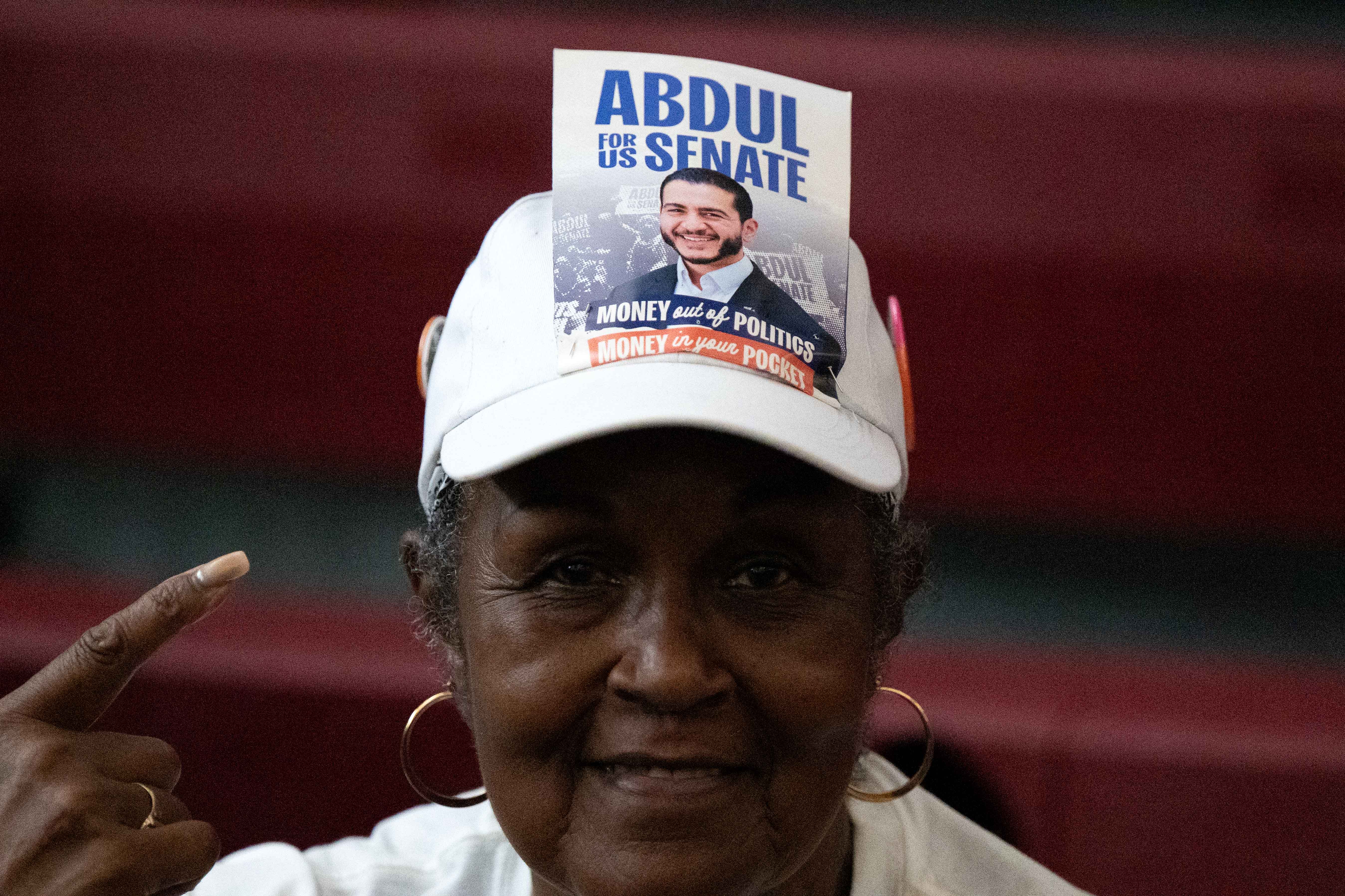
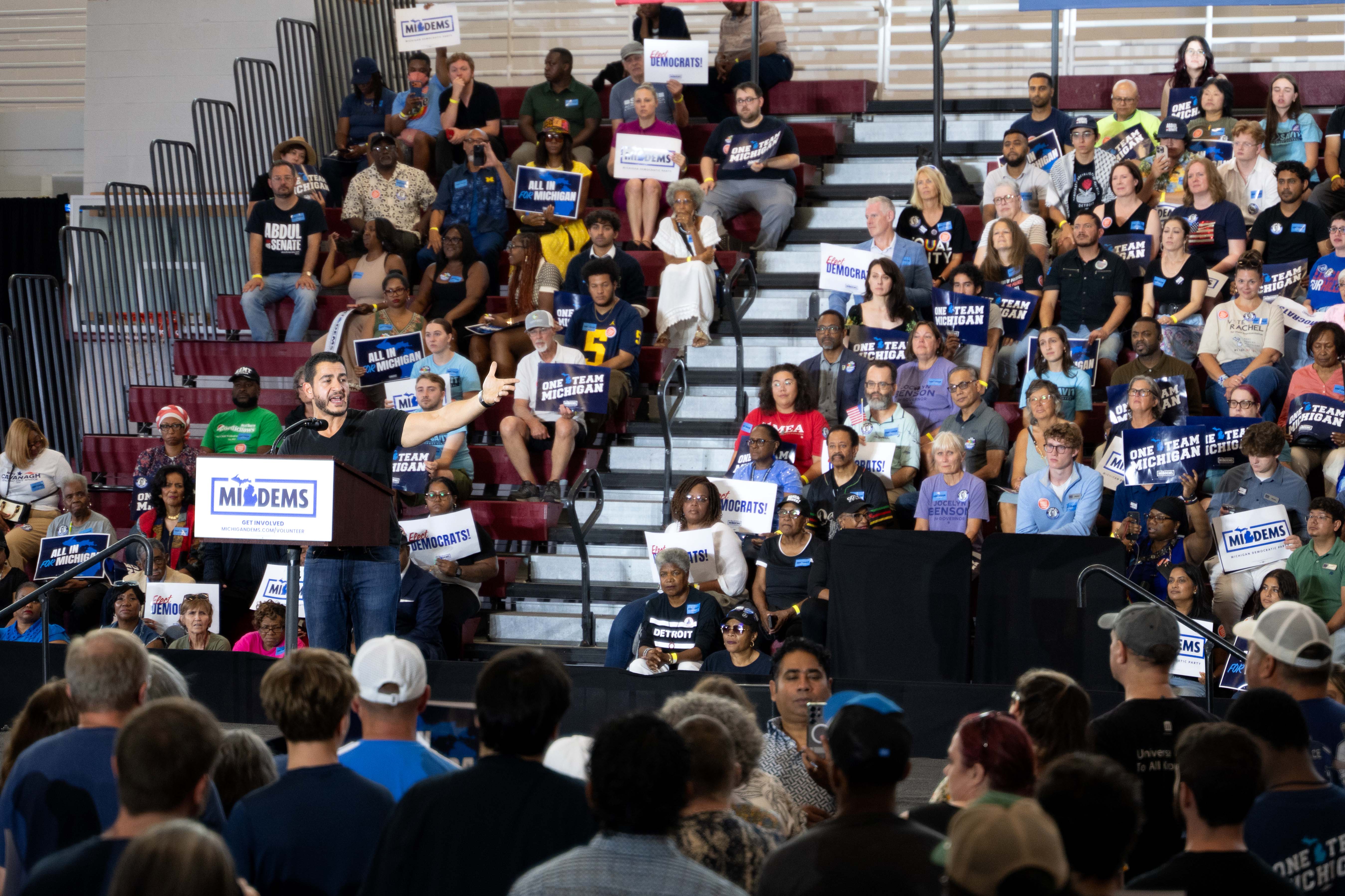
DETROIT — Battleground Senate candidate Abdul El-Sayed bounded onto the stage and raised his arms to the loudest cheers of the night at a Michigan Democrats rally on Friday, electrifying the crowd as he reiterated several pillars of his populist campaign: Medicare-for-all, getting corporate money out of politics and taxing the rich.
Read more Window closes for Ohio GOP to replace Rep. Max Miller on the ballot
But what he didn’t say before the 1,300-person crowd stood out. El-Sayed didn’t mention Israel, or the pro-Israel lobby that spent tens of millions of dollars to defeat him. He also didn’t rail against the Democratic establishment that stood against him in the contentious primary he won Tuesday.
Instead, he struck a more conciliatory note as he campaigned at a rally alongside other Democratic statewide candidates and former transportation secretary Pete Buttigieg. After trading barbs for months, he called his former opponents, Rep. Haley Stevens and state lawmaker Mallory McMorrow, “incredible public servants.”
El-Sayed is adopting this gentler tone as he faces the challenges of healing the wounds left by a bruising primary campaign and wooing Democrats who backed Stevens to support him in the general election, which is expected to be among the most competitive Senate races in November.
“He needs to bridge the gap between the Stevens crowd and his crowd, and bring all Democrats together, and not get mired down in some very contentious issues,” said Matt Johnson, 73, a retired college professor and Stevens voter from the Detroit suburb of Birmingham, who attended the rally on Friday.
El-Sayed defeated Stevens by one percentage point, a remarkable victory for a candidate who was drastically outspent. But it was not the trouncing his supporters had hoped for, and the narrow win instead showed the work cut out for him to shore up support among Black, older and suburban voters who favored Stevens.
The Michigan Democratic Jewish Caucus, in a statement released after the primary in which El-Sayed harshly criticized Israel and its backers, said he needs to “address the harm caused during this campaign” and “commit to engaging directly with Michigan’s Jewish community.”
In interviews with more than a dozen Black voters across Detroit, most said El-Sayed needed to do more outreach to their communities. Some of his fiercest Democratic critics also did not appear at the rally and have endorsed his candidacy only tepidly or indirectly. Rep. Hillary Scholten, who before the primary refused to commit to supporting El-Sayed if he became the nominee, released a statement that called for a “forward” focus but did not name him.
Holding on to the U.S. Senate seat being vacated by retiring Sen. Gary Peters (D) is crucial for Democrats to win control of the chamber. For the most part, mainstream Democratic elected officials are lining up behind El-Sayed, even after he led a campaign sharply critical of them and their donors.
He spoke with Chuck Schumer (New York), the Senate Democratic leader who backed Stevens in the primary and whom El-Sayed has criticized, about how to work together and win in November, according to Schumer. The Senate Democrats’ campaign arm is already airing advertisements backing his candidacy. Former vice president Kamala Harris sent out a fundraising email on El-Sayed’s behalf the day after the primary. Michigan Gov. Gretchen Whitmer (D), who backed Stevens, also announced her support for his candidacy.
And Stevens and McMorrow swiftly and enthusiastically endorsed El-Sayed’s candidacy. McMorrow, who dropped out in July, said in a news conference alongside him on Wednesday that Republicans are hoping Democrats “retain” their “family fights” through the general election.
On Wednesday, shortly after the race was called, Stevens, who harshly criticized El-Sayed during the campaign’s closing stages, announced her “full support” for him. She also introduced El-Sayed at a private breakfast hosted by the Michigan Democratic Party on Thursday.
In an interview Friday, Stevens said she plans to be active in campaigning for El-Sayed and other Democrats in the general election.
“I just said, hey, whatever you guys want,” Stevens said in an interview. “If you need me, great, and if not, I’m just here, and I’m happy to be here.”
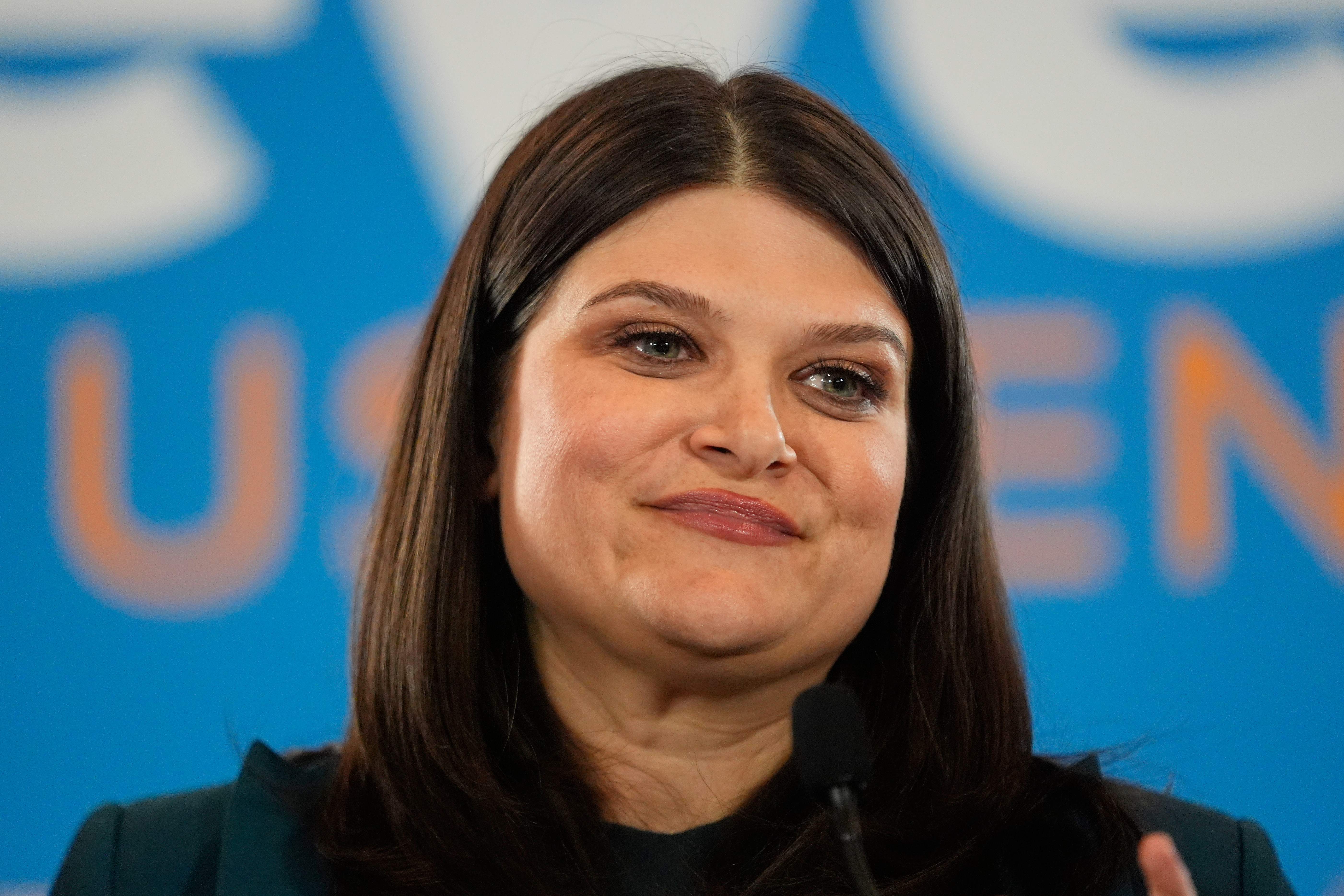
Before and after the conversation at a Southern restaurant in Detroit’s New Center, while walking around, Stevens stopped many people on the streets, hugged several and enthusiastically encouraged them to support El-Sayed and the rest of the Democratic ticket, describing him as a “great candidate.”
Republicans, meanwhile, are trying to recruit disgruntled former backers of Stevens, particularly those who view him as too far left.
Mike Rogers, a former congressman who ran uncontested to become the Republican Senate nominee, made direct and bipartisan overtures to Democrats, saying in a video on X that “the fight is far greater than just left versus right.”
“If you’re among the majority of Democratic voters that woke up on Wednesday feeling, well, hopeless, because the person who won does not represent your values, well, just know there is still hope,” said Rogers, who narrowly lost a 2024 bid for Senate in Michigan.
Many in El-Sayed’s corner have urged him against moderating his rhetoric before the general election.
El-Sayed’s messaging worked to win him the primary, and he doesn’t need to change it now, said Tresure Lott, an El-Sayed supporter and community activist. “It’s more about what Democrats need to do to be more unified with us,” she said in an interview in Royal Oak, a Detroit suburb.
Roxie Richner, a spokeswoman for El-Sayed, said the campaign is bringing together a broad coalition with more than 500 public events so far.
Read more Group urges Democrats to woo moderate voters with populist policies
“Abdul has built a public service record delivering for Michiganders in Detroit and Wayne County, and he’ll continue the essential work of showing up, listening, and welcoming every Michigander into this movement as he works to earn every vote,” Richner said in a statement.
The Michigan electorate is about 13 percent Black, and African Americans are key to powering Democratic victories in statewide elections. Stevens had an eight-point edge in the counties with the highest Black populations, according to a Washington Post analysis of election and demographic data.
Several Black residents interviewed in Detroit, a majority-Black city that Stevens won by 28 percentage points in the primary, said that they felt like they haven’t heard from or seen El-Sayed enough in their community.
“I’m not familiar with you enough, and I don’t even know that you even care about Black issues at all,” said Tamara Harris, a 55-year-old insurance adviser.
David Billingslea, a resident of the Detroit suburb of Ferndale who supported El-Sayed in the primary, said the new nominee can boost his chances by coming to Detroit and “talking to Black folks.”
Stevens, when asked in the interview if El-Sayed should do anything differently in the general election to gain some of her voters’ support, said that she had “told him I had some Black-owned businesses that maybe he’d want to go talk to.”
During the primary campaign, El-Sayed, a former top public health official in the Detroit area, attended many Sunday services at Michigan churches and received the support of some Black religious and community leaders, though significantly less than Stevens. He also sought to speak with older Black voters in Detroit, visiting numerous senior centers and speaking with voters.
El-Sayed, who frequently criticized Israel and the American Israel Public Affairs Committee during the primary, may also face challenges with Michigan’s Jewish community, which has historically backed Democrats. Jewish adults make up 1.4 percent of the Michigan electorate, according to the American Jewish Population Project, but small groups can sway closely decided elections.
Dennis Bernard, a past president of the Jewish Federation of Detroit and the national chair of government relations for the Jewish Federations of North America, predicted that many in Michigan’s Jewish community will support Rogers, the Republican nominee, in the general election or sit it out.
Bernard, a self-described independent who voted for Stevens in the primary, said he would support Rogers, describing El-Sayed as “a threat to our community” due to his criticisms of Israel.
Some Jewish voters, particularly in the younger generations, are not supportive of the Israeli government, and many nationally have voted for Democratic candidates critical of Israel. However, many have harder feelings about El-Sayed because of how he has focused on calling Israel’s actions in Gaza a genocide and fixated on AIPAC’s spending on behalf of Stevens.
Several Jewish community members, in interviews, criticized El-Sayed’s comments after a March attack on Temple Israel in a Detroit suburb by a Lebanese-born American, who was reportedly mourning relatives killed by an Israeli airstrike. At the time, El-Sayed said that “hurt people hurt people” and called for peace to end a cycle of violence. Although he stressed that the attack was “heinous” and unjustified, his critics said his comments were rationalizing the attacker’s motivations.
During the campaign, El-Sayed repeatedly condemned antisemitism and sought to separate it from criticism of Israel. As evidence he isn’t singling out Israel, he frequently notes that he opposes military aid to his parents’ native Egypt.
President Donald Trump also piled on with criticism of El-Sayed on Wednesday at a rally in Las Vegas, calling him a “man of hate” and saying that the Democrat “hates” Jewish people “with a passion that burns in his heart.”
Aaron Starr, a rabbi in Southfield, Michigan, and president of the state board of rabbis, called El-Sayed “complicit in speaking language of hatred and division” and said his focus on AIPAC is “clearly an antisemitic dog whistle.” The vast majority of his congregants are concerned about the way El-Sayed speaks about Israel and AIPAC, he said, and he has heard some voice displeasure with Stevens for her quick endorsement.
In his victory speech, El-Sayed said his “commitment to Jewish safety is the same commitment that I have to the safety of my own daughters” — a remark that Starr said he “really appreciates” and “means a lot.”
Hasan Piker, a popular left-wing streamer and fierce critic of Israel who has campaigned with El-Sayed, said on a recent live stream that El-Sayed does not owe other Democrats after they treated him poorly during the primary. Questions about whether El-Sayed can unite Democrats are just asking whether he can win over supporters of Israel, Piker said.
El-Sayed has rebuffed calls to stop campaigning with Piker. But he seems more inclined than Piker to reconcile with his former opponents.
“Obviously he’s got his perspective on it, and he’s welcome to his perspective. It’s not mine,” El-Sayed said in an interview with MS NOW’s Jacob Soboroff on Wednesday night. “My perspective on it is that you have to ask for every vote.”
Read more Hunter Biden opens up about his pardon and Joe Biden’s cancer
Theodoric Meyer contributed to this report.