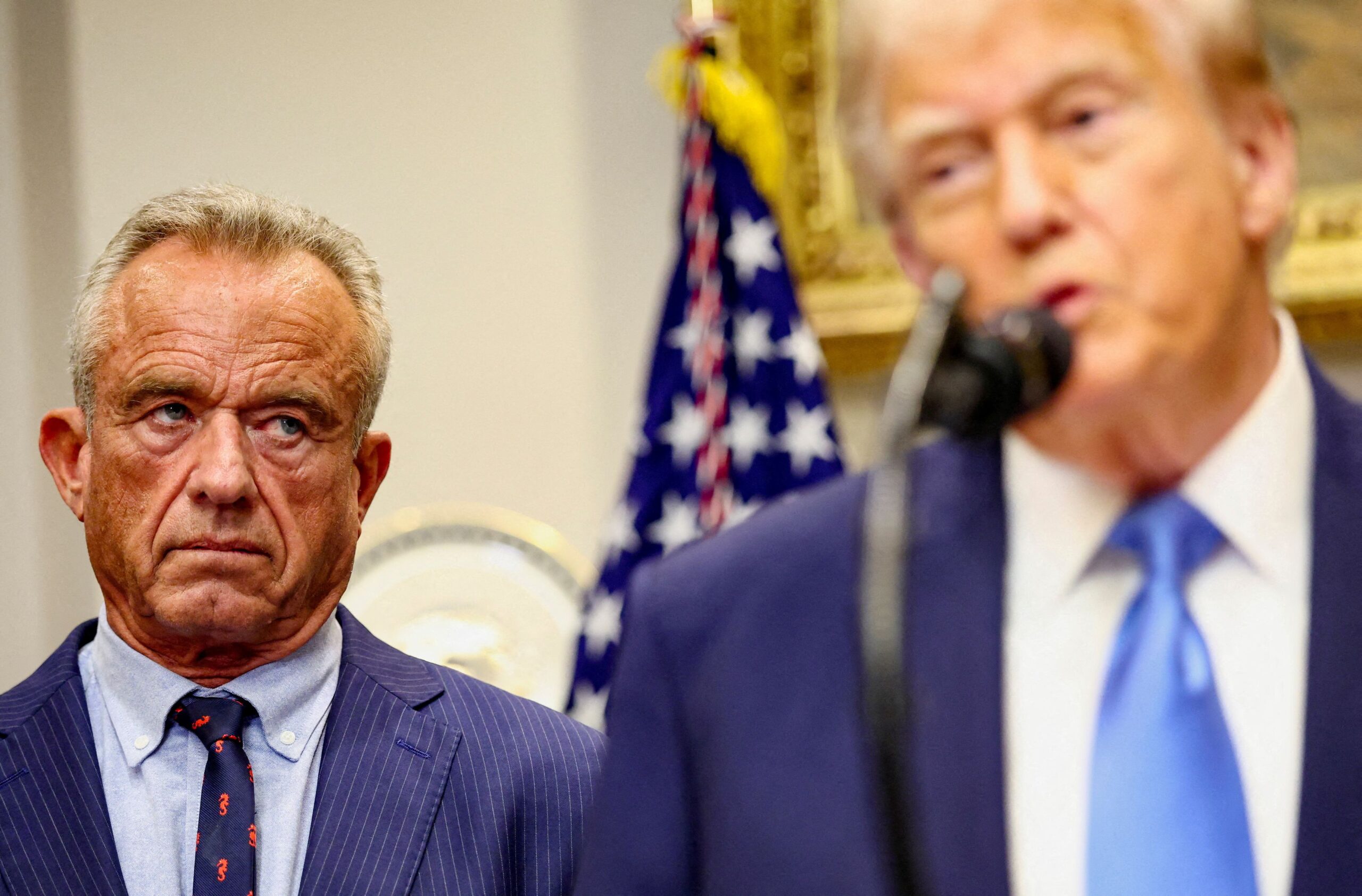
The president signed an order instructing states to revise their rules. He also called for narrowing which vaccines are administered to children and splitting shots into multiple appointments.
Read more Nationals ride their bullpen to a sweep-clinching rout of the Reds
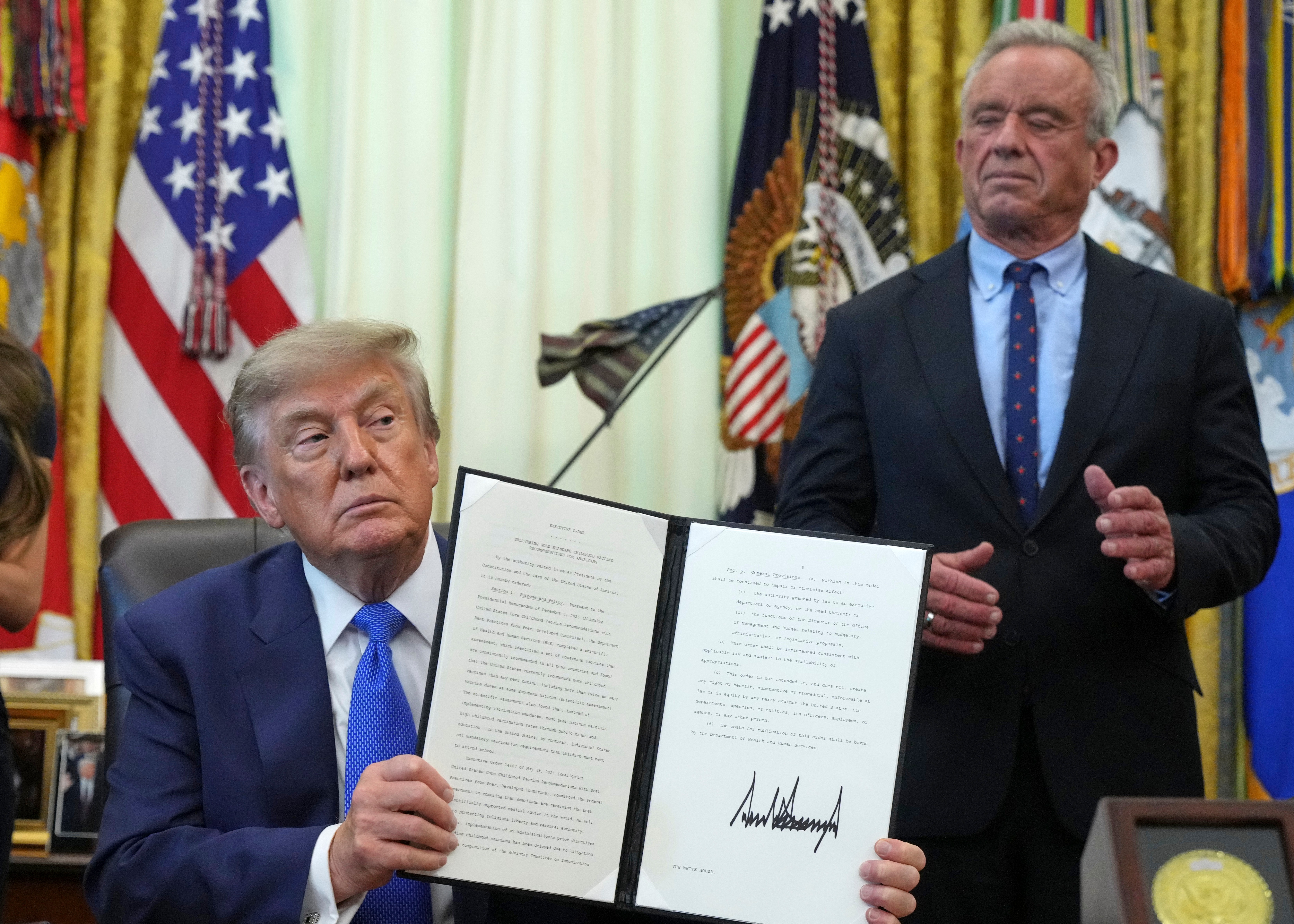
President Donald Trump on Monday made his most significant attempt yet to reshape how Americans vaccinate their children, signing an executive order that called for cutting the number of recommended childhood vaccines, spacing out those shots and making other changes that would upend decades of federal guidance.
Speaking in the Oval Office, the president reiterated his long-held claim that childhood vaccines have led to a rise in U.S. autism cases, an idea that outside researchers have largely debunked. Trump also mused on the current number of childhood vaccines and said reducing their frequency was “common sense.”
“Large amounts — like vats — of vaccine are currently pumped into your child’s body,” Trump said in the Oval Office, flanked by Health Secretary Robert F. Kennedy Jr. and other administration officials.
In reality, the volume in most vaccines is about half a cc — roughly one-tenth of a teaspoon of liquid, said Andrew Racine, president of the American Academy of Pediatrics.
The president’s plan was immediately criticized by scientists, physicians, Democrats and some congressional Republicans, who said the order was dangerous and warned that it could lead to fewer children receiving vaccines against preventable diseases.
They also said that Trump’s comments were unscientific and leaned on discredited theories.
The order puts new pressure on states, health insurers, pharmaceutical companies and medical professional to align with the president’s approach to vaccines or continue a growing trend to break with federal guidance.
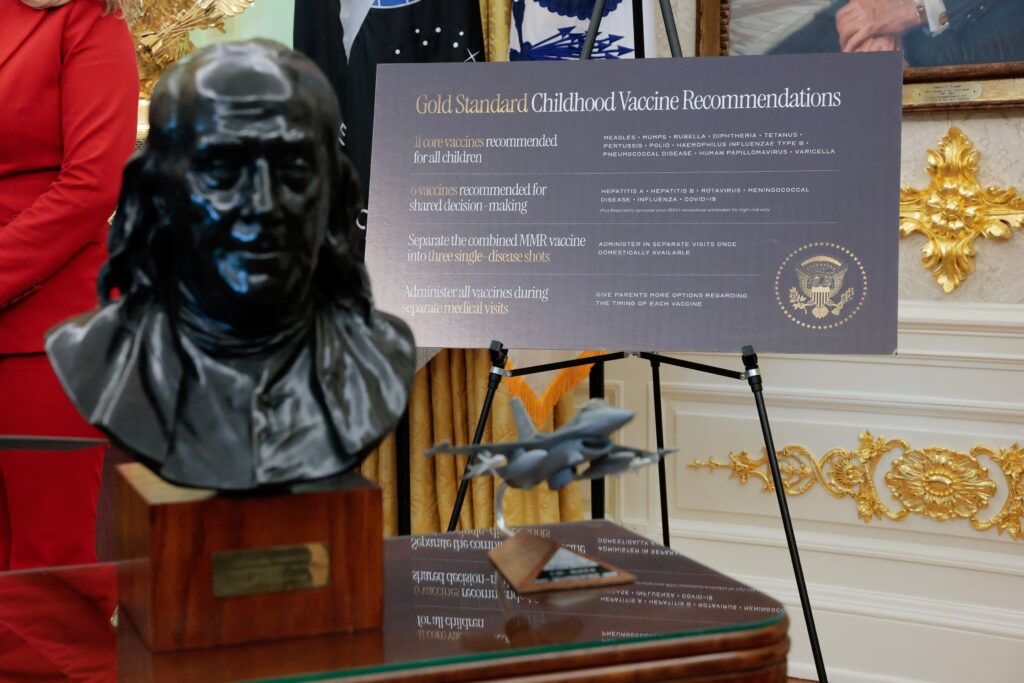
Under Trump’s plan, vaccines against 11 diseases — including measles, mumps, rubella, polio and whooping cough — would be recommended for all children, down from 18 diseases under the current childhood vaccine schedule. Trump’s order also calls for breaking up the combined measles, mumps and rubella vaccine into three separate shots, among other changes intended to space out immunizations.
Trump claimed that his administration’s recommendations would cut the amount of vaccine administered to children to one-fifth of the level that they currently receive at a given medical visit. He also said he adopted a similar schedule when vaccinating his own children, even though it meant more trips to medical offices.
“It’s inconvenient, it’s five stops, but it’s something that I think will have a huge impact on autism,” the president said.
The order represents Trump’s latest attempt to revamp long-standing vaccine recommendations, breaking with decades of White House deference to scientific experts and past presidents who celebrated how vaccines have reduced the threat of polio, measles and other diseases that menaced children.
Trump’s plans have been hailed by some conservative Republicans and supporters of the Make America Healthy Again movement that helped Trump recapture the White House in 2024.
But his vaccine agenda has been broadly panned by Democrats and independents. Several Senate Republicans and some of the president’s own political advisers have urged Trump to abandon his efforts. Polls have also found that trust in U.S. health agencies, which declined during the coronavirus pandemic, has fallen further under Trump.
Outside medical groups have warned that Trump’s changes could backfire by leaving children more exposed to diseases such as measles. Physicians and scientists have said that the single MMR shot is proved to be safe and effective and that breaking it up could leave children vulnerable to dangerous diseases for longer.
“I’m not sure that there is anything that has been as thoroughly looked at as this question about whether or not there is a link between autism and vaccines. And the answer is unequivocally no,” said Racine, a pediatrician who has been treating children for more than 40 years.
The order’s practical effect is uncertain. States, rather than the federal government, generally set vaccination requirements for children attending school. Many states have already said they no longer follow vaccine recommendations from the federal government and instead follow those from the American Academy of Pediatrics and other major medical organizations.
Medical experts, health care organizations, most Democratic officials and some Republicans, however, said that, at minimum, the new White House guidance would create confusion for parents and doctors.
“I’m a doctor. This executive order is wrong,” Sen. Bill Cassidy (R-Louisiana), the chairman of the Senate Health Committee, wrote on X. “The President does not have the expertise to make these changes. Vaccines are overwhelmingly safe. Vaccines are effective. Vaccines DO NOT cause autism. Breaking up vaccines will mean children have to get more shots to get the same protection.”
Under the order, dubbed “Gold Standard Childhood Vaccine Recommendations,” the White House divides vaccines into three categories and directs federal agencies to take steps to advance them. It also calls for rethinking the long-standing practice of grouping vaccines to reduce the number of medical appointments parents of small children need to schedule.
Vaccines against several other diseases, including hepatitis A and B and meningococcal disease, would be recommended for certain high-risk groups or through shared decision-making between parents and doctors. Influenza and coronavirus vaccines would also fall into the shared decision-making category.
White House officials told reporters on Monday that they believed health insurers would continue to cover recommended vaccines.
That push to split up the MMR vaccine would diverge from the practices of several peer nations the administration has cited as models for U.S. vaccine policy. Denmark, Australia and Canada administer measles, mumps and rubella immunizations in combination vaccines. Britain this year began replacing the MMR shot with a four-in-one vaccine that also protects against chicken pox.
Read more Trump picks longtime aide Will Scharf as new top White House lawyer
“The executive order makes the repeated argument that the U.S. should align with what I see as handpicked peer nations, and yet those handpicked peers that we should be following give MMR together,” said David Higgins, a pediatrician and an assistant professor of pediatrics at the University of Colorado Anschutz Medical Campus.
There are also manufacturing and logistical challenges that would come with breaking up the combination shot into its individual components, which are not currently available in the United States, industry experts have said. There’s no indication that vaccine companies “have any interest in making the investment or time,” Racine told reporters.
In a statement, Merck, one of the manufacturers of the current MMR vaccine, said combination vaccines make children more likely to receive all their recommended shots on schedule.
“To date, there has been no published scientific evidence that shows any benefit in separating the combination MMR vaccine into three individual shots,” the company said. “Use of the individual components of combination vaccines increases the number of injections for the individual and may result in delayed or missed immunizations.”
Breaking up the MMR vaccine could also mean more shots and more trips to the pediatrician for parents trying to keep their children fully vaccinated.
Pressed on his claim Monday that the current MMR vaccine could be “lethal,” Trump admitted that he had no scientific proof for that claim.
“What I’ve heard is that there are some people that say it is that way, and I say, ‘Well, let’s say there’s a 5 percent chance of it; let’s split it up,’” Trump said.
The call to break up the MMR vaccine comes as the United States is experiencing its worst year for measles in 35 years.
Trump has pushed officials to take additional steps to overhaul the childhood vaccine schedule, citing his concerns about a debunked link between childhood vaccines and autism, The Washington Post reported last week.
Medical associations and public health advocates and experts have condemned the revisions to the childhood immunization schedule, arguing they endanger children and are built on faulty assumptions. Comparisons to other countries can be misleading because nations differ sharply in population, access to universal health care and disease burdens, they note.
In January, the administration moved to reduce the number of vaccines routinely recommended for all children, bypassing the government’s traditional process for changing the schedule.
A federal judge in March blocked the administration from implementing those changes, siding with major medical organizations that argued Kennedy had unlawfully changed vaccine policy and improperly reconstituted the federal panel of outside experts that advises the government on vaccines.
The order explicitly acknowledges that the administration’s earlier vaccine directives have been “delayed due to litigation” and instructs federal agencies to advance the new recommendations “to the fullest extent allowable by law.”
Under the order, the White House is calling for proposed changes to come within 90 days from the health department’s Task Force on Safer Childhood Vaccines — a long-defunct panel resurrected last year to the cheers of anti-vaccine activists. The task force should “assess the ideal timing and sequencing of all core childhood vaccines” and adjust the childhood schedule “as appropriate,” the document says.
It also calls for the development of more alternative adjuvants to aluminum. Adjuvants are ingredients added to vaccines that help the body produce an immune response to offer protection from diseases.
Some high-level Food and Drug Administration officials last year believed it would be infeasible to take aluminum adjuvants out of vaccines and couldn’t be done on a practical timeline.
The order also advises states to “consider updating relevant laws and regulations” regarding school vaccine requirements.
Whether states will do so remains to be seen. Several statutes place vaccine recommendations under the authority of the Centers for Disease Control and Prevention and its independent vaccine advisory panel, said Dorit Reiss, a professor at the University of California College of the Law at San Francisco, whose research focuses on public health law.
“The president can instruct them to consider this, but an E.O. is not a substitute to the congressional process,” Reiss said.
The order also opens another potential legal front over state vaccination requirements. It directs the Justice Department to pursue what it calls “meritorious” legal challenges to state laws involving parental authority and religious and medical exemptions. That is likely to create additional confusion over which schedule doctors and families should follow, pediatricians said.
It could also put political pressure on Republican-led states to remove vaccines from school requirements, Reiss said.
“Even if that’s not legally sound, the potentially chilling effect on states and organizations who deliver vaccines is great,” said Higgins, the University of Colorado assistant professor. “It’s real.”
Read more Alexandria Ocasio-Cortez says she’s freezing her eggs