For more than a decade, the Democratic Party has defined itself by its opposition to Donald Trump and everything for which he stands.
Read more Trump joins leaders of crypto companies in push for industry-backed bill
Midterm elections almost always are referendums on the president and the party in power. But this year’s election season is providing mounting evidence that although Democratic animosity toward Trump is a given, it is no longer sufficient to hold the party together as it did during 2018’s off-year contests.
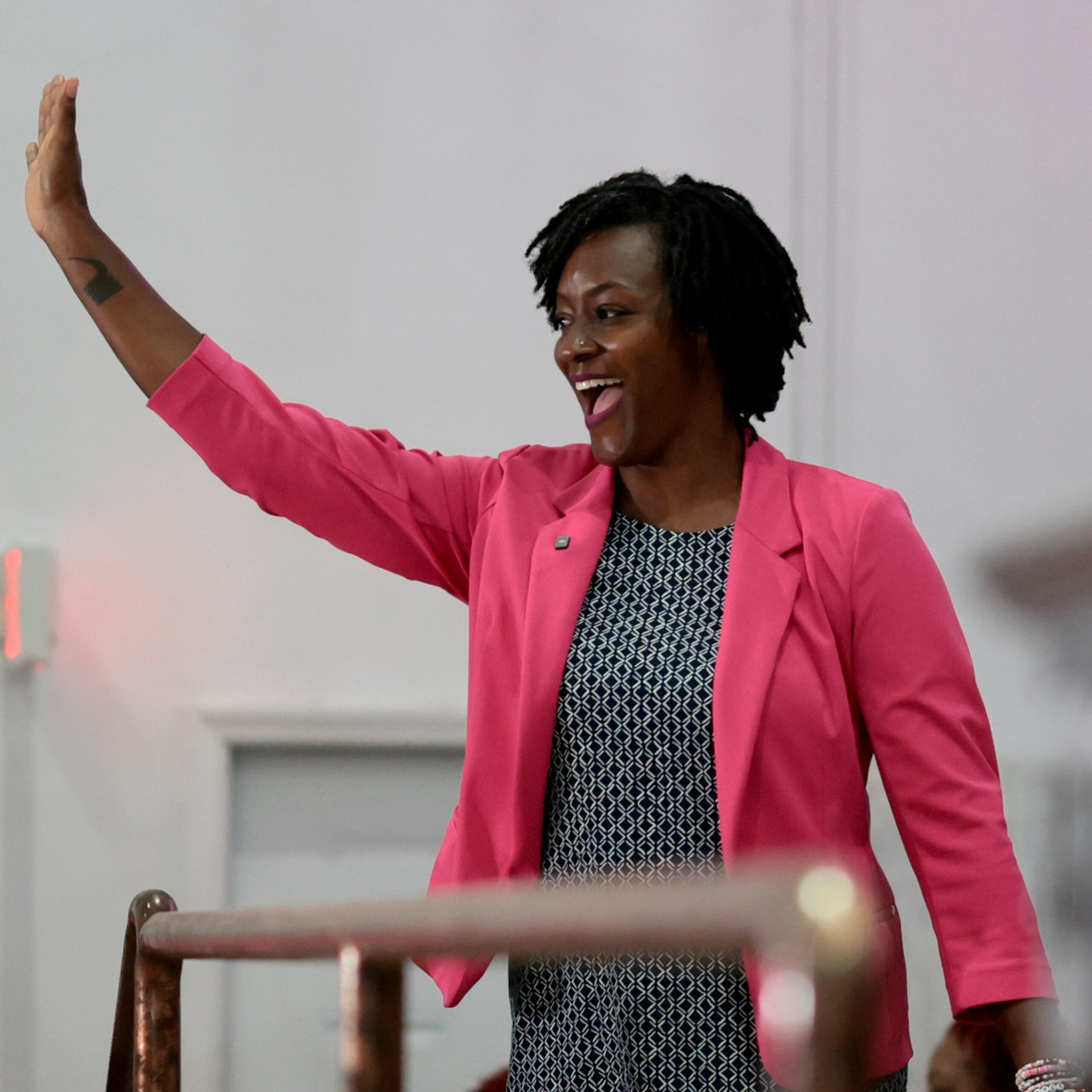
Florida’s Democratic Senate primary on Tuesday was the latest example: A folk hero of the Trump resistance, former Trump National Security Council aide Alexander Vindman, was trounced by state Rep. Angie Nixon, who joined the Democratic Socialists of America a few weeks before the election.
Vindman was a key witness during Trump’s 2019 impeachment, testifying that he had been on a phone call in which the then-president had pressured Ukrainian President Volodymyr Zelensky to investigate rival Joe Biden and his family.
Vindman campaigned as a champion of democracy and had the backing of the Democratic establishment, as well as a $16 million war chest that dwarfed the less than $1 million that Nixon raised. But Vindman, by many accounts, proved a lackluster candidate who didn’t take his opponent seriously.
Nixon, meanwhile, had earned her combat stripes in Tallahassee, the state capital, and Jacksonville, her north Florida district.
She spent almost six years in the legislature opposing the agenda of Florida’s Republican governor, Ron DeSantis. In May, she was arrested while staging a five-hour sit-in in the governor’s office against the GOP’s mid-decade redistricting process, which gave Republicans a leg up in four additional House races. Earlier, she had preempted a vote on that map by marching onto the House floor with a hot-pink bullhorn and shouting: “This is a violation of the Constitution.”
Nixon, campaigning under the slogan “Change can’t wait,” has also turned her fire on her own party. “Floridians don’t want the establishment in Washington, D.C., deciding who their Democratic nominee and U.S. senator is going to be,” she told the Tampa Bay Times.
Vindman’s loss, by double digits, follows the primary defeats of other Democrats who had positioned themselves at the vanguard of the Trump resistance.
Read more United States debt surpasses $40 trillion
They include Rep. Dan Goldman (New York), who had gained national prominence as the House Intelligence Committee’s lead counsel in Trump’s first impeachment trial, and Rep. Diana DeGette (Colorado), who had been an impeachment manager at Trump’s second trial before the Senate, in 2021, after the Jan. 6 attack by his supporters on the U.S. Capitol.
Reps. Al Green (Texas) and Shri Thanedar (Michigan), both of whom had introduced impeachment articles during Trump’s second term, also lost their primaries. And lawyer George Conway, a former Republican who became one of the president’s most prominent antagonists on cable news, placed fifth in a crowded primary for an open New York City seat, getting barely 6 percent of the vote.
It is understandable that Democrats would be disillusioned with what their party has been doing to thwart Trump. “We are at a point where, like Woke 1.0, Resistance 1.0 is also dead. Donald Trump was impeached twice, and he’s president again,” said Tré Easton, vice president for public policy at the Searchlight Institute, a Democratic think tank. “People want more from the Democrats.”
So voters are moving on, even if many of their candidates haven’t.
The challenge moving forward is how Democrats confront the new forces that are emerging within their party. Should they once again gain control of at least one house of Congress in November, as seems likely, they will have to offer at least a semblance of a governing agenda.
But the bigger test will come as they turn their attention to the presidential contest of 2028, and a political future that will unfold beyond Trump’s time in office.
It could well be a contentious exercise. And the standard-bearer who emerges will probably be the one who can demonstrate an effective way to redefine what the party stands for while also creating a broad space in which the various factions of the party can feel comfortable.
“We are overdue for it,” Easton said, predicting that the 2028 nominee will be picked by “a Democratic primary electorate that really wants to define itself not by what it is against, but by what it is for.”
Read more What it means that Democrats are winning special elections in Trump country