Median Strategies, a fake polling firm, claimed it was a “social experiment.” The fraudulent poll received some attention but was shunned by mainstream poll aggregators and exposed by a reporter.
Read more Democrats’ view of Trump’s first term improves in retrospect, poll finds
Welcome to The Pollwatcher and thanks for joining me. In addition to helping you make sense of what Americans think and which polls are worth your attention, I want this to be a place where you can ask questions about how polls work. Send me an email and let me know what’s on your mind: [email protected].
The Los Angeles Times landed a big polling scoop Tuesday:
The fake polling firm fessed up after L.A. Times inquiries, posting a statement saying “Median Strategies was created as a short term social experiment to examine how purported polling information could enter and spread through the political information ecosystem without independent verification.” The group did not name any individuals or real organizations involved, leaving the effort shrouded in mystery.
Before the poll was exposed, the California Post and Fox 11 Los Angeles featured it in their reporting. Mayor Karen Bass (D) touted the favorable poll results on X, and two anonymous X accounts, @PollTracker2024 and @OpenSourceZone, shared it to their more than 50,000 followers.
Neither the California Post, Fox 11 nor @PollTracker2024 responded to a request for comment about their coverage of the fake poll. In response to questions, a spokesman for @OpenSourceZone said in a statement to The Post that it “relies on publicly available polling information and does not independently verify the underlying data of every survey. Median Strategies presented itself as a polling organization, and its polling appeared legitimate based on the information available to us at the time.” The site added that “we’re reviewing our standards for evaluating newer polling organizations, including what qualifies as an established pollster, following this incident.”
The L.A. Times’s Noah Goldberg sniffed out the bogus poll within a week of it gaining significant attention.
“I found the poll suspect immediately because the firm was so new, had so few followers, and did not have an actual human pollster listed on its website,” Goldberg wrote in an email to The Post. “We have pretty high standards at The Times when it comes to writing about a poll. A polling outfit must have cross tabs available for us and they have to have a pollster! If there is no human associated, that is a pretty big red flag in my opinion.”
Median Strategies also was not listed by three major poll-tracking websites, including the New York Times, RealClearPolitics and FiftyPlusOne. I asked each organization how it evaluated the Median Strategies poll, with two providing detailed answers:
“Bravo,” said longtime pollster Mark Blumenthal, who helped create pollster.com, one of the first big poll-tracking websites in the mid-2000s. “The fact that common aggregators have put transparency standards into place helped keep this bogus data out of their aggregates.”
Blumenthal said his bigger concern is “fly-by-night X and other accounts with no standards, no details, often without a link. … I sincerely wish journalists and other people with a following would stop sharing those bare-bones tweets.”
The scrutiny described by the L.A. Times, New York Times and FiftyPlusOne showcases the unglamorous, rarely seen work of poll vetting.
Read more This coach is banned from working with kids. Why is he still coaching?
In my first job on the ABC News Polling Unit, I helped maintain spreadsheets tracking 2008 presidential primary polls. Whenever a new pollster released a survey, I called to ask for the full questionnaire, how the sample was drawn and any other details if they were not described in the report. Based on those answers, the polling team decided whether the poll was “airworthy.”
The Washington Post also vets each poll cited in our coverage — as do several other news organizations — but the task has gotten bigger with more than 200 organizations conducting polls ahead of the 2024 presidential election. The American Association for Public Opinion Research’s (AAPOR) Transparency Initiative has led many firms to report more about their polls, yet many election pollsters have not committed to it.
The Median Strategies episode showcased the strengths and weaknesses of the current polling ecosystem. A fraudulent poll in a prominent election got some attention, but it was shunned by mainstream poll aggregators and exposed by a reporter.
Fake polls are rare, although the quality of published polls varies widely. If you read a poll and wonder whether you should trust its results, here are four questions to ask:
These don’t cover everything, but a “no” to any of these should warrant caution and will identify the most common problems. AAPOR’s cheat sheet for understanding polls is also a useful resource.
A Gallup poll released Thursday found 54 percent of Americans drink alcohol occasionally, tying last year’s record low in polling since 1939 and down from 58 percent in 2024 and 62 percent in 2023.
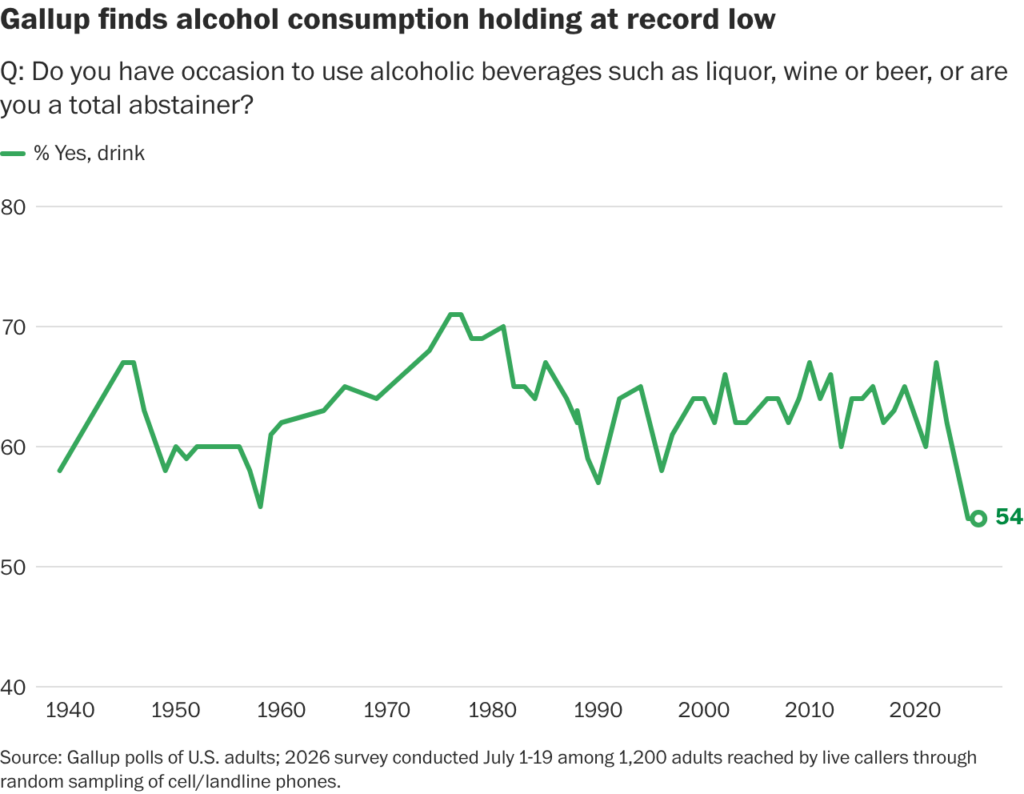
Another high-quality survey echoes the sobering trend since the covid-19 pandemic. The government’s premier survey on alcohol and drug use, National Survey on Drug Use in Health, found the share of people ages 12 and older who drank in the past 30 days dropped from 48.7 percent in 2022 to 44.4 percent in 2025. Encouragingly, that survey also found significantly fewer people qualify for an alcohol use disorder than in 2021.
Income gap in youth sports: An AP-Ipsos poll found higher-income families are more likely to enroll kids in organized sports, according to an AP-Ipsos poll. The gap wasn’t small: “About 7 in 10 K-12 parents with a household income of at least $100,000 annually say their children play organized sports, compared to about 4 in 10 parents with a lower household income.” The poll found 31 percent of sports parents spend less than $500 annually on their children’s sports, while 37 percent spend between $501-$2,000 and 32 percent spend more than that.
Young adults increasingly worry about AI: A Pew Research Center poll found 55 percent of Americans ages 18-29 are “more concerned than excited” about the increased use of artificial intelligence in daily life, up from 47 percent last year and 39 percent in 2024. Concerns are up across most age groups, with clear majorities expecting AI will lead to fewer jobs over the next 20 years.
Do you have questions about how polling works? Is there a specific topic or poll you’d like me to write about? Send your questions, comments and ideas to [email protected].
Read more Private equity’s billion-dollar scramble to own a piece of sports