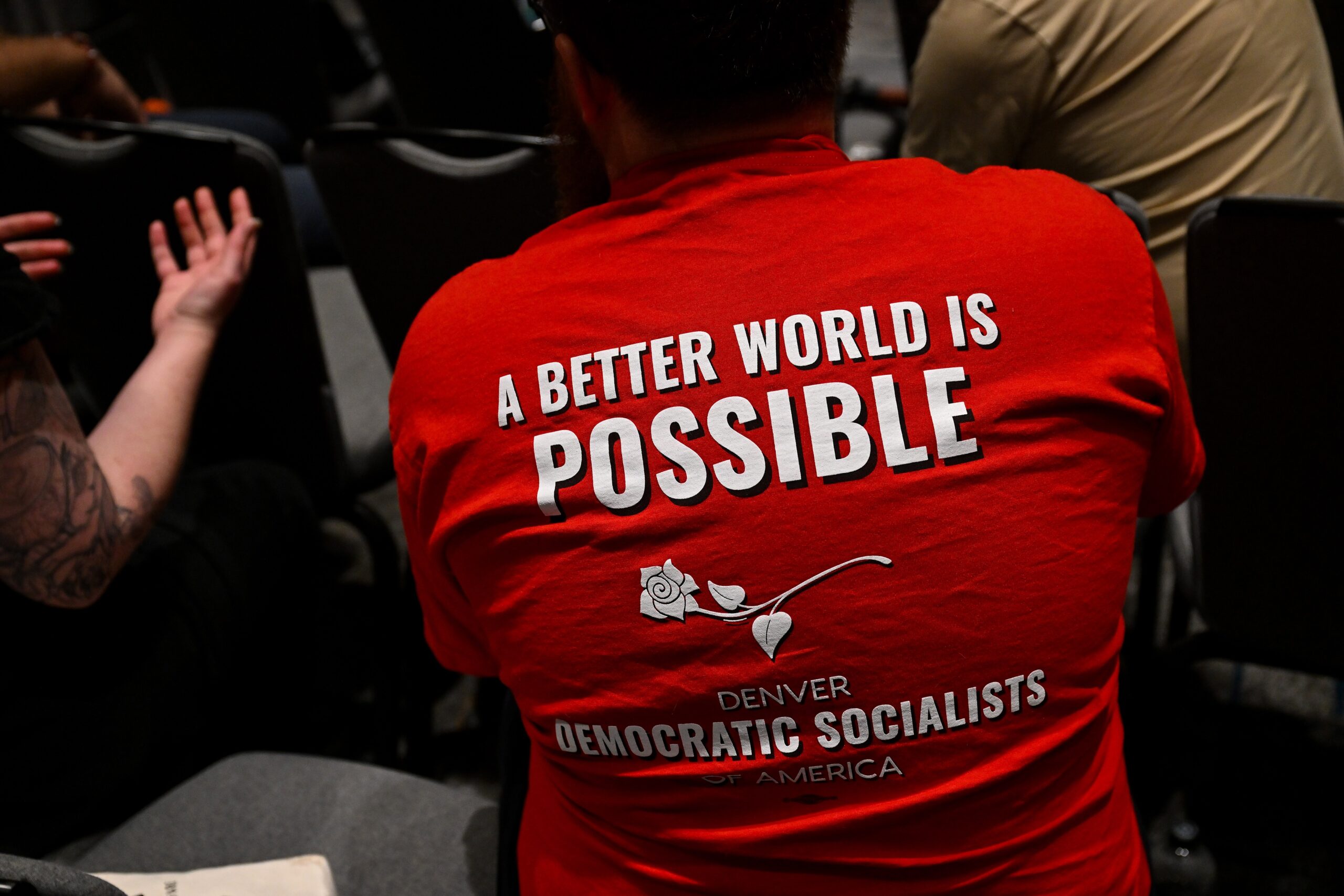
The party document aims to upend the status quo. That can mean a bumpy ride for candidates trying to win in the short term.
Read more Secret White House bunker undercuts Trump’s ballroom lawsuit, ex-officials say

As soon as Angie Nixon pulled off a surprise victory in Florida’s Democratic primary for U.S. Senate last week, the questions began.
The Democratic Socialists of America ”calls for abolishing the Senate,” an NBC anchor said to her. “Do you support abolishing the Senate?”
“Many people are very frightened of their positions,” a CBS host said, before launching a similar line of questioning.
Then, on MS NOW: “What about abolishing prisons, which is one of the platforms of the national DSA?”
Nixon, a three-term state lawmaker who joined DSA earlier this summer but was not endorsed by the group, denied supporting any of those policies.
But the pile-on was yet another sign of how the ambitious, long-term policy ideas that have driven enthusiasm for the group can cause problems for candidates who need to appeal to the mainstream.
The DSA’s national platform, which includes universal rent control and abolishing the Senate and the Supreme Court, is meant to offer bold alternatives to the status quo — a posture that its leaders say has powered the group’s rapid rise.
The ensuing response, though, epitomizes how the organization’s dual goals — to reimagine what’s possible politically and to win elections — are not always compatible.
“I see this document as symptomatic of a broader problem,” said Rodericka Applewhaite, rapid-response director at the political action committee Majority Democrats, which supports moderate Democratic candidates. “Voters were sick of a political system that felt stale, insular and disconnected.”
But if the DSA’s alternative approach is a draw to disillusioned voters, she added, it also gives Republicans low-hanging fruit to hurt all Democrats by portraying them as radical.
DSA leaders spent the past year revising the platform, known to its members as the “program,” in a year-long process meant to include its various ideological wings.
In addition to abolishing the Senate, the Supreme Court and, eventually, prisons and police, it calls for universal child care, phasing out fossil fuels and ending military and economic aid to Israel.
“We need a big, transformational, long-term conversation, or else people will continue to check out of the political process,” said Frances Gill, who led a committee to revise the document.
She and other DSA leaders said the group does not expect candidates to align with every piece of its platform as they try to win elections, though some in the group have floated incorporating it into the endorsement process.
Party platforms for Democrats and Republicans often reveal divisions between core party activists and more moderate voters, but seldom to this degree. In 2020, the GOP decided not to even write a platform, in part to avoid fights over issues like abortion restrictions.
But for a group founded outside the mainstream whose primary wins have suddenly pulled it onto a much bigger political stage, the effect has been magnified: Those victories are bringing the group into the spotlight while also demonstrating how harsh that spotlight can be.
“I don’t think the DSA program idea is a moon-shot idea. It’s a crazy idea,” said Rep. Bradley Schneider (D-Illinois), the chair of the moderate New Democrat Coalition in the House. “Many of the things in there are just rank, stupid ideas that aren’t going to make life better.”
DSA counts just two members in Congress but is on track to see its presence on Capitol Hill at least quadruple next year. Schneider noted that actually passing legislation in the House will require far more votes — 218 — than adherents to the group can offer.
Read more Pence says U.S.-Canada trade fight adds to affordability concerns for economy
The most radical ideas, like abolishing a chamber of Congress, would need a constitutional amendment, requiring supermajorities in Congress and of state legislatures.
Patrick T. McHenry, a former GOP congressman from North Carolina, said he expected his party to focus heavily on the platform ahead of the November midterm elections. The tail, he added, could be long.
“Everybody’s hot to trot on these crazy ideas now,” McHenry said. “The wider electorate for a presidential election cycle will not be as favorable to these socialist policies as a midterm will.”
The DSA, which saw an explosive rise following the presidential campaigns of Sen. Bernie Sanders (I-Vermont) and again after Zohran Mamdani was elected New York mayor, first adopted a platform during its 2021 national convention.
It has been redrafted and revised every two years since, most recently by a committee that pored over each line, before being green-lit by the DSA’s top elected body.
Titled “Workers Deserve More,” it is divided into sections on foreign and domestic policy and democratic-system changes. Several of its 16 points are largely in step with the progressive wing of the Democratic Party, such as Medicare-for-all and the Green New Deal.
More ambitious ideas, including those that would reshape the American form of government, have generated the most attention.
Cliff Connolly, a member of the DSA’s top committee, said he pushed to include Senate abolition precisely to force that idea further into the mainstream.
He compared it to the abolition of slavery in the 1830s and ’40s. People viewed it negatively and wanted to limit or reform it, he said, but within 10 years, the idea became mainstream.
“Maybe it sounds weird at first because it’s not something people have thought of,” he said, but the Senate “is a place where good ideas that most people agree with go to die.”
What that means for people running for Congress — including for the Senate — is another question.
Nixon, the first and only DSA member to win a statewide primary this year, did not receive the group’s backing. She has called herself a “capitalist” after being grilled on the DSA’s platform during cable news interviews, noting that she owns a small business.

Chris Rabb, the Democratic nominee for a deep-blue House seat in Pennsylvania, was endorsed by both the local DSA chapter and the national group. He also distanced himself from the platform, which in some cases goes further than his own.
Rabb advocates overhauling the Supreme Court, for example, but not abolishing it entirely.
He engaged in a lengthy process to win the local endorsement, he said, but it did not include any discussion of the national platform. The national endorsement, which came later, did not require him to sign off on the platform either, he said.
Ashik Siddique, one of DSA’s national co-chairs, said he hopes to eventually incorporate the platform into the national endorsement process — in part, to get everyone on board.
But he said that even if candidates are enduring criticism for the platform, particularly on conservative platforms like Fox News, the scrutiny is sharpening their ideas and bringing them attention with new audiences.
After Siddique’s first appearance on the network earlier this summer, he said he received an email from an elderly truck driver in rural Georgia, telling him he liked the group’s ideas.
Read more Trump has long wanted to lose 15 pounds. Physicians wish he would.