A federal judge rejected the administration’s rationale for cutting down trees and ordered it to stop until she conducts more hearings.
Read more Spending by outside groups crosses $1 billion in competitive congressional races

The federal judge who halted work at the Washington golf course President Donald Trump plans to redevelop issued a sharply worded opinion Tuesday night arguing that officials raced to remove hundreds of trees because Trump wanted quick action on his project, not because the National Park Service suddenly decided to implement a years-old preservation plan.
“The Court concludes, on this limited record, that government officials raced to undertake the [tree-management plan] because President Trump demands haste on his redesign, and not because of some newfound zeal to implement a small part of a seven-year-old” report, U.S. District Judge Ana C. Reyes wrote.
The 21-page opinion formalized the temporary restraining order Reyes issued earlier Tuesday, barring the government from removing additional trees at East Potomac Golf Links through Oct. 26. The administration must also provide the court and plaintiffs, who are suing to block Trump’s project, three business days’ notice before making any irreversible change to a permanent feature of the historic public course.
Reyes summarized her concerns about the project’s speed and lack of scrutiny in a blistering passage early in her ruling.
“Breakneck speed to clear trees that posed no harm,” she wrote. “The reason? Disputed. The budget? Unclear. The environmental impact? Unstudied. The urgency? None. Next steps: bulldoze hundreds more.”
The government has maintained that the recent work stems not from Trump’s proposed redesign but from a 2019 cultural-landscape report that recommended thinning vegetation and restoring the course’s historic links-style character.
But Reyes rejected the notion that the cutting was unrelated to Trump’s plan to remake East Potomac into a championship-level course.
“It is a coincidence, the Government seems to suggest, that [Department of the Interior] cut down hundreds of trees at the Course weeks after the President asked DOI to cut down trees at the Course,” Reyes wrote, “and not, say, any other time in the last seven years.”
“That asks rather a lot of coincidence,” she added.
The opinion followed an extraordinary hearing Monday in which Reyes repeatedly rebuked Justice Department lawyers for allowing the removals despite her warnings, saying the government had squandered the court’s trust and could no longer be relied upon to provide meaningful notice without a formal order.
Reyes found that the DC Preservation League and two golfers challenging the project are likely to succeed on their claim that the Park Service violated the National Environmental Policy Act by failing to adequately study the work’s environmental consequences.
Read more Does a video store privacy law apply online? The Supreme Court will decide.
The opinion traces how the tree-removal plan moved through the administration in five days last week. Interior Deputy Chief of Staff Gregory Wischer instructed a senior Park Service official Oct. 5 to implement recommendations from a 2019 cultural-landscape report “as soon as practical.” Acting NPS Director Jessica Bowron approved the plan the following day.
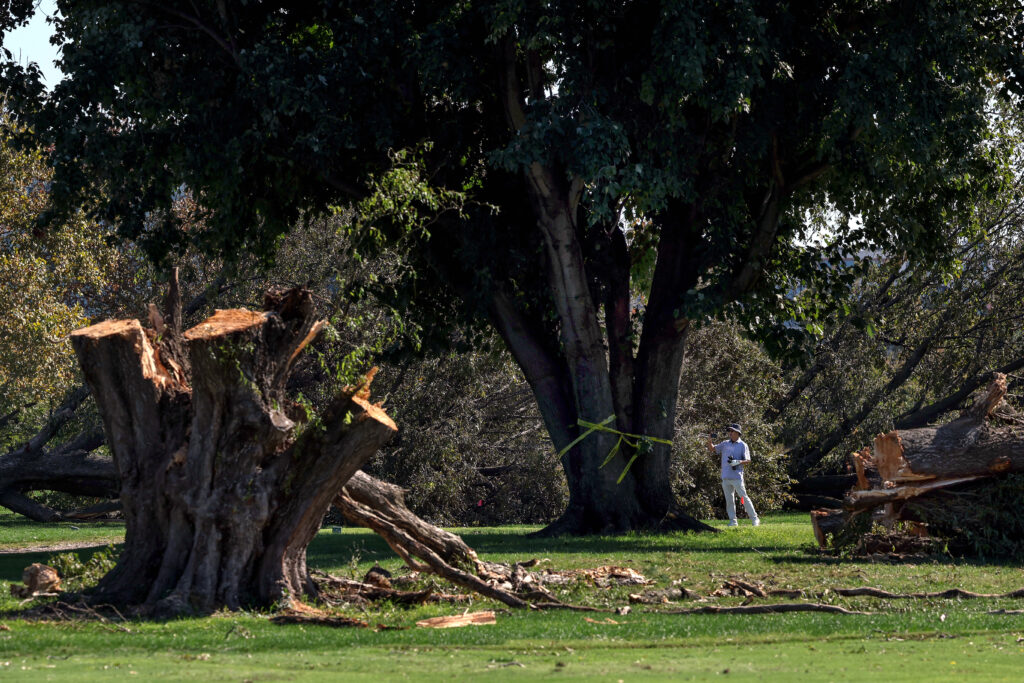
Three days later, on Friday, the government notified the court at 4:55 p.m. that work would begin the next morning. Though two Park Service officials testified Monday that there was no urgency to complete the cutting, by the end of Saturday crews had removed approximately 430 healthy, noninvasive trees. And government attorneys told the court nearly 300 more remain targeted.
Reyes also focused on the Park Service’s compressed environmental review. The agency issued one document exempting the work from fuller analysis Friday, the day before cutting began. A second document was completed Sunday, after crews had removed roughly 200 more trees than the first review anticipated.
Reyes contrasted the East Potomac process with a previous tree-removal project at Rock Creek Golf Course, where the Park Service spent six months preparing an environmental assessment exceeding 250 pages and a finding of no significant impact exceeding 300 pages.
“Presumably that assessment of the forest did not miss half its trees,” Reyes wrote.
The judge also ruled that the tree-management plan itself qualifies as final agency action subject to judicial review, even if Trump’s broader redesign remains conceptual. That finding allows the plaintiffs’ challenge to the tree plan to proceed without requiring Reyes to decide whether the larger golf-course proposal is final.
The Interior Department did not respond to a message seeking comment about the judge’s ruling. Attorneys for the plaintiffs hailed the temporary order while emphasizing that they will seek longer-lasting relief.
“The administration has time and again tried to avoid the law in their mad rush toward converting a public recreation space to a high-end golf course, and today’s order will stop them from doing further irreparable harm to a precious public resource,” they said in a joint statement. “We are pleased that the court intervened and will prevent additional work while we seek more lasting relief.”
Reyes is scheduled to hear testimony Monday from Bowron and Wischer about how the plan developed and why officials moved so quickly. The temporary order will remain in effect while the court considers whether to issue a preliminary injunction.
Read more How the pre-election search of Rep. Ilhan Omar’s home breaks Justice Dept. norms