The justice let stand a lower court ruling, a rare GOP defeat in a nationwide redistricting war ahead of November’s midterm elections.
Read more Sen. Roger Marshall’s challenger in Kansas criticizes him for suing patients
Supreme Court Justice Brett M. Kavanaugh on Tuesday let stand a lower court order blocking a Missouri congressional map that had been designed to give Republicans an additional seat in the U.S. House of Representatives in November’s midterm elections.
Kavanaugh’s order also allows the state to put a referendum on the November ballot asking voters to decide whether to use the GOP-leaning map for future elections.
The decision is a rare loss for Republicans in a nationwide redistricting war that has played out in state legislatures, federal courts and the Supreme Court over the past year. Kavanaugh did not provide his reasoning.
Democrats and Republicans have redrawn — or are redrawing — maps in nearly 20 states, hoping to secure an advantage in congressional elections beginning with this November’s midterms, which will determine control of the House and the Senate.
President Donald Trump sparked the fight in summer 2025 when he urged Texas Republicans to further gerrymander the state’s map to give Republicans a shot at winning up to five additional seats in Congress. Other states soon jumped into the fray, as legislators from each party sought to redraw congressional districts in states where they controlled the government.
Tuesday’s Supreme Court ruling comes just as Missouri is finalizing its electoral slates for November and is preparing to send mail-in ballots to voters.
Democrats hold two of the state’s eight congressional seats, and the new map would likely have given Republicans a good shot at picking up one of them in November.
The justices overturned a Missouri Supreme Court ruling from early September that sided with an anti-gerrymandering group, People Not Politicians, which had challenged the new map.
The case began last year when Missouri Republicans redrew their congressional map at Trump’s urging. The new plan was meant to ensure that Rep. Emanuel Cleaver (D), whose district covers most of Kansas City, would not be reelected to the seat he has held since 2005.
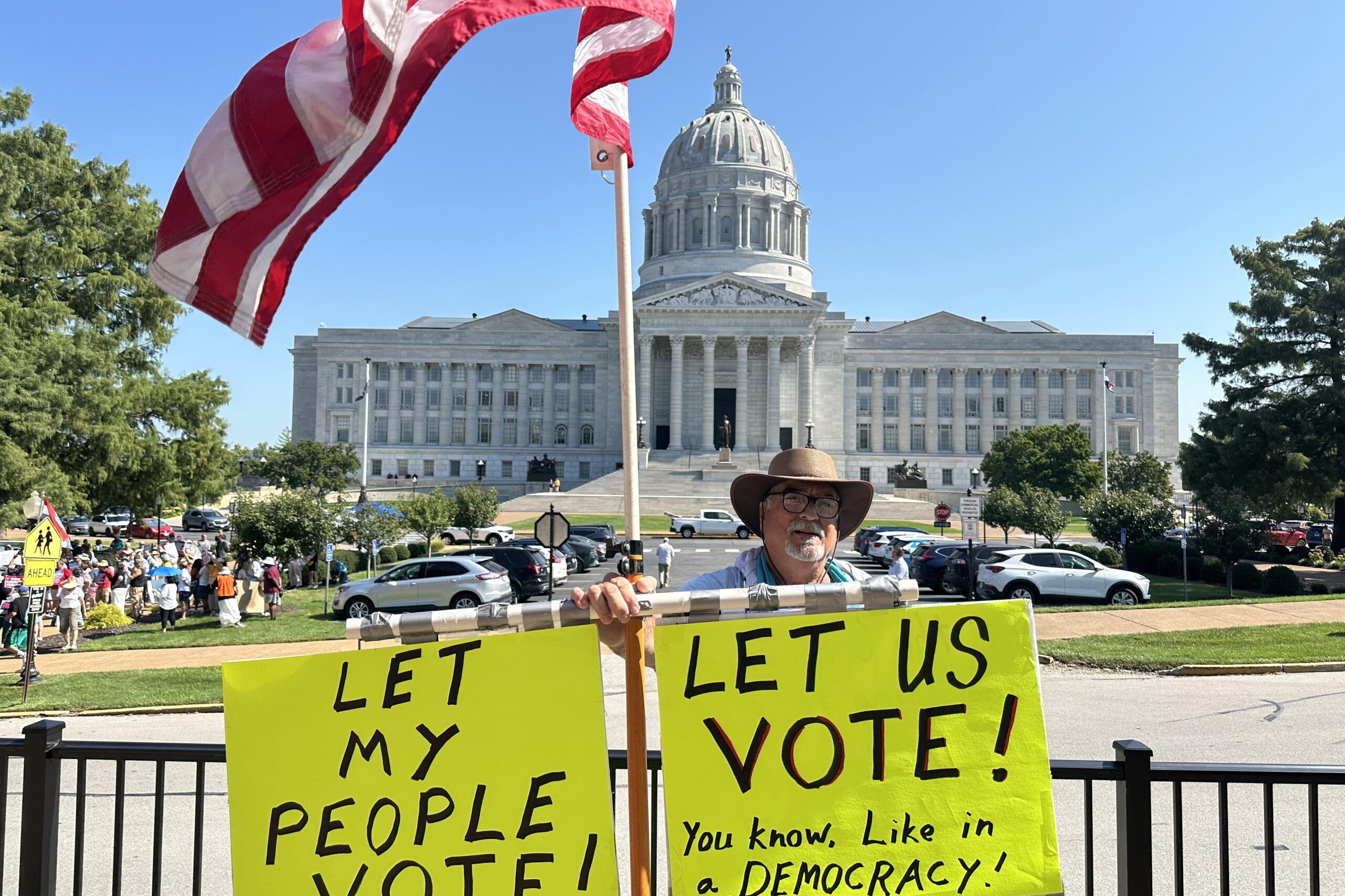
People Not Politicians collected more than 300,000 signatures to place a referendum on November’s election that would prevent the state from using the new map until voters decided on whether to implement it.
Missouri Secretary of State Denny Hoskins (R) disallowed the petition, arguing that the state’s referendum rules did not allow measures related to congressional redistricting.
Richard von Glahn, the head of People Not Politicians, filed a lawsuit. A state court ruled against him, clearing the way for the new map favoring Republicans to be used for an August 2026 primary.
Read more Paxton’s former top law enforcement official endorses Talarico
But the Missouri Supreme Court reversed that decision, ordering the state to revert to the old map for November’s election. The court found that People Not Politicians had submitted enough petitions to force a referendum on the new map.
Trump decried the move, posting on social media: “This is a Dark Day for ‘Justice’ in Missouri!”
Hoskins, in his appeal to the U.S. Supreme Court, asserted that a result of the state high court’s ruling, a “federal-election-administration disaster is unfolding in Missouri.”
“Absent a stay, hundreds of thousands of voters will be forcibly switched to new districts and forced to vote on General Election candidates they had no role in choosing,” Hoskins wrote.
Attorneys for von Glahn wrote in his response that People Not Politicians had followed procedures and met the deadline to submit a referendum. They said Hoskins was trying to game the situation.
“Missouri’s Secretary of State waited until the last possible day — and only after he had implemented HB 1 in the congressional primary — to object to the referendum, in the hopes of running out the clock on the judiciary’s tolerance for a last-minute reversion to the 2022 districts,” von Glahn’s attorneys wrote, referring to the bill that created the new electoral map.
This is not the first time the Supreme Court has weighed in on the redistricting fights that could affect the upcoming midterms on Nov. 3.
In December, a divided high court allowed a Texas redistricting plan that bolstered the GOP to take effect. In February, the justices permitted California to gerrymander its own districts to counteract Texas’s move.
In a separate, more sweeping ruling in April, the conservative majority on the Supreme Court greatly weakened the last remaining pillar of the Voting Rights Act, which was intended to help minority groups elect candidates of their choice under certain circumstances.
That ruling touched off a scramble by GOP-led states to redraw districts in the South that have mostly been held by Black Democrats. In the wake of the ruling, the high court allowed Louisiana Republicans to eliminate a majority-minority congressional district in time for November’s election.
The court is now weighing other issues related to the midterm elections. The Trump administration has asked the justices to greenlight sweeping restrictions on mail-in balloting and to allow it to roll out a database that would allow states to check whether voters are citizens.
Read more Supreme Court declines Catholic mother’s bid for son’s vaccine exemption in N.Y.