Private voting rights attorneys and Democratic attorneys general are preparing to defend election officials and file lawsuits against the federal government.
Read more Takeaways from the latest primaries as Trump reverses a losing streak
The Trump administration in recent weeks has warned states that it would withhold federal funding and even arrest and prosecute election officials if noncitizens cast ballots in federal elections.
Now, with high-stakes midterm elections only months away, private voting rights attorneys and some attorneys general in Democratic states are gearing up to defend election officials and file lawsuits against the federal government if they believe the Trump administration is attempting to undermine the elections.
While the administration casts its efforts as a way to preserve election integrity, voting rights groups and others see a threat to public servants working to carry out elections. President Donald Trump has claimed noncitizens are voting in large numbers despite numerous reviews showing it rarely happens in state and federal elections.
The Washington Litigation Group — a nonprofit law firm that formed last year to more broadly challenge the Trump administration in court — is hiring lawyers to focus on protecting polling officials, government workers and voters ahead of the November elections.
The D.C.-based group, which raises money from individuals and foundations, is adding about six attorneys to focus on election litigation. The new hires include former prosecutors, constitutional law experts and public interest lawyers.
Their preparation includes consulting with state and local election workers in case they end up needing representation and training election workers on how to respond if federal officials approach them.
“We won’t know until we know,” said Nathaniel Zelinsky, senior counsel at Washington Litigation Group. “But what we have seen from DOJ is concerning.”
Trump and his allies made election security a cornerstone of the Justice Department and his administration, claiming, without evidence, that the he, not Joe Biden, is the rightful winner of the 2020 presidential election.
The Trump administration has devoted significant resources to relitigating the 2020 presidential election — and has sought to sow doubt in the security of the upcoming elections. The Justice Department seized earlier this year election records stored in warehouse in Georgia’s Fulton County, which has been central to right-wing conspiracy theories about Trump’s loss in 2020.
Ahead of the midterm elections, the Justice Department has sued 30 states and D.C. for their voter rolls, but so far it has lost every one of the 23 legal challenges that have been decided. Under federal law, states run the nation’s elections — not the federal government — and states have historically not been asked to hand over their voter rolls to the federal government.
The Justice Department declined to comment for this article.
Justice Department officials have repeatedly said it is preparing to ensure that the country has a safe and fair election for the upcoming midterm elections and 2028 presidential contest. They have pointed to noncitizen voters as a threat to election security — though reviews have shown that while there are instances of noncitizens voting, it is extremely rare.
In early July, Harmeet K. Dhillon, who runs the Justice Department’s Civil Rights Division, sent letters to election officials in 50 states last month and warned that they could be arrested if they knowingly allow noncitizens vote in their jurisdictions.
“Any election officer, including the chief election officer of the state, who knowingly retains noncitizens on the state’s” voter list “or facilitates noncitizens in receiving and casting ballots could be subject to criminal liability,” Dhillon wrote
Those letters were backed by similar threats made by Homeland Security Secretary Markwayne Mullin.
“If the election officials, once we gave them the information they need to secure their elections, and they chose not to, then those individuals can also be held accountable by fines, by penalties, and even depending on how far it goes, prison time,” Mullin said in a news conference last month.
Read more House GOP faces complaint for using floor footage in campaign materials
It has long been illegal for noncitizens to vote in federal elections and, in 1996, the federal government imposed hefty penalties for noncitizens who register to vote or cast a ballot, including fines, jail time and deportation. But relatively few cases are prosecuted, largely because federal officials have struggled to find the rampant noncitizen fraud that Trump has described.
Last week, Justice Department officials said they plan to dispatch about 1,000 monitors to the polls this fall. The Justice Department routinely sends monitors to polling places to ensure election laws are followed and voters’ rights are protected, though 1,000 is a larger number than is typically sent.
Given the Trump administration’s rhetoric around the election, Democratic lawmakers and some election advocacy lawyers have raised concerns about whether the election monitors would interfere in the election proceedings.
“On its face, it doesn’t look unusual. In a normal context, it would be a Tuesday,” said Kyle Feeney, a former federal prosecutor who now works at the Washington Litigation Group. “But it’s impossible to separate the announcement of 1,000 election monitors from, for example, the letters Harmeet Dhillon sent out to states threatening to arrest election workers if noncitizens vote.”
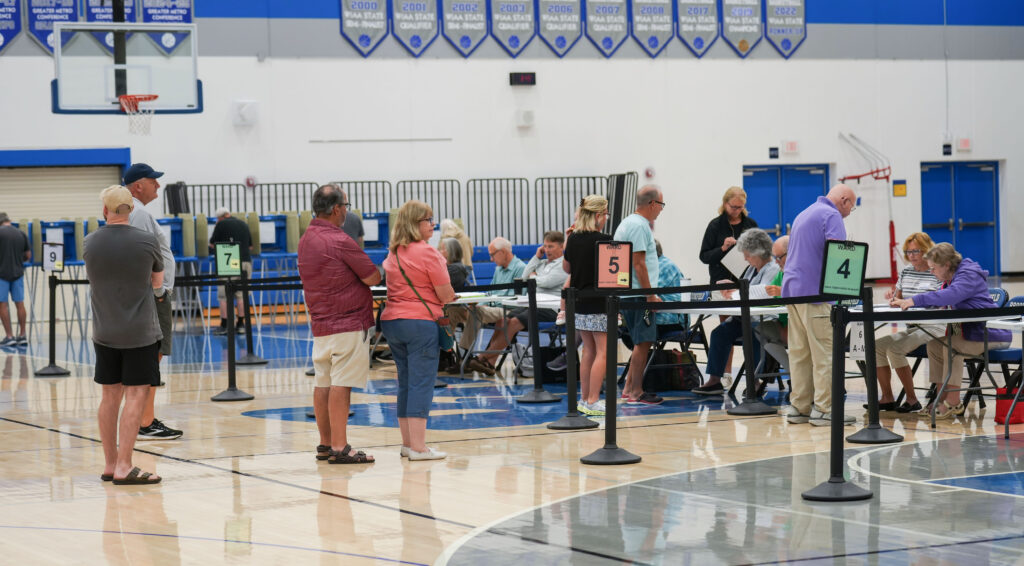
Washington Litigation is not alone in preparing for the what-ifs that could emerge from the upcoming elections. Democratic state lawmakers across the country have introduced bills to protect mail-in voting, early voting access, election results and more.
State attorneys general say they are preparing to file lawsuits against the federal government if they encroach on states’ rights to run elections. Nick Brown — the Democratic attorney general of Washington state and an executive committee member of the Democratic Attorneys General Association — said that he is particularly worried about the Trump administration potentially sending federal agents or troops to polling sites.
While the Trump administration has not said it would send immigration officers or federal troops to the elections, the president, when asked, did not rule out the possibility.
“The reality is that the federal government used to be for multiple administrations a trusted partner in how states and local governments ran their elections,” Brown said in an interview. “And now they are the biggest adversary by far. I don’t think there is another way to frame that.”
The Brennan Center for Justice — a nonpartisan policy advocacy group that has often supported liberal positions on voting — has said that it is also ready to go to court if the Trump administration sends federal troops to polling places, arguing that any deployment that intimidates voters or interferes with voting would be illegal.
States and advocacy groups have tried to fight the president’s executive order curtailing who is allowed to use mail-in voting to cast their ballots — a fight that has reached the Supreme Court.
On Monday, the Supreme Court gave Trump a preliminary victory, allowing the president to move forward with his plan to bar the U.S. Postal Service from sending mail-in ballots to voters not on lists of citizens created by federal agencies. Litigation is still ongoing and it is unclear if the new rules would be able to take hold before the November elections.
The Bipartisan American Election Project — a group founded to fight Trump’s efforts to assert more federal control over elections — wrote an amicus brief to the Supreme Court arguing against the constitutionality of Trump’s executive order limiting who can cast a mail-in ballot.
“Our country is experiencing extraordinary conflict over the administration of elections and the acceptance of election outcomes,” the group wrote. “The foundational principles on which free and fair elections have been based are now the subject of a flood of litigation in federal and state courts, intense regulatory battles, and polarizing rhetoric about the reliability of elections.”
Zelinsky of Washington Litigation Group said he expects more litigation in coming months as the Trump administration’s plans for the elections take hold.
“We have been litigating everywhere,” Zelinsky said. “And the next front is elections.”
Read more Judge issues setback to Trump administration plans to restrict mail-in ballots