As legislation is introduced at a record pace, shifting political views are driving more proposals that seek to restrict the tech giants.
Read more Republicans court debate on expanding the Supreme Court
As public backlash erupts against data centers, AI companies have found themselves in a race with state lawmakers.
Companies are rushing to construct facilities for the servers that power their platforms. Legislators, across the country and the political spectrum, are increasingly racing to limit them.
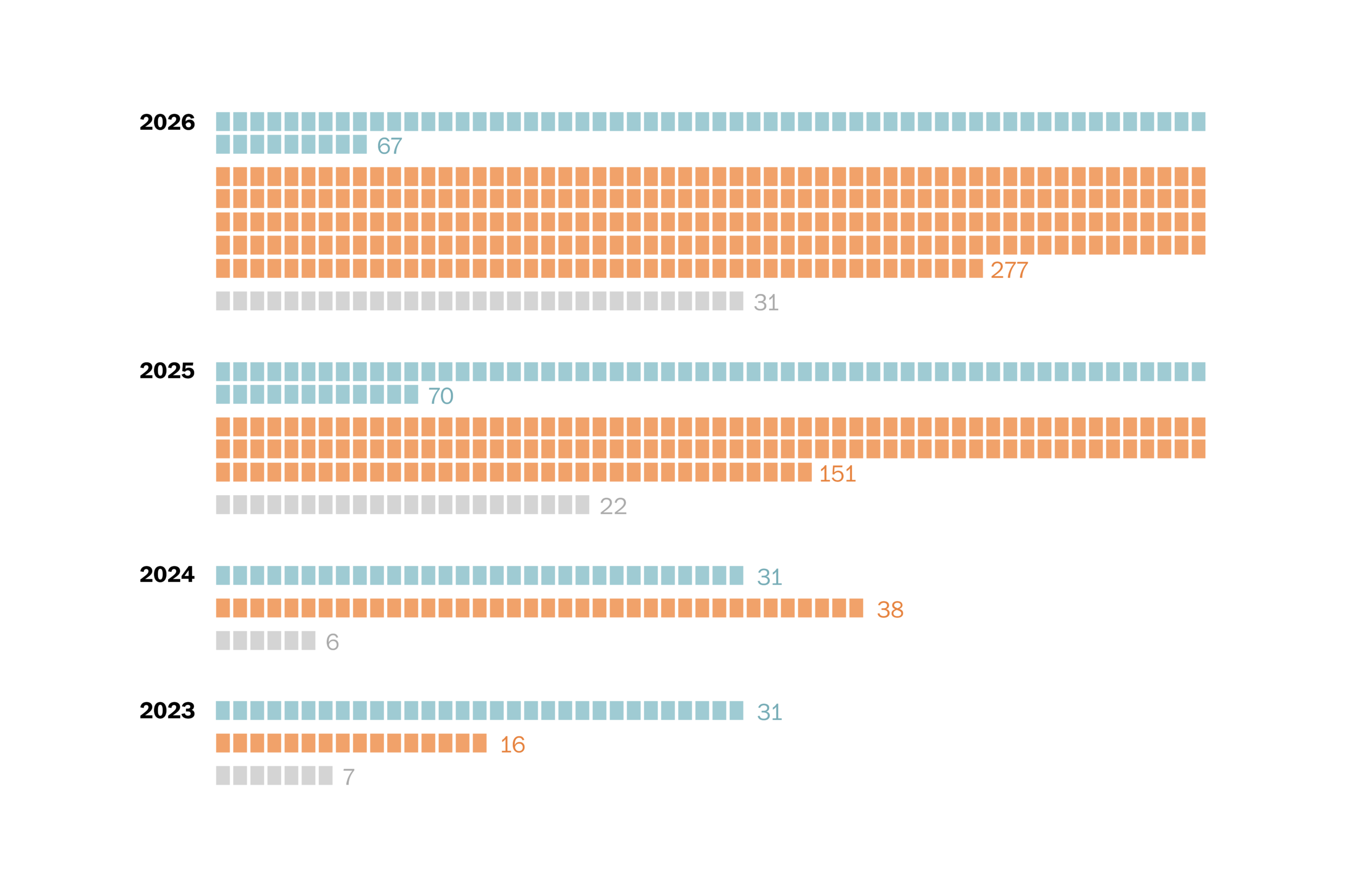
State lawmakers have already introduced at least 375 bills on data centers this year, according to an analysis of legislative records by The Washington Post. Just over halfway through 2026, that number exceeds the total number of such bills in the three previous years combined. Roughly three-quarters of those bills introduced this year seek to restrict data centers in some way.
As with most legislation, a majority of the bills failed to pass, The Post’s analysis found, though many are still pending.
Data centers are now a rare issue uniting Americans of both parties in their opposition. About 7 in 10 Americans said they would oppose a data center being built near them, according to a recent poll from Gallup. Many cited concern about electricity costs and data centers’ environmental impacts.
Earlier this summer, voters in Monterey Park, east of Los Angeles, overwhelmingly backed the nation’s first permanent ban on data centers.
And politicians have likewise changed their positions. In the past six months, Republicans’ statements on data centers have turned sharply negative, according to a Post analysis of thousands of social media posts and newsletters. It follows a similar pivot by Democrats, whose statements largely turned against data centers early in 2025.
At first, state legislatures mostly embraced data centers. Following the release of the first public version of ChatGPT, about 57 percent of data center-related bills introduced in 2023 sought to facilitate their growth through tax breaks, fast-tracked approvals and other incentives.
But by mid-2026, the balance had long since shifted. The majority of data center bills now seek to restrict them in some way, The Post’s analysis found.
Through roughly the first half of this year, bills halting data center development, reducing existing incentives or adding new costs more than doubled compared with all of 2025, while the number of bills creating, expanding or extending financial benefits fell slightly.
Still, few politicians are embracing grassroots demands for full bans or pauses on data center construction.
Democrats are sensitive to labor unions that back the projects. Republicans are trying to balance supporters’ outrage with President Donald Trump’s enthusiastic support of data centers.
Fourteen states have introduced bills proposing a full moratorium, according to the National Conference of State Legislatures. Just one, in New York, has passed so far, though other states have introduced bills to allow local governments to implement their own bans.
Few states illustrate the shift as clearly as Illinois.
In 2019, Illinois lawmakers exempted data centers from electricity and sales taxes, hoping to attract cloud computing facilities to the state. Gov. JB Pritzker (D) celebrated the opening of Meta’s data center in DeKalb, Illinois, saying in 2023: “Their decision to locate here is a reflection of the hard work that our General Assembly members and our administration have done to position our state to win this business.”
Now, AI data centers also qualify for those incentives. The Illinois Power Act, introduced in February, would have required data centers to cover the cost of their own utilities and the infrastructure needed to connect them, forced operators to use renewable energy and required public reporting on water consumption.
The act failed to pass earlier this year, prompting Illinois to stop processing tax incentive applications in July, at the direction of Pritzker.
Read more Secret Service is getting the fortified White House that past presidents resisted
Lawmakers in the state have moved to regulate data centers in other ways, including by requiring environmental and utility protections and giving municipalities more control over data center approval, though most of those provisions haven’t passed yet.
Virginia, informally known as the data center capital, enacted two bills in 2023 friendly to data centers. But since then, Virginia lawmakers have introduced 58 bills aimed at restricting them, passing five.
Virginia’s data center restrictions have focused on the most immediate harms of the resource-hungry facilities.
This year alone, the state’s lawmakers passed bills to regulate data center water consumption, limit emissions from backup generators and prevent noise pollution from the constant hum of cooling fans.
Data centers have only begun to reach neighboring West Virginia, which unveiled its first two major projects earlier this year.
“As the world stands on the cusp of a new digital and economic frontier, West Virginia is once again stepping forward to be a technology leader,” Gov. Patrick Morrisey (R) said at a news conference last month.
Before 2025, West Virginia lawmakers had introduced only one bill on data centers. They introduced seven bills last year and another 22 this year, passing two aimed at letting data centers generate their own power, therefore bypassing the traditional electrical grid.
So-called “microgrid” legislation is a common form of pro-data center legislation. Similar microgrid-related provisions were introduced in at least 18 other states, The Post’s analysis found.
Last month, Pennsylvania Gov. Josh Shapiro (D) ordered stringent regulations on data centers, reversing his past support of them. The order stops short of a complete moratorium but makes constructing data centers exceptionally difficult.
The state’s lawmakers have introduced at least 23 bills in 2026 aimed at restricting data centers, including repealing incentives and pausing data center development.
Shapiro, who is up for reelection this year, acknowledged the hardening public opposition to data centers.
“We’ve had enough here in Pennsylvania — and I’m not going to let it happen on my watch,” Shapiro said before signing the executive order. “If these companies want to do business here, they need to comply with the strictest guardrails in the nation on data center development, starting today.”
Methodology
The Post used Legiscan to download more than 1,300 bills, introduced between Jan. 1, 2023, and July 15, 2026, which mentioned data centers by name. Bills that regulated government-owned data centers, non-AI data centers or only incidentally mentioned data centers were excluded from the analysis.
The Post used a large language model, OpenAI’s GPT-5.4 Mini, to group each bill into one of 12 categories based on the bill’s primary focus. This classifier had an accuracy rate of 94 percent on a hand-labeled test set of 100 bills.
Those categories were then sorted into one of two primary groups: “restrictive” bills that constrained data centers in some way, and “facilitative” bills to make it easier for them to operate or expand. An additional “other” category was also created, primarily for bills that ordered studies or reports about data centers to be conducted without taking additional legislative action.
Read more Maduro seeks to fend off narco-terrorism trial, arguing he has immunity