
Thursday’s vote followed testimony from the top U.S. commander overseeing the military campaign.
Read more Supreme Court preserves access to mail distribution of widely used abortion pill

The House on Thursday failed to advance a resolution requiring the Trump administration to end its war in Iran — the first time it has considered such a measure since the lapsing of a legal deadline for lawmakers to authorize the conflict.
The measure failed after a dramatic tie vote of 212 to 212, with three Republicans joining nearly all Democrats.
The Senate on Wednesday rejected a similar initiative.
Rep. Jared Golden (Maine), the lone Democrat to vote no, indicated in a statement that he would support a forthcoming “clean” bid to halt the war.
The measure that failed Thursday was proposed early in the war by a faction of pro-Israel Democrats — Golden among them — as a compromise intended to win some Republican backing. It would have given the Trump administration 30 days to seek lawmakers’ explicit authorization to prolong the conflict.
In explaining his no vote, Golden argued that those terms are no longer relevant because hostilities have already gone on longer than the War Powers Act permits.
The Vietnam-era law is meant to prevent a president from usurping Congress’s right to declare war and requires that the administration seek approval from lawmakers to continue a military operation beyond 60 days. In the case of Iran, that deadline passed two weeks ago.
Still, most in the GOP, which controls both chambers of Congress, have shown little appetite to enforce the war powers authority even though the war — which has upended the global economy and forced many Americans to pay more for gas and other goods — has become a political liability for some lawmakers.
The Trump administration has argued that its ceasefire with Tehran reset the 60-day clock and notified Congress on May 1 that hostilities had “terminated.”
After declaring a ceasefire in April, President Donald Trump has threatened to resume military strikes on Iran unless it agrees to a peace deal and reopens the Strait of Hormuz, a vital waterway for the flow of oil, fertilizer and other commodities.
Sen. Lisa Murkowski (Alaska), one of three Republicans who backed the measure that failed in the Senate earlier this week, rejected the administration’s assertion that it could resume military strikes without Congress’s approval.
In a statement, she said she will “oppose any effort to redefine ‘hostilities’ in ways that allow the president to wage war indefinitely.”
Read more House investigating GOP Rep. Chuck Edwards over sexual harassment allegations
Trump has dispatched envoys to negotiate a peace deal with Tehran, but the process has largely stalled. This week, he called Iran’s last proposal “garbage” and said the ceasefire was on “life support.”
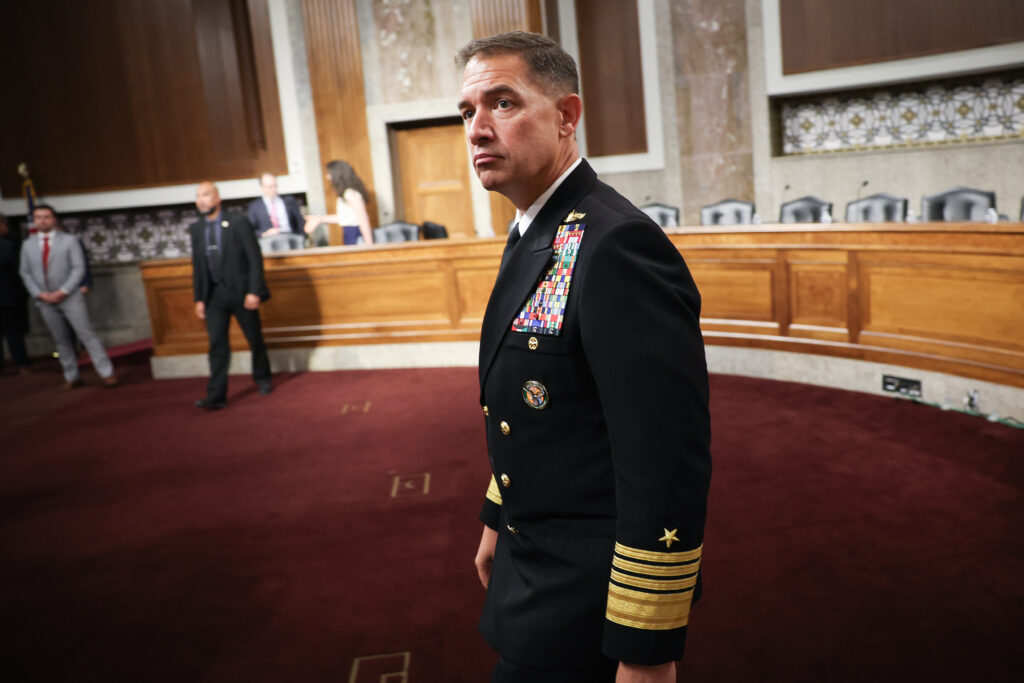
Thursday’s House vote followed a hearing in the Senate with Adm. Brad Cooper, who oversees the Iran war as head of U.S. Central Command. It was his first public testimony on Capitol Hill since the conflict began.
In many cases, Cooper declined to directly answer lawmakers’ questions, including whether American ground troops would be needed to accomplish Trump’s goal of securing Iran’s nuclear material.
Throughout the session, the admiral frequently deferred either to other federal agencies or to the “policymakers” who issue orders to the military. While he has discussed U.S. operations against Iran with some of the lawmakers in private or classified settings, a number of them appeared frustrated by his unwillingness to engage in the public setting.
“The vast majority of what you told us should also be told to the American people,” said Sen. Richard Blumenthal (D-Connecticut).
“We have regulations. We have the law of order. We have human rights obligations. We have our own targeting requirements to avoid civilian harm and death,” Gillibrand said, asking whether Cooper had adhered to all laws in place.
Cooper said he had personally issued warnings to Iranians on a few occasions in an effort to mitigate civilian deaths — and that the report had not been corroborated.
There is one active civilian-casualty investigation, the admiral added, referring to a Feb. 28 attack on an elementary school in Iran that Iranian officials said killed 175 people, mostly children. Defense Secretary Pete Hegseth said in March that a comprehensive investigation of the incident is underway.
The Washington Post and other media outlets have reported that despite the massive U.S. aerial campaign, Iran maintains the ability to launch attacks with a substantial amount of its missile launchers and munitions.
Cooper pushed back against that reporting but did not address questions on how much of Iran’s arsenal remains, instead focusing on its ability to produce future munitions, which he said had been “virtually eliminated.”
Read more Appeals court shows some skepticism of Trump’s effort to punish law firms
Dan Lamothe contributed to this report.