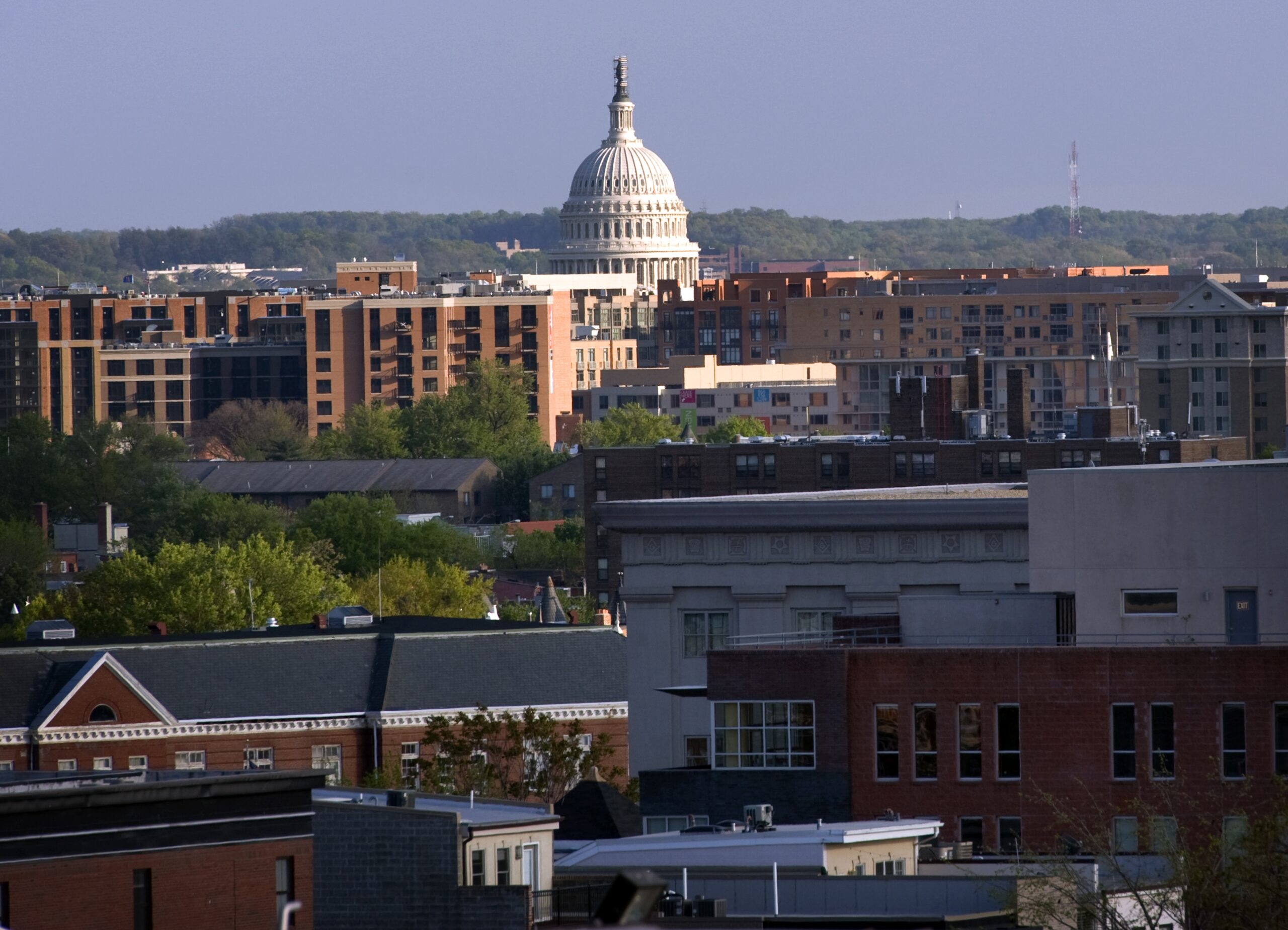
The federal requirement caps most construction in Washington to a maximum height of 130 feet, about half that of the president’s 250-foot project.
Read more Garcia homers, Wheeler sharp as Phillies beat Padres 6-4 for season sweep
The head of a federal commission reviewing President Donald Trump’s planned 250-foot triumphal arch said Thursday that he believed a federal law limiting the height of construction in Washington should not apply to the controversial project.
Will Scharf, the Trump-appointed chairman of the National Capital Planning Commission, said that he had “thought deeply” about whether the Height of Buildings Act, which was enacted in 1910 and intended to preserve the capital city’s historical views and character, should apply to the project. The law restricts most construction in Washington to a maximum height of 130 feet, and the commission has historically applied the law when deciding whether to approve projects in the region.
But Scharf said he was skeptical of long-accepted legal arguments about the Height Act’s applicability to the arch and other federal projects. He cited examples of Washington-area construction, such as the 166-foot-tall National Archives building on Pennsylvania Avenue, that exceed the law’s limits.
“I believe, speaking personally, that the best reading of the law is that the Height of Buildings Act is not applicable to federal construction,” Scharf said, as the commission prepared to receive public comments on the planned arch.
The commission later voted to advance the project but did not bestow its final approval. The administration, which does not believe it needs congressional authorization for the project, has said it will provide at least 14 days’ notice before beginning construction of the arch.
Trump has prioritized the planned arch, saying that the 250-foot-tall structure should be constructed as part of the nation’s 250th-anniversary celebrations. The Commission of Fine Arts, another panel that Trump has packed with allies, voted last month to approve the project, which would be built in Memorial Circle, a traffic roundabout at one end of Arlington Memorial Bridge tucked inside the boundaries of Washington.
The project is being steered by the Interior Department, and Nicolas Leo Charbonneau, a classical architect at Harrison Design, is overseeing the arch’s design.
Architects, historical preservationists and Washington residents warned the planning commission Thursday that the arch would tower over nearby monuments — including the Lincoln Memorial, which is about 100 feet tall — with several speakers invoking the city’s height rules.
The arch is “inconsistent with the Height of Buildings Act that protects the plan of the city,” said Carol Quillen, chief executive of the National Trust for Historic Preservation. The organization, which is charged by Congress with helping preserve historical buildings, is suing the Trump administration over the president’s planned White House ballroom.
Read more Braves add depth at catcher by acquiring veteran Austin Wynns from Angels, DFA Chadwick Tromp
Career staff on the planning commission also have questioned how the proposed arch would comply with the federal law restricting the height of construction.
“NCPC has always applied the Height of Buildings Act to federal projects,” the commission’s staff wrote in a report released ahead of Thursday’s hearing, asking the Interior Department to justify its project in light of the height restrictions.
Scharf, who is also Trump’s staff secretary, said he supported that request and hoped that the response would “provide clarity” on the legal issues involving the Height Act and Trump’s planned arch.
The Interior Department previously has said that it is working with the Federal Aviation Administration to determine whether the arch would pose any new safety risks, given its proximity to Reagan National Airport.
The majority of the public opposes the project, which is also the subject of a lawsuit brought by several military veterans who say the towering structure would alter their visiting experience to nearby Arlington National Cemetery. Fifty-two percent of Americans are against the planned arch, compared with 21 percent who favor it, according to a Washington Post-ABC-Ipsos poll conducted in April.
The Height Act and its effects on Washington have frequently sparked debate in D.C., with critics arguing it constrains development and proponents saying it is necessary to maintaining the character of the nation’s capital.
The law includes a carve-out for some buildings on Pennsylvania Avenue NW to be 160 feet tall.
Defenders of the restriction say that the law must be preserved.
“Washington’s special status as the nation’s capital is appropriately expressed in its physical form, a part of our national heritage that must be judged as far more momentous than issues of real estate development,” according to a 2013 letter issued by the fine-arts commission.
Read more Report: Ballroom donors won $50B in contracts after giving to Trump project