The president criticized a GOP senator, a Democratic governor and Iranian leaders at what he said was the first televised Cabinet meeting from the retreat.
Read more Photographer of viral ICE image threatens to sue super PAC for using it
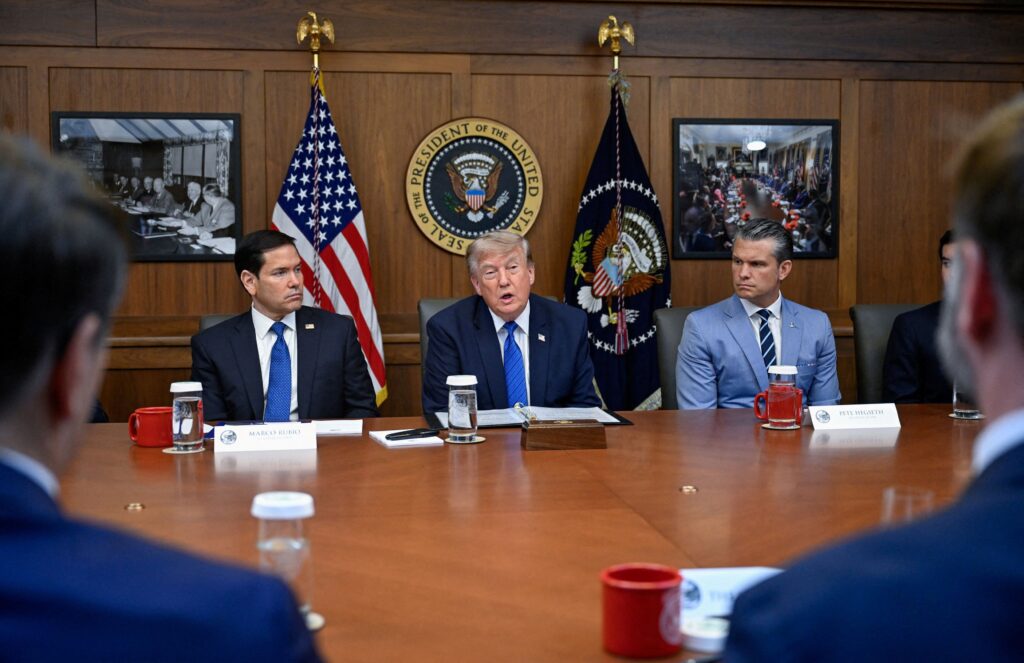
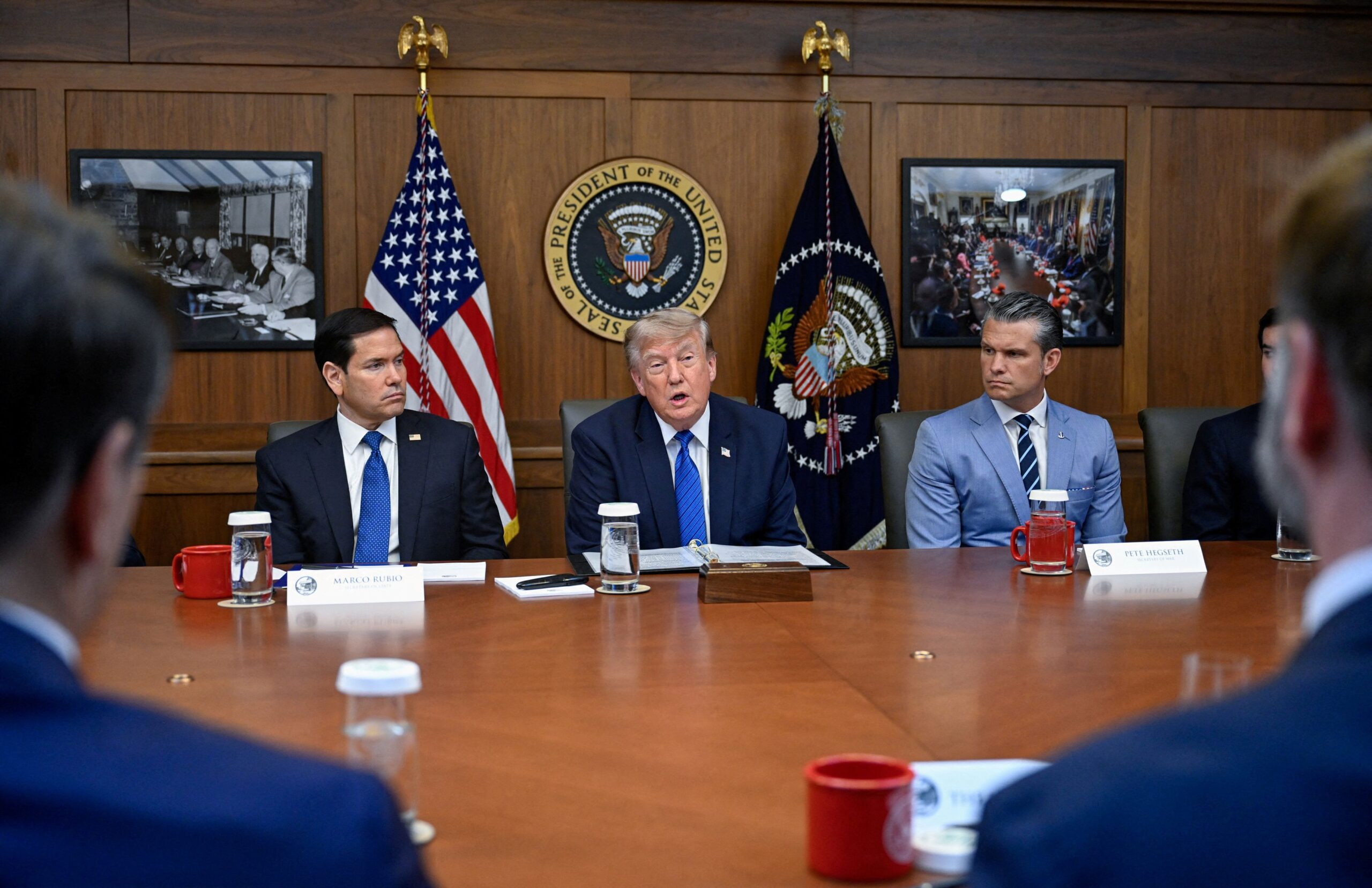
President Donald Trump on Friday held what the administration said was the first televised Cabinet meeting at Camp David, assembling his deputies at the secure wooded retreat to tout the administration’s accomplishments.
But the rural Maryland setting, long used by presidents for sensitive private meetings or as a tranquil escape, swiftly became the latest stage for Trump’s frustrations over a series of stalled domestic and foreign policy initiatives.
Trump railed against Republican senators blocking his nominee for attorney general, lamented the collapse of his proposed $1.8 billion Justice Department payout fund, questioned whether Iran was negotiating a potential ceasefire in good faith and warned that Democrats would open U.S. borders if they won the midterm elections.
He again lashed out at Sen. John Cornyn (R-Texas), one of several GOP lawmakers to resist Trump’s policies as his popularity drops and the midterms approach. Cornyn — who lost his primary bid this year after Trump endorsed his opponent — has joined with other lame-duck senators to hold up acting attorney general Todd Blanche’s nomination for the full-time position.
Cornyn has “become a very angry person,” Trump said, also praising Blanche, his former personal attorney. “Todd Blanche is a very, very good man, and he shouldn’t be in the middle of this.”
The president’s remarks Friday, which echoed similar complaints he has made in person and on social media, were most striking because of the unusual backdrop. The media has historically not been allowed to visit Camp David, and reporters who covered Friday’s Cabinet meeting were told to leave their cellphones outside the room, because it was a secure information facility. However, the White House allowed several live video streams of the meeting, and photographers were permitted to take pictures.
The president and White House officials said it was the first televised Cabinet meeting from the rustic compound. Trump in May had planned a Cabinet meeting at the site but canceled it, citing the risk of bad weather.
Camp David, which is about 60 miles north of Washington, was established by President Franklin D. Roosevelt in 1942 as a secure presidential retreat during World War II. Roosevelt dubbed it “Shangri-La,” after a fictional paradise in the Himalayas. About a decade later, President Dwight Eisenhower renamed the compound Camp David, in honor of his grandson, drawing some derision.
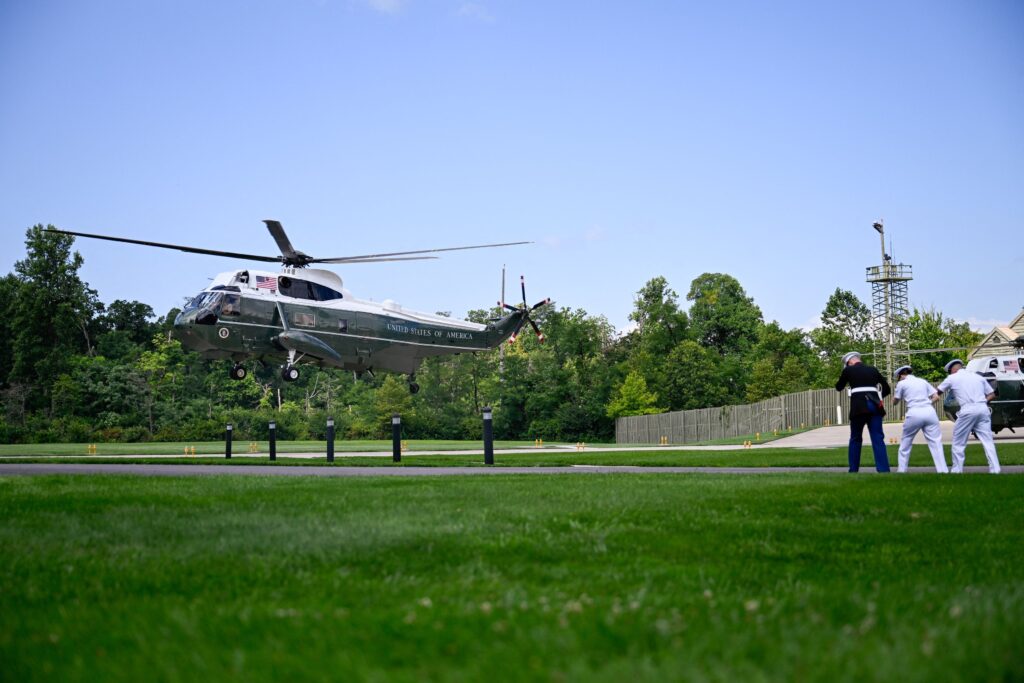
The site has been used by past presidents to host foreign leaders, review sensitive intelligence and break away from the day-to-day pressures of the presidency. Joe Biden, Trump’s predecessor, was particularly fond of biking and walking the camp’s trails.
Trump spent time at Camp David in his first term but has preferred visiting his own properties recently and is set to spend this weekend at his resort in Bedminster, New Jersey. He touted his decision Friday to trade the increasingly gold-festooned White House for the wood-paneled walls of the presidential retreat, located in Catoctin Mountain Park.
“This room is a very, very special room,” Trump said, as the meeting began. “I don’t believe the press has ever come anywhere near it, but we are the party of transparency.”
For the first 40 minutes of Friday’s meeting, Trump and several deputies highlighted his policies, such as efforts to negotiate lower drug prices, while sometimes stopping to admire their surroundings. Health Secretary Robert F. Kennedy Jr. said that he had been to Camp David more than 60 years earlier, when his uncle John F. Kennedy was president and his father was attorney general.
“My father loved this place. My uncle loved this place,” the health secretary said, contending that John F. Kennedy resented Eisenhower’s decision to rename the compound and would have renamed it “Shangri-La” had he had a second term.
Read more Trump blames Minnesota, not Iran, for cyberattack on water systems
Trump’s Cabinet members, as they have at past meetings, also took the opportunity to lavish praise on the president. Defense Secretary Pete Hegseth credited Trump for policies that he said had boosted morale in the military, including the president’s effort to rebrand the department as the “Department of War” and putting military vehicles on parade and in flyovers to celebrate the nation’s 250th anniversary.
“Parades, 250 [anniversary] flyovers, the American people seeing and feeling their military in ways they have not in the past,” Hegseth said. “That’s spirit.”
Other parts of the meeting, including Trump’s exchange with reporters, focused on the president’s unhappiness over a variety of issues, including the defunct payout fund. Trump had said the fund would compensate people who claim they were improperly investigated by the government, but Democrats and some GOP lawmakers said the fund could inappropriately reward people such as rioters who damaged the U.S. Capitol on Jan. 6, 2021. A federal judge has warned the administration not to resurrect the plan.
Trump said Friday that the payout fund was “dead,” adding that he wished it would be resurrected but claiming that he didn’t want to personally benefit from it.
“I probably was abused more than anybody in the history of our country, but I wasn’t looking for that,” Trump said.
Trump also lashed out at political enemies and touched on other topics that have rankled him.
The president warned that migrants would swarm and overrun U.S. borders if Democrats defeated GOP lawmakers in the upcoming midterms, invoking a recent incident at a Spanish outpost in North Africa.
Trump separately mocked Minnesota Gov. Tim Walz (D), a frequent foe, blaming Walz’s own government for a cyberattack on the state’s municipal water systems. U.S. intelligence agencies suspect that Iran launched the cyberattack, a possibility that Trump ruled out.
“Iran’s got bigger problems than worrying about Minnesota,” Trump said, calling the state’s government “grossly incompetent.”
Walz wrote on social media that “Trump knows exactly who is responsible for this attack, and knows that other states were hit too,” linking to news coverage of similar cyberattacks in other states.
The governor also poked Trump by invoking the ongoing conflict with Iran, which has helped drag down the president’s polling and drive up gas prices.
“Trump can’t beat Iran because he’s too busy waging war with Minnesota,” Walz wrote.
Read more What happened this week under Trump