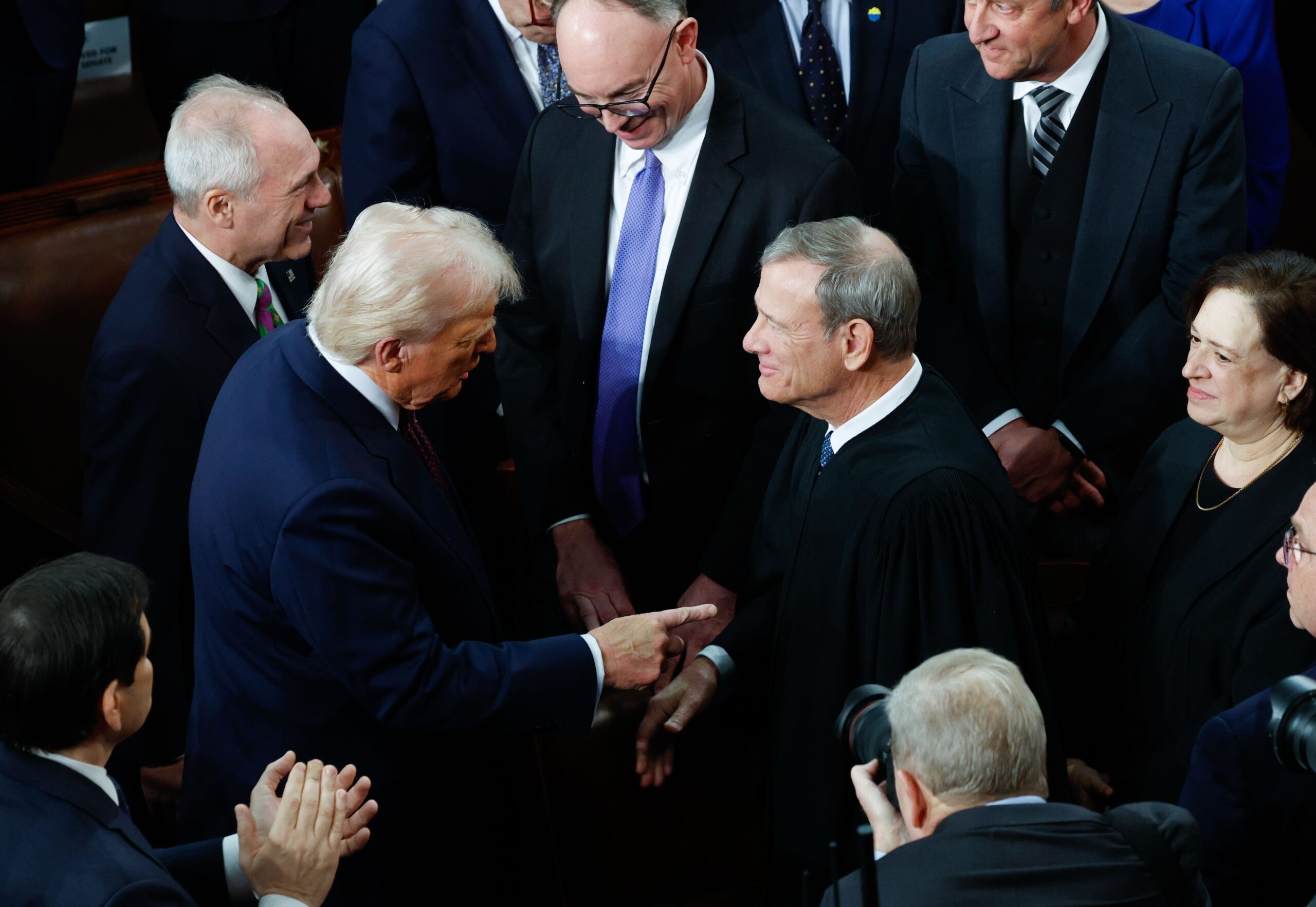
As the court prepares to rule on several of the president’s priorities, tensions are running high — even with his own appointees.
Read more Schwarber, Harper homer again as Phillies beat Mets 6-2 to win series
When Supreme Court Justice Neil M. Gorsuch hosted a gathering of his former clerks last year, a prominent attorney and Donald Trump ally who had played a key role in Gorsuch’s rise was notably absent.
Gorsuch had nicknamed his friend Mike Davis “the general” for helping him secure his first federal judgeship, leading a campaign to get Gorsuch confirmed to the Supreme Court and then serving as one of his inaugural clerks.
But the relationship soured last year as the Supreme Court began to rule on some of Trump’s policies, according to two people with direct knowledge of the matter, speaking on the condition of anonymity to discuss a sensitive issue.
One recounted how Gorsuch became upset when Davis lashed out at Justice Amy Coney Barrett, calling her a “rattled law professor” for siding with the court’s liberals in a pair of rulings against Trump. The other said Davis was angered by Gorsuch’s vote to block Trump’s use of a wartime authority to deport Venezuelans.
The people differed on whether Gorsuch had asked Davis not to come to his clerks’ gathering or he chose not to. Either way, the rift highlighted the growing conflict between Trump, his MAGA allies and the justices, which has burst more fully into public view in recent months.
That turbulence makes for a tense backdrop in the waning days of the Supreme Court’s 2025-26 term, as the justices prepare to rule on three signature Trump initiatives: limiting birthright citizenship, firing the heads of independent agencies and reshaping the Federal Reserve.
Many legal experts believe that the justices have signaled they will rule against Trump on two out of the three, blocking his bid to deny citizenship to those who were born to parents here illegally or lacking permanent residency, as well as his effort to remove a governor of the Fed board.
“It seems like almost 100 years since you’ve had a clash approaching this level between the president and the court,” said Jeffrey L. Fisher, a law professor at Stanford University. “You’d have to go back to the New Deal to have any kind of an analogue.”
During the 1930s, President Franklin D. Roosevelt tried to pack the court by expanding it from nine justices to 15 after the court struck down key parts of the New Deal. The plan ultimately failed, but not before the court began upholding some policies that Roosevelt championed, possibly in response to his threats to add justices.
Davis, who declined to comment on his relationship with Gorsuch, said in an interview that if the court rules against Trump on birthright citizenship, as he expects, it would be an inflection point. Birthright citizenship is the principle that nearly everyone born on U.S. soil is a citizen.
“When the Supreme Court gives Chinese birth tourists birthright citizenship, it’s going to destroy its legitimacy with a broad swath of the American public,” Davis said, referring to people who ostensibly travel to the United States to have American children. “They are following politics and vanity projects instead of the law.”
Defenders of birthright citizenship note that the 14th Amendment says that “all persons born or naturalized in the United States, and subject to the jurisdiction thereof, are citizens of the United States and of the state wherein they reside.”
In another major case on Trump policies, the court will decide whether the president can remove without cause the heads of roughly two dozen independent agencies, such as the Federal Trade Commission and the Federal Communications Commission, that Congress set up to be insulated from political influence.
In addition, the justices will rule on whether Trump can fire Federal Reserve governor Lisa Cook while a lawsuit over her removal plays out in the courts. A ruling for Trump would give the president far greater control over the powerful central bank.
These rulings, and other major decisions, are likely to come in the next week or so as the justices sprint toward the end of the term in late June or early July.
The disaffection with the Supreme Court among Trump’s allies is notable because the president reshaped the court in his first term with three staunchly conservative appointees, who have delivered major victories for conservatives on abortion, affirmative action, religious rights and more.
This term, the justices have handed the administration a string of wins on the emergency docket, allowing Trump policies on limiting immigration, freezing foreign aid and dismantling the Education Department to move forward for now.
Trump appointed Gorsuch, who did not respond to a request for comment, along with Brett M. Kavanaugh and Barrett.
The wins have not satisfied Trump, who has attacked the court — including his own nominees — in increasingly caustic and personal terms that legal scholars say have little historical precedent; Trump has called the justices “bad,” “stupid,” “weak” and other epithets.
Davis suggested that such comments could have an effect on the justices. “Sometimes feeling the heat helps people see the light,” he said.
White House spokeswoman Abigail Jackson said in a statement that “this administration values the judicial branch.”
“The American people have always valued President Trump’s ability to freely speak his mind and share his thoughts directly with them,” Jackson said. “It’s one of the many reasons why the President was resoundingly re-elected. He will unapologetically share his opinions about the Court’s rulings, as is his right.”
Richard Lazarus, a Harvard University law professor, said the heart of the conflict is Trump’s view that the conservative justices owe him fealty, rather than acting as an independent branch of government.
Read more Brendan Sorsby plans July workout for NFL teams before supplemental draft, AP source says
“There’s no question that Trump, starting with the tariff case, has taken aim at the court and made quite clear his expectation that justices who were nominated by Republican presidents should vote for his positions,” Lazarus said.
In a 6-3 decision in February, the justices ruled that Trump did not have the authority under a 1977 law to impose sweeping tariffs on most of the nation’s trading partners. Of the court’s conservatives, Gorsuch, Barrett and Chief Justice John G. Roberts Jr. joined the liberals in the majority.
After that ruling, Trump excoriated some of the justices at a news conference in ways he had previously reserved for lower-court judges. The president said he was “ashamed” of the justices who ruled against him, later singling out Barrett and Gorsuch.
“I think it’s an embarrassment to their families, you want to know the truth,” he said.
In April, Trump kept the heat on by becoming the first sitting president to attend arguments at the court. Many saw his appearance at the birthright citizenship case as an attempt to pressure the justices to back the administration.
Later that month, Trump accused the liberal justices of embracing “warped and perverse policies, ideas, and cases” and said the conservatives “give the Democrats win after win.” He added that “certain ‘Republican’ Justices have just gone weak, stupid, and bad.” The justices do not see themselves as representing particular parties but as expressing judicial philosophies.
Trump’s attacks have continued. In a nearly 550-word Truth Social post in May, Trump lamented Barrett and Gorsuch’s lack of “loyalty” for ruling against him on tariffs.
“Well, maybe Neil, and Amy, just had a really bad day, but our Country can only handle so many decisions of that magnitude before it breaks down, and cracks!!!” Trump wrote.
Amid the acrimony, the justices and Trump have also exchanged olive branches. Trump invited the court’s conservatives to a state dinner for Britain’s King Charles, while Roberts hosted Vice President JD Vance and second lady Usha Vance at a recent gathering.
The justices have offered only muted responses to Trump’s broadsides.
Asked whether he owed loyalty to the president during a CBS News interview in May, Gorsuch said his “loyalty is to the Constitution.” In March, Roberts said attacks against judges and justices are “dangerous” and have ”got to stop,” but did not mention Trump.
Behind that reserve, Trump’s attacks have sparked debate among the justices, according to a person familiar with their thinking, who spoke on the condition of anonymity to describe private conversations. Some want to ignore the attacks, while others favor a more forceful public response, the person said.
Roman Martinez, who heads the Supreme Court practice at Latham & Watkins and argues frequently before the court, said responding to Trump could prove a slippery slope.
“The net result of being drawn into a back-and-forth with politicians is it is going to lower the stature of the court and the institution and make it look more political and politicized,” Martinez said. “I don’t think that’s in the court’s best interest.”
Fisher said it appears Trump is trying to demand loyalty from the justices the way he has with lawmakers and administration appointees, but he lacks an effective cudgel. Supreme Court justices have lifetime appointments, so Trump cannot threaten them with primary challenges or fire them.
“He’s casting about, looking for some way to make the court feel like he’s watching them and is putting pressure on them, but I don’t think it has much of an effect,” Fisher said.
Hanging over the strained relationship is the question of whether the president will openly defy one of the court’s rulings at some point, a scenario that many legal experts say could plunge the nation into a constitutional crisis.
Most legal experts say the administration appears to be complying with high court orders so far. They note that Trump went along with a ruling blocking the deployment of National Guard troops to Chicago, among others.
But dozens of lower-court judges have found that Trump officials are flouting their decisions, particularly when it comes to immigration cases. And some experts see signs of slippage even when it comes to the Supreme Court; Lazarus said the administration’s response to the tariff case, for example, “strikes me as pretty close to non-compliance.”
The Supreme Court struck down Trump’s tariffs as illegal, and a specialized trade court has ordered the administration to refund $166 billion in import levies paid by businesses. Despite the rulings, Trump officials have gone back to court arguing they should not have to refund the full amount.
Trump also said in an interview that he would “remember” companies that do not seek a refund, a comment some saw as a warning to those that do. A judge has complained about the pace of the administration’s refunds. The administration has said it is difficult to process so many payments.
Whatever the outcome in the remaining cases this term, Fisher said he sees no letup in the tension between Trump and the court.
“Almost all substantive policymaking is coming out of the White House instead of Congress, so it stands to reason there is going to be continued friction between the courts and the president,” Fisher said. “All the more so when you have a president that describes himself as willing to push boundaries.”
Read more Wyndham Clark quiets a US Open crowd that rooted for him to lose