More voters are casting ballots for Democrats compared with the numbers in previous midterms, fueling the party’s hope for big wins in November.
Read more Why Trump has been attacking the Supreme Court, with 3 key rulings ahead
Americans are voting this year for Democrats at far higher numbers in primaries and special elections compared with previous contests, according to a Washington Post analysis, evidence that voters are unusually motivated heading into November.
Turnout is rising in Democratic primaries even when they aren’t hotly contested and the nominee has little chance of winning in the general election, according to the Post review of 990 races, over three cycles, in 25 states.
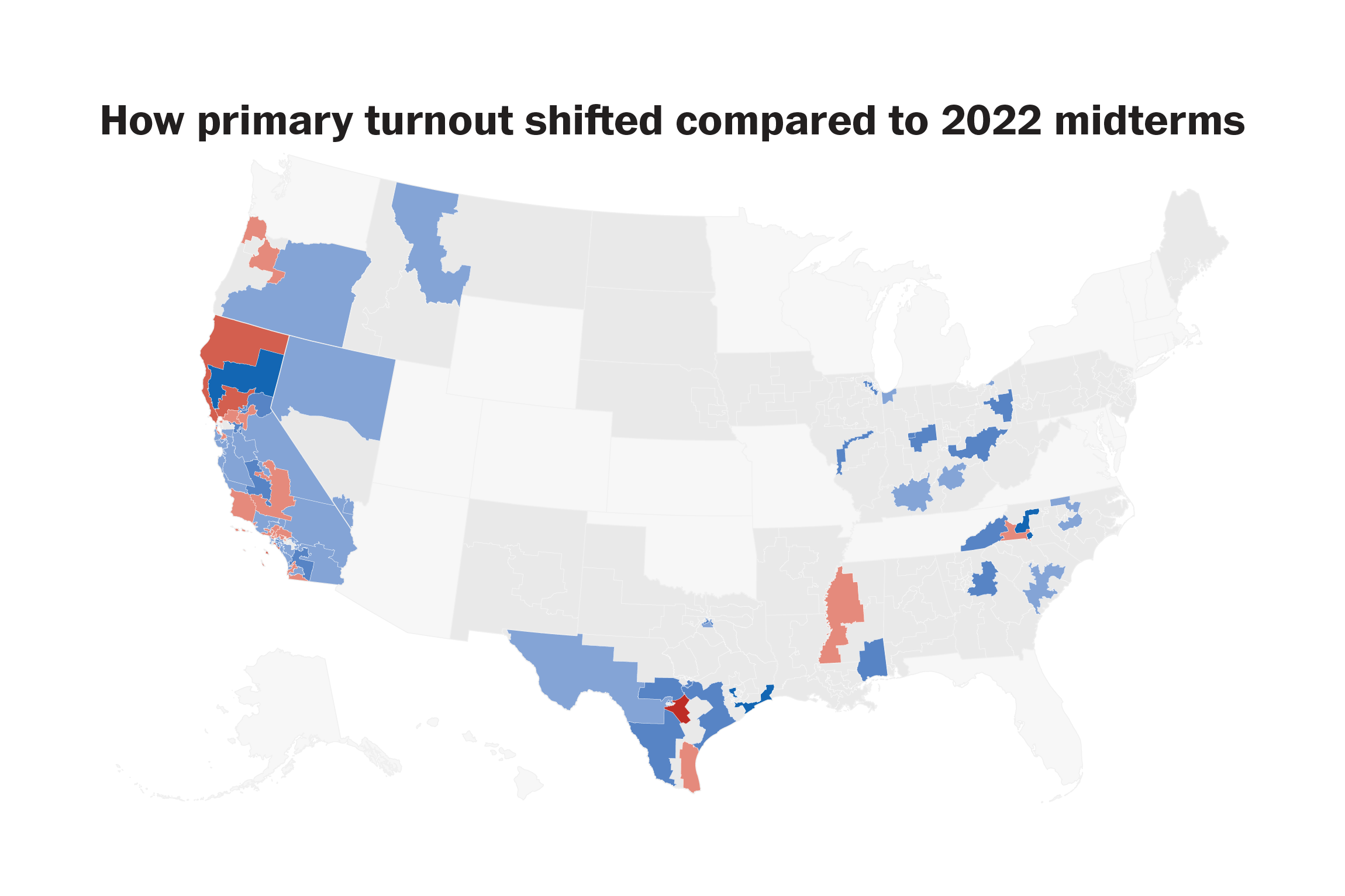
In over 90 percent of Democratic House primaries held this year, voters cast more ballots than during 2022, when Republicans flipped the House.
So far this year, people cast 12.6 million ballots in Democratic House primaries compared with 8.6 million in GOP primaries.
The gains in Democratic votes go beyond intraparty contests. Results of House special elections since President Donald Trump began his second term have shifted left, with Democrats outperforming their party’s previous nominees.
Election experts caution that primary and special elections do not always predict general-election trends.
Still, the increased votes, combined with polls showing voter discontent with a GOP-controlled Washington, have fueled Democratic hopes that they can retake control of Congress.
“Something would really fundamentally have to change in a way that would favor the Republicans to change the dynamics that we’re seeing right now,” said Michael McDonald, a voter turnout researcher and political science professor at the University of Florida.
Republicans say their financial advantage and a map that favors their party will matter more in November than voters showing up in crowded Democratic primaries. But Democrats see surging turnout as clear evidence that their message resonates and momentum is on their side.
Here are five takeaways from the Post analysis.
Midterms typically follow a consistent political pattern: The party out of power gains ground. This year is shaping up to be a strong rebound year for Democrats.
Turnout has already increased in nearly 93 percent of the 121 Democratic House primaries that were also contested in 2022, compared with 57 percent of the contested Republican primaries.
The primaries that saw the largest increases in turnout skewed heavily Democratic.
Turnout is surging in Democratic primaries for districts the party is heavily favored to win and likely to lose.
For example, Democratic votes increased 70 percent since 2022 in the primary for Georgia’s 10th Congressional District, a Republican stronghold.
Georgia Democratic Party Chair Charlie Bailey said he views the surge as a product of organizing in a battleground state and a sense of “betrayal” that life has gotten more costly under the Trump administration. Georgians choose which party’s nominating contests to vote in under an open-primary system.
Read more Schwarber, Harper homer again as Phillies beat Mets 6-2 to win series
Bailey noted that 54 percent of voters in the May primary selected Democratic ballots. That was the largest margin in a midterm primary since 1998, when Democrats held power in the state.
The median turnout for Democrats in contested House primary races has soared since past midterms. And it significantly exceeded turnout in Republican races, unlike the last two cycles when voters showed up in similar numbers.
The trend for people participating more in Democratic primaries holds regardless of the competitiveness of the district.
Turnout increased in more than 8 in 10 of the 82 Democratic House primaries that weren’t competitive in 2022 and aren’t this year. Of the 86 uncompetitive Republican House primaries, however, only 58 percent saw higher turnout.
Republicans, at Trump’s urging, tried to mitigate some of the traditional midterm partisan backlash by launching a national redistricting war that has left them with an advantage in 10 additional districts.
But even in districts redrawn to favor Republicans, more Democratic votes are still being cast in primaries.
Democrats still received a majority of votes in the primaries for three of the five districts redrawn in Texas to benefit Republicans. The share of ballots cast for Republicans in primaries grew in two of them.
In California, where voters approved a new congressional map designed to net five seats for Democrats, redistricting appears to be paying off. In each of the five new blue-leaning districts, the share of ballots cast for Democrats exceeded the number cast in the 2022 primaries. California candidates of all parties appear on the same primary ballot, and the top two finishers advance to the general election.
When presented with a choice between parties in special elections, Americans are increasingly voting for Democrats.
The outcomes of eight special elections for a House seat since the 2024 general election shifted in Democrats’ favor.
Democrats have also been performing better in special elections for state House races. Georgia state Rep. Eric Gisler (D) flipped a deep-red state legislative seat in the Athens area during a special election in December, prevailing in a district Trump had won by 12 percentage points one year earlier.
“Democrats are fired up in general. I think Republicans are a little more subdued,” Gisler said in an interview.
Gisler recalled seeing reelection signs in 2024 promising voters low prices. “Well, they’re not getting low prices,” Gisler said.
“When I talk to Republican voters here, they say they’re put off by what this administration and what the Republican Party has been doing,” he said. “It doesn’t mean that they want to rush over to vote for Democrats, but they’re very unhappy with what they’re seeing.”
The analysis is based on 2026 House primary results up to June 9 from the Associated Press, and primary races from 2018 and 2022 from the same districts. Primaries are compared between midterm years if a race was contested in both midterm years. Primaries are compared based on district number, regardless of redistricting. The votes in nonpartisan primaries are split by Democratic or Republican candidates and considered as separate primaries in analysis. A primary is considered competitive if the margin between the first-place candidate and the runner-up candidate is less than or equal to 10 percentage points. In nonpartisan primaries, competitiveness is determined within party lines. Special-election results are from the AP. The analysis does not include results from the special election in California’s 14th District held on June 16.
Read more Brendan Sorsby plans July workout for NFL teams before supplemental draft, AP source says