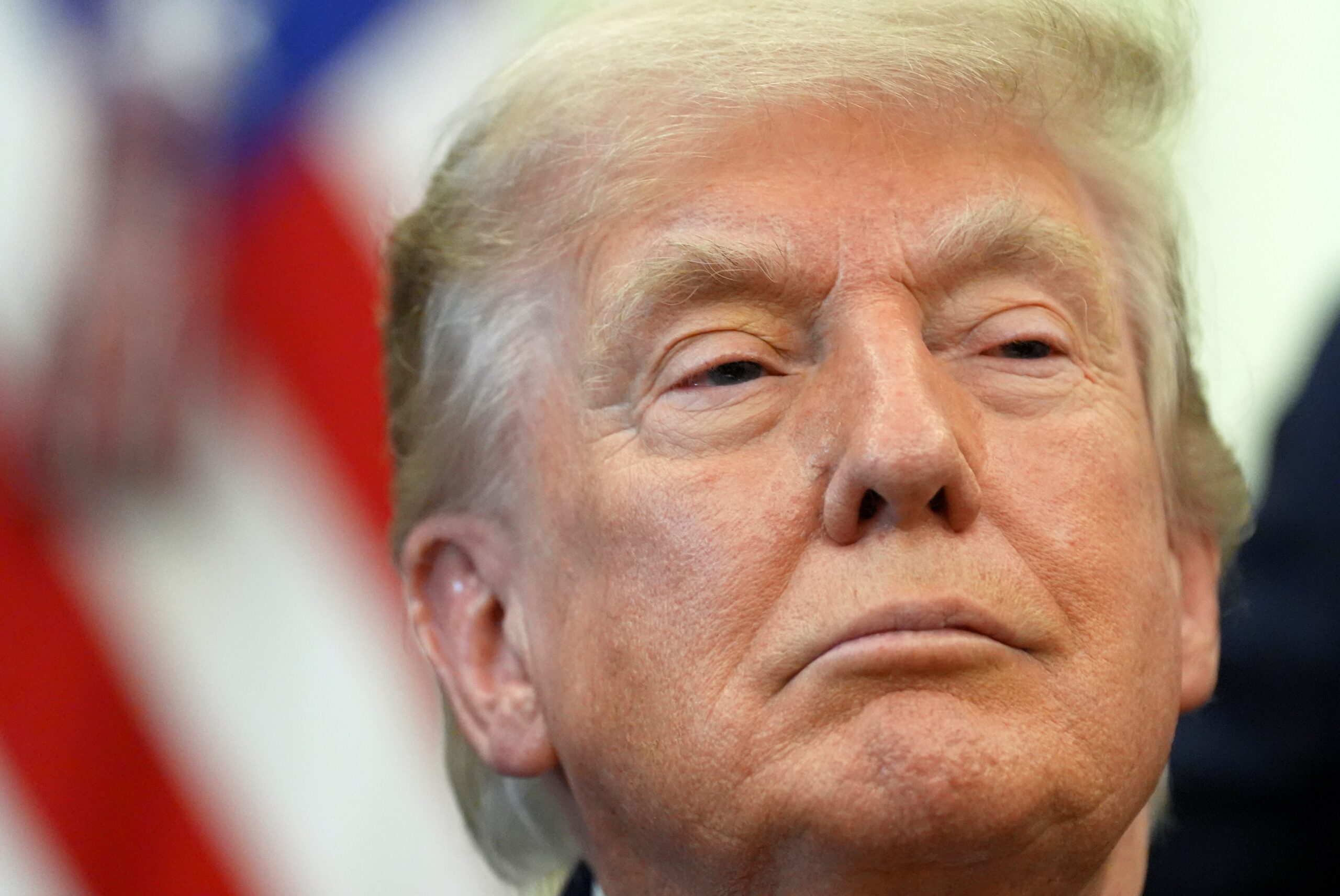
A book released this week from two veteran White House reporters gives a revelatory look into the inner machinations of President Donald Trump’s office as he sought to consolidate and project power, take unprecedented legal risks, and transform the nature of the presidency during the first year of his second term as commander in chief — with even fewer constraints.
Read more Democrats slam New York Republican candidate for ‘concentration camp’ remark
The book, “Regime Change: Inside the Imperial Presidency of Donald Trump,” from New York Times White House correspondents Maggie Haberman and Jonathan Swan, describes what they say are the behind-the-scenes moments that led to the president’s decisions to launch a war in the Middle East, relentlessly pursue retribution against a string of his perceived enemies, and dramatically transform the federal government.
“Regime Change,” released Tuesday, also has bucked a trend of books about Trump seeing sluggish sales and has driven conversations across Washington. The publisher has had to order 150,000 additional copies after 150,000 were sold by the end of the first day of sales, said Julia Prosser, Simon & Schuster’s director of publicity.
Here are some of book’s alleged revelations about Trump’s turbulent year you may not have heard about:
An email from the Office of Personnel Management to hundreds of thousands of federal workers about a month after Trump’s inauguration is said to have proved to become a major fissure between Musk — whom Trump had chosen to lead the U.S. DOGE Service — and his administration.
The email — with the subject line “What did you do last week?” — directed federal employees to outline within 48 hours five things they had accomplished in the previous week. A lack of a response, Musk wrote on X, would be seen as a resignation.
Senior staff at the White House, the book reports, were “in the dark about what Musk was doing,” White House Chief of Staff Susie Wiles “was livid” and Cabinet members were “agitated or enraged.”
The White House and representatives for Musk did not immediately respond to a request for comment on this passage.
Haberman and Swan outline how they say Witkoff, a former attorney and real estate investor named Trump’s Middle East envoy, built a diplomatic back channel with Russia.
Though Keith Kellogg, a retired lieutenant general, was initially selected to serve as Trump’s special envoy in Ukraine at the start of his second term, the book says the president quickly turned his sights to Witkoff for communications with Russia about the war. Trump allegedly told Kellogg “he was not to talk to the Russians.”
“Nobody on your team can talk to these people because we’re working on a deal,” Trump reportedly said during an Oval Office meeting, effectively giving his job as special envoy to Witkoff.
Witkoff, the book says, was reportedly in touch with Kirill Dmitriev, the head of Russia’s sovereign wealth fund, as a back channel to Russian President Vladimir Putin. Saudi Crown Prince Mohammed bin Salman endorsed Dmitriev as a back channel and also offered to facilitate talks with the Russians, the book says.
After meeting with Putin, Witkoff reportedly told Trump “that Putin had said he had been so upset on the day of the attempt on Trump’s life that he had gone to Mass to pray.” They also report that “as a gift, Putin had commissioned a portrait of Trump from that day in Butler — his face streaked in blood, his fist raised.”
The White House did not immediately respond to a request for comment regarding the book’s characterization of Witkoff’s role.
Vexed by the Federal Reserve, Trump toyed with firing Jerome H. Powell from his position as chair of the Fed’s Board of Governors in his first term before advisers talked him out of it, according to the book. In Trump’s second term, however, a close aide at the time told the reporters that Trump decided he was not going to fire Powell, “he’s just going to torture him.”
Last summer in the Oval Office, Trump said “it’s so fucking ridiculous” that Powell kept interest rates high, according to the book. “What about that fucking building? Can we stop it? Can we stop construction? I just want to bust his fucking balls,” Trump reportedly said during the meeting, referring to the Federal Reserve headquarters renovation underway in D.C.
Read more Supreme Court hands Trump major victories on his immigration agenda
White House spokesman Kush Desai, in a statement to The Washington Post, defended Trump, saying that he “rightfully called out the Federal Reserve’s track record of failure.” The Federal Reserve declined to comment.
As Trump took bigger risks in his second term, including many unpopular with voters and his own base, he cared less about polling, Haberman and Swan write.
Behind the scenes, according to the book, some Trump aides told Haberman and Swan they wished the president had been more anxious about “the dangers he was courting, and about his plunging poll numbers” — the unpopular war in Iran, the Epstein files, tariffs and the affordability crisis.
But, “to the extent he still cared about polling at all, he was seeing far fewer polls than during his first term,” the authors write. His advisers know that Trump is “not receptive” to being briefed on those harsh realities. “More than ever before as President, he was operating on pure gut instinct,” they write.
Desai, responding to The Post about the claims regarding the president’s indifference to polling, said that “the most important poll occurred in 2024,” when Trump was elected.
“The President does not make … important decisions based on fluid, and long discredited, opinion polls, but on what is best for the American people,” he added.
In June 2024, two senior OpenAI executives, Greg Brockman and Brad Lightcap, gave Trump — whom the authors describe as “not into AI” and someone who “had only begun sending text messages in 2022” — a demonstration of ChatGPT, according to the book.
But after watching ChatGPT instantly summarize an executive order on AI policy into a sentence where every word started with the same letter and then turn it into a poem, Trump reportedly said: “Those words it’s using. They’re beautiful.” The authors write that the president “was hooked” and “captivated by the masters of this new universe.”
After sitting for a candlelight donor dinner in April 2025, Trump and Nvidia CEO Jensen Huang grew their “mind meld,” the authors call it, as the U.S. gave near “free rein to the AI industry in one of the biggest bets of his presidency,” Haberman and Swan write.
Trump administration officials would “would quietly marvel at just how influential Huang appeared to be with the President,” they report.
The White House and OpenAI, which operates ChatGPT, did not immediately respond to The Post’s request for comment.
Haberman and Swan report they sat down with Trump in the Oval Office on the 17th day of the U.S. war with Iran to discuss the reporting in their book. By then 13 American service members and thousands of Iranians had been killed.
Looking at images of maple trees on the Resolute Desk, Trump said he was ordering trees for the White House. He then showed the reporters another printout with the headline “339 billion all-time views” of Trump’s TikToks — to which he asked them, “Can you believe it?” White House Communications Director Steven Cheung reportedly told them: “The numbers are out of control after the operation,” referring to the war with Iran.
A White House official said in a statement to The Post that the president “remains focused on keeping the American people safe, lowering costs for American families, and making this country greater than ever before — including the beautification of the White House and our nation’s capital.”
Read more After wins by democratic socialists, centrist Democrats unite to push back