
Members of Congress are still somehow disappearing for extended periods without much explanation.
Read more Trump aimed to finish these projects by July 4. Many are not done.
In today’s edition … Car loans are getting worryingly lengthy … you tell us your thoughts on working-class politicians … but first …
In August 1872, Rep. John V. Creely (R-Pennsylvania), in heavy debt, disappeared. The freshman congressman’s absence wasn’t noticed very quickly — Creely hadn’t been the most active member of the House to begin with, and news traveled slower back then.
Things have changed since 1872. We live in a virtual panopticon and everyone has a camera and a tracking device in their pocket.
And yet, members of Congress are still somehow disappearing for extended periods without much explanation.
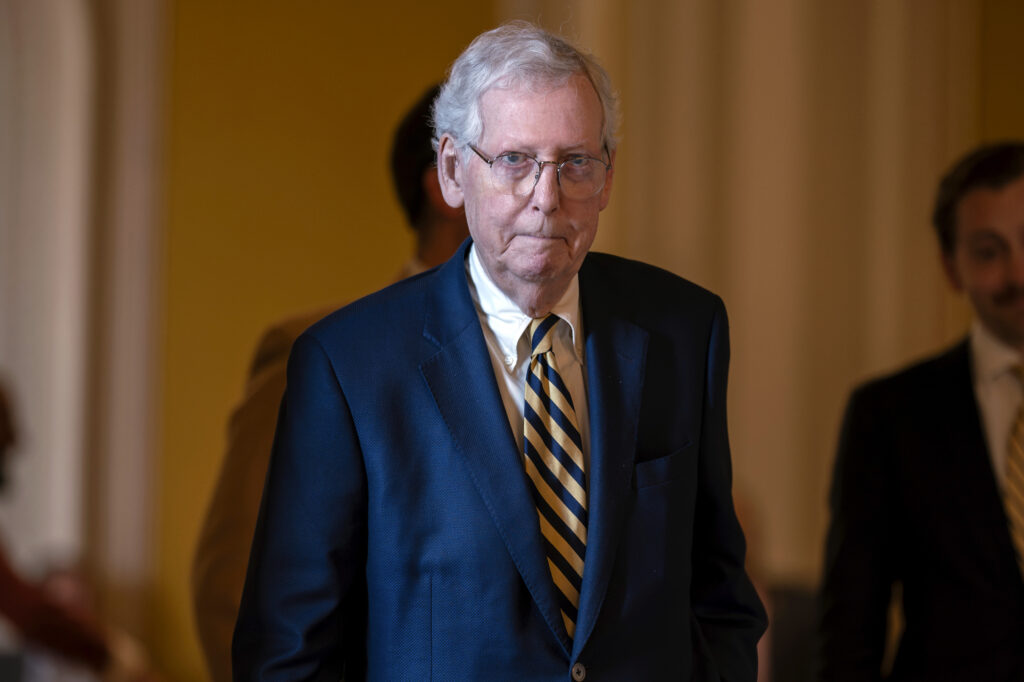
Sen. Mitch McConnell (R-Kentucky) was admitted to the hospital on June 14, and his office has been cagey about the cause of his lengthy hospitalization or his current state.
Rep. Tom Kean Jr. (R-New Jersey) missed more than 140 votes over the course of four months. He returned at the end of June and revealed he had been receiving treatment for depression.
Rep. Frederica Wilson (D-Florida) missed weeks of votes this spring, and only offered up an explanation after reporter Jamie Dupree pointed out her extended absence. The 83-year-old was recovering from eye surgery.
Last year, former representative Kay Granger (R-Texas) stopped showing up to Congress in the last few months of her final term. She was eventually found in an assisted-living facility, and her son later told the Dallas Morning News that she had “dementia issues.”
“Some of these episodes sound kind of like things that used to happen,” said Eric Schickler, a political science professor at the University of California at Berkeley who focuses on Congress. “We’ve gotten used to this idea that members of Congress show up and are supposed to be there and they’re going to get into political trouble if they’re not. I don’t think that was necessarily the case so much in earlier times.”
Schickler notes that serving in Congress didn’t really used to be a career, and with other professional responsibilities — not to mention the difficulty of traveling to D.C. from around the country — members would routinely be absent from Congress, with absentee rates on roll call votes of around 20 percent.
That started to change in the 20th century, as Congress professionalized, travel became easier, and the general public became more knowledgeable about the day-to-day activities of their representatives in D.C. But even with professionalization on Capitol Hill, there aren’t accountability structures in place for attendance.
Members of Congress are not required by law to divulge health issues that would interfere with their ability to carry out their duties, nor are they required to attend a certain percentage of votes. There have been cases of members of Congress missing years of their terms due to incapacitation, leaving their constituents unrepresented and refusing to let someone else give them a voice in Washington.
The only recourse for removing an incapacitated member of Congress is for them to retire, resign, lose reelection or be kicked out by two-thirds of the members of their chamber of Congress. Congress is notoriously hesitant to police its own and has become even more so during our deeply partisan times, particularly when one party has a narrow majority in a congressional chamber.
“We’re just in this era of really slim majorities and also such intense polarization,” said Schickler. “You want to hold the seat for your party.”
McConnell, 84, no longer leads Senate Republicans, but still holds roles in key committees, such as the Senate Appropriations Committee, where his absence has left the committee in a deadlock as they try again to hash out a plan to fund the government for fiscal year 2027 ahead of a Sept. 30 deadline.
The Appropriations Committee has already delayed hearings on some appropriations bills because of McConnell’s absence, a Republican aide told our colleagues Jarrell Dillard and Noah Robertson.
The situation is reminiscent of former senator Dianne Feinstein’s final months of life in 2023, in which the then-89-year-old senator’s health issues caused her to miss more than two months of votes. Even after she returned to Congress, concerns about Feinstein’s cognitive decline and ability to do her job remained. She died a few months later.
Feinstein’s decline left some voters with a sense that the person they elected to represent them was not being forthright about her ability to do so — concerns McConnell is now facing as well. These sorts of incidents have raised broader questions about the responsibilities officeholders have to their constituents when they find they can no longer carry out their duties, because of age, injury, illness or any other reason. (And as the United States’ 250th just reminded us, Americans really don’t like going without representation.)
Read more Bulldozing renegade John Riggins will get his number retired
“There’s a risk of a disconnect between Congress and the public. Voters see themselves as having jobs that they have to do and they’re held accountable,” Schickler said. “Congress clearly has long had a kind of reputation with the public and sticking around for a long time while not able to do the work doesn’t do anything to help the institution’s reputation with the public.”
Plenty of data points to the fragile state of the economy: gas prices climbing again, rising grocery bills, and the rise of “buy now, pay later” installment plans.
But this report from our colleague Todd C. Frankel really stood out: “New car buyers are taking out longer loans, putting less money down and financing more as they struggle to keep pace with new vehicle prices that today average close to $50,000.”
That is a worrying sign.
Edmunds, the automotive analysis firm, found nearly 24 percent of new-car loans were for at least 84 months, or seven years, a strikingly long payment plan as loans running past six years hit a new high of 36 percent, up from about 27 percent a decade ago.
Some of Edmunds’s analysis of this trend was particularly worrying.
“Car shoppers are caught in a dangerous practice of focusing heavily on their monthly payment while ignoring the potential long-term damage to their wallets,” said Ivan Drury, Edmunds’s director of insights. “Pushing loan terms past six or seven years might make an average monthly payment more digestible today, but it’s a mathematical trap.”
Drury explained that when you pay a 7 percent annual percentage rate over 84 months, you are paying $10,000 on average in interest.
“Unfortunately, stretching out the term to be able to swallow a higher-priced vehicle guarantees you’ll be building equity at a snail’s pace, leaving you highly vulnerable to falling underwater when it’s time to trade in,” Drury said.
Documented: The summer season is in full swing in Lake Placid, New York, host of both the 1932 and 1980 Winter Olympics, but ICE raids have caused “fear and anxiety among immigrant workers” who help power the local economy.
Tampa Bay Times: It’s a little disconcerting to see a home hoisted into the air. But the way the service — which puts a house on what are basically stilts to avoid flooding — is booming could represent a warning in our warming world.
Los Angeles Times: Bonnie Tyler, the raspy-voiced Welsh singer and songwriter known for her 1983 hit “Total Eclipse of the Heart,” has died at 75.
We received a lot of interesting feedback on our question about what counts as working class in politics. We wrote about how Democrats, facing troubling numbers from working-class voters over the last decade, are testing whether biography can solve a working-class problem.
“This is not as simple as it seems. There are many versions of working class from gig to mid level management. The issue, as I see it, is despite where one might be now, not forgetting how you got there. And not being corrupted by the lobbyists,” wrote Rick Prescott. “Most working class people have it tougher than is reported. All it takes could be one thing and their life is disrupted.”
Gary Cook took issue with our story, arguing we were conflating “experience with poverty and working class.”
“While I welcome politicians who understand the life situations that make programs like SNAP essential, I can also see that many “working class” people, whose families have scraped by in low-paying jobs (sometime multiple jobs), might not identify with the stories being told by these “up from poverty” candidates,” Cook wrote.
And Colin Beasley added that “background, while relevant, is not necessarily the leading indicator. ”
“Someone can come from working families and leave that socioeconomic life behind, both in how they live and how they attend to those around them. Empathy is the critical indicator; whether someone shows true empathy for the working class, regardless of their background, whose belief system, emotional intelligence, and emotional engagement recognizes the value of every human being and whose actions in policies supported, promoted and developed would be the true working class representative,” Beasley added.
And lastly, Mildred Champlin noted that Franklin D. Roosevelt was “the most privileged president” to ever serve but “did the most for the working class.”
The race to replace Graham Platner took shape yesterday. Our colleague Ben Binday has a good look at who could replace him, with these Democrats entering the race to varying degrees. Not all of you live in Maine and will have a choice in November, but we wanted to ask: Do you think someone who is aligned with Platner deserves to win the nomination? Or do all of Platner’s issues make it a better idea to nominate someone well outside of his orbit? What do you think? Let us and your fellow Early Brief readers know at [email protected].
Read more Arenado homers, Kelly pitches 7 strong innings as Diamondbacks beat Padres 3-1 to split series
Thanks for reading. You can follow Dan on X at @merica.