He has been intently focused on this and is expected to address the nation on it.
Read more Key GOP senator says Blanche must meet with Epstein victims to get his vote
Less than four months before the midterm elections, President Donald Trump is addressing the nation Thursday night. He’s expected to talk about his 2020 loss and false claims of voter fraud.
“It’s really big news,” Trump said earlier this week.
Election experts are skeptical Trump will announce anything earth-shattering. His administration has spent the past year and a half trying to find widespread evidence of voter fraud from an election held six years ago. To date, it has yet to publicly share anything.
“We know what happened with the 2020 election,” David Becker, a former Justice Department voting rights attorney and head of the nonpartisan Center for Election Innovation & Research, said in a briefing with reporters this week. “We know that it was the most reviewed election in American history.”
There is a concern among some election experts and Democrats that Trump could be laying the groundwork to declare fraud in November’s midterm elections if Republicans lose control of Congress or other big races.
Here’s what’s going on.
His administration has demanded sensitive voter data from all 50 states: The data could include personal information such as partial Social Security numbers or your mother’s maiden name. Some Republican-led states have turned it over voluntarily; other states have ignored the requests or fought the Justice Department in court and won.
“The motive for the request for voter data in the first place was always suspect,” Arizona Secretary of State Adrien Fontes (D) said in an interview this spring after his state won a lawsuit on the issue. “And we fought that tooth and nail and the way the DOJ was looking to potentially abuse or exploit voter information.”
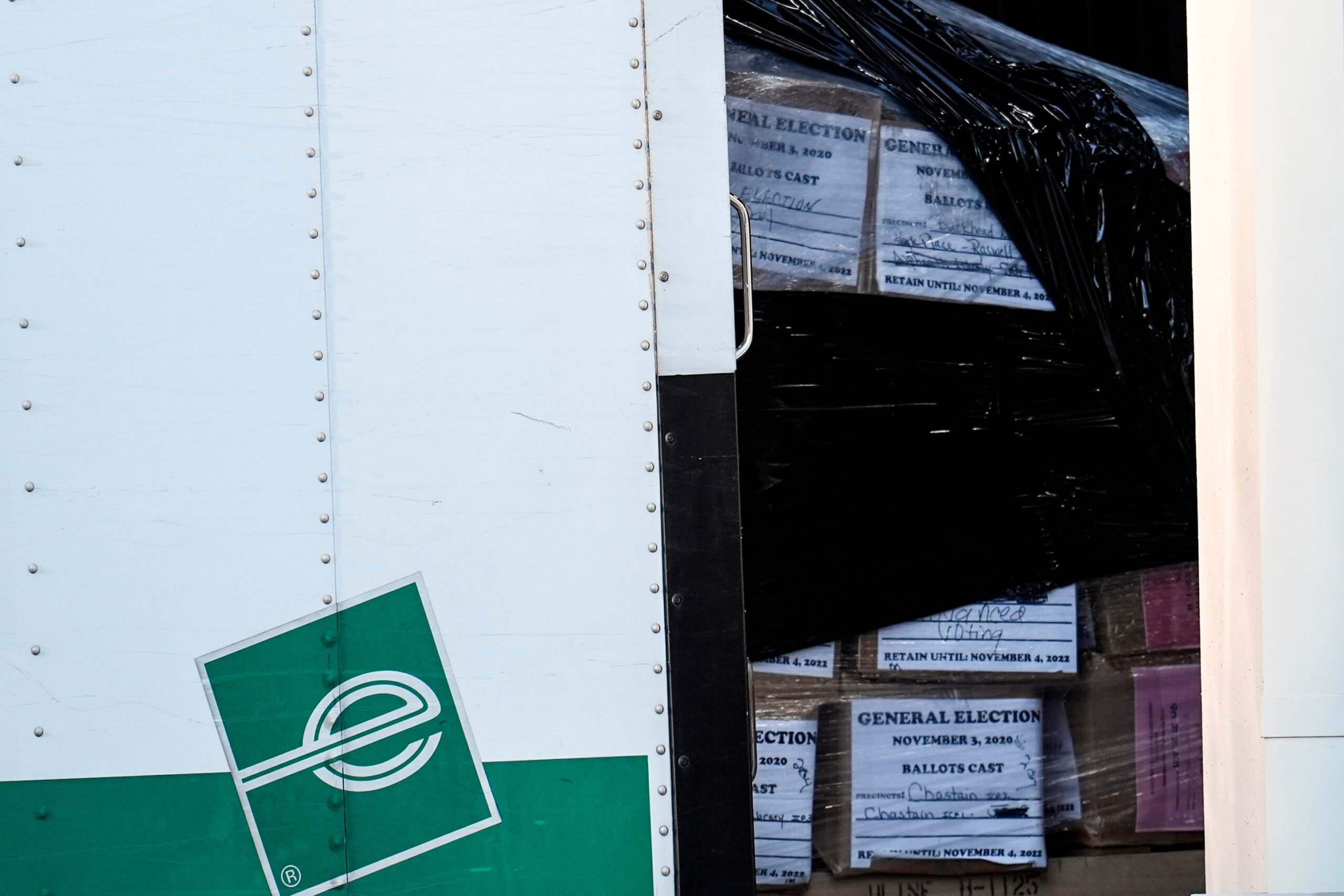
It has targeted 2020 ballots in some states Trump lost: Earlier this year, the FBI shocked election experts when it seized 2020 election ballots from Georgia’s most populous (and most Democratic) county. The FBI has also tried to get ballots in Arizona and Wisconsin.
“We have never seen the federal government step in and seize voting materials like this, anytime that I can remember,” said Tammy Patrick, a former election official in Arizona now with the nonpartisan Election Center.
States don’t normally hold on to ballots from past elections, but Georgia was required to after all the lawsuits from Trump’s campaign.
“I don’t know where they are now,” Fulton County Board of Commissioners Chairman Robb Pitts said after the FBI took the ballots. “I don’t know what they’re doing with them. Are they opening the boxes? Are they stuffing other ballots into there? I have no clue.”
It has been looking at voting machines in Puerto Rico: Trump’s focus on voting machines comes from more unproven conspiracy theories about why he lost in 2020.
Read more 19-year-old photos of Messi and a baby Yamal are delighting soccer fans
Election experts stress that voting machines are a safe way to tabulate votes and are protected by myriad safety nets: They aren’t connected to the internet, their access is closely guarded, they are tested before and after elections, and in most states there is a paper ballot record to compare against.
Becker says that examination of voting machines in Puerto Rico underscores how the administration is grasping at straws to try to find evidence of fraud. “If you’re trying to prove you were hacked in the last election, Puerto Rico is not your Plan A,” he said. “It doesn’t even have a vote for president.”
The administration has been looking into whether there was foreign interference in 2020: Other countries meddling in U.S. elections isn’t new. U.S. intelligence agencies have said that Russian and Iranian spies tried to influence Americans to vote a certain way in the 2020 election. They also determined Russia tried to influence Americans with disinformation and interfere with the vote in 2016, which Trump won.
The Washington Post reports that in his address, Trump is expected to claim that China or other nations accessed U.S. voter data. But beyond the privacy issues this raises, it’s not clear how that would change the outcome of an election, Becker said. “I could have my kid’s class list,” he said, “but I can’t change my kid’s grades.”
Since he got back into office, Trump has suggested banning mail voting, taking over voting in certain states, sending troops to the polls and even letting him count the votes — actions that would seem clearly unconstitutional. Presidents don’t have the authority to change elections, much less run them, and courts have struck down his attempts to do so.
The Constitution says states run their own elections, while Congress can dictate the time, place and manner. (Trump is trying to get Congress to pass voting restrictions for November’s elections but hasn’t been able to get the votes.)
“There are good reasons why we don’t have a single person, a president, in charge of elections,” Wendy Weiser with the Brennan Center for Justice, a nonpartisan think tank that focuses on democracy issues, told me last summer when Trump first suggested taking control of elections.
Amid all this, election experts say states are doing an excellent job running free and fair elections and hope that Americans will show up in high numbers in November to vote.
“We should be very proud we have gone 250 years and we are still having elections,” said Fontes, the Arizona secretary of state. He pointed out that elections have been held successfully through the Civil War, World War II, the 1918 flu pandemic and the coronavirus pandemic, as well as after an insurrection at the Capitol and countless natural disasters including fires in Hawaii and flooding in North Carolina. “We are an ornery bunch of Americans, and we are not going to let politicians in D.C. disrupt our way of expressing ourselves.”
Amber Phillips writes The 5-Minute Fix newsletter, a quick analysis of the day’s biggest political news. Send her an email here, or ask a question that could be featured in an upcoming newsletter.
Read more Federal panel urges changes to Trump plan to fence Lafayette Square