In their bid to counter GOP redistricting, Democrats debate breaking up Black-held districts.
Read more Perales has a shaky Nationals debut, but he arrives with a triple-digit fastball
A clash over Black representation in a recent South Florida congressional primary brought national attention to an increasingly urgent debate within the Democratic Party, as it searches for ways to counter the off-cycle nationwide redistricting campaign that President Donald Trump launched last year.
Republicans have added more than a dozen conservative-leaning House districts across the country, giving them an outside shot at holding on to their threadbare majority in November — and leaving Democrats, who have limited options to offset those gains, desperate to catch up.
Searching for places to create new blue seats, Democrats are considering breaking up urban districts drawn to elect Black members in liberal states such as Illinois, New York and Maryland, then moving some of those voters to Whiter, more conservative suburban districts. Some within the party vehemently oppose this idea because they fear it could further reduce the number of Black Americans in Congress, which is already set to take a hit from Republican redistricting.
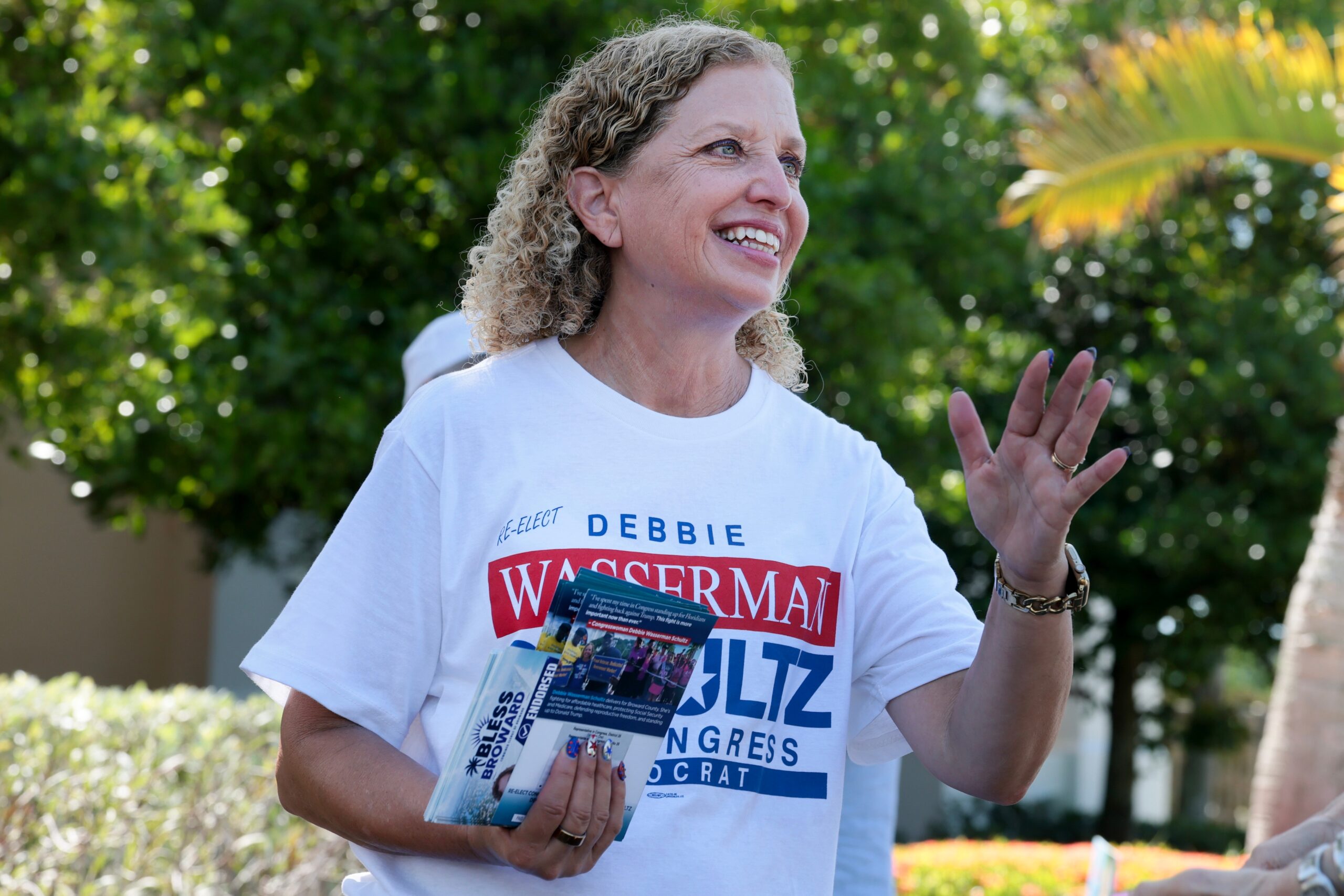
In Florida, Black politicians criticized Democratic Rep. Debbie Wasserman Schultz, who is White, for decamping from a more competitive seat to a safely Democratic but heavily Black district nearby after state Republicans redrew congressional lines this year to benefit the GOP.
Whether the seat — one of only about three dozen nationwide with a Black majority or plurality — should continue to have a Black representative, as it did for decades, became a major point of contention in the competitive primary, which Wasserman Schultz ultimately won.
Democrats are now facing a conundrum as they chart a path forward: When control of the House is on the line, how much can they afford to prioritize diversity in their ranks?
It’s a political headache for a party that prides itself on being powered by Black voters. About three-quarters of Black people lean Democratic, according to the Pew Research Center, nearly double the rate of White people. All but a handful of the five dozen Black members of Congress are Democrats.
“If we’re going to be in this together, then let’s truly be in this together. Let’s not do the pick and choose,” said Florida Rep. Felicia Robinson (D), chair of the state’s Legislative Black Caucus, who once called Wasserman Schultz’s decision to move districts “a slap in the face” to the Black community.
While she agreed that Democrats should prioritize maximizing House seats, Robinson said that, if the party silences Black voters in the process, “you make it kind of easy or more appealing for people” to become independents or Republicans instead.
House Minority Leader Hakeem Jeffries (D-New York), who declined an interview request, and his allies argue that Democrats may need to sacrifice some predominantly Black districts in order preserve Black political power on the whole.
They contend that winning back Congress is more important than protecting individual seats, because congressional control would allow Democrats to stop Republicans from further dismantling civil rights protections, including the extreme gerrymandering that has decimated Black representation across the South.
Chris Taylor, a spokesperson for the Congressional Black Caucus, acknowledged that redistricting could shift some of their members’ seats. But the interests of the Black community, he said, are not served if Republicans subservient to Trump remain in control of Congress.
“The shared goal of the caucus is to ensure that we’re able to fight for the American people,” Taylor said.
The matter is especially sensitive in the wake of an April Supreme Court decision that cleared the way for Republican states such as Tennessee, Louisiana and Alabama to eliminate Black-majority districts once protected by law. Without those seats, membership of the Congressional Black Caucus, which reached a historic peak this session, is poised to decrease next year. Some Democrats worry their party’s redistricting efforts could accelerate that decline.
“There could be backlash to the Democratic Party if they started trying to dilute Black voting power,” said Christian Grose, a professor of political science at the University of Southern California and director of its Democracy and Fair Elections Lab, who published a book on race and representation in Congress. “They are core members of the party.”
One early effort to expand the number of safe Democratic seats already snagged over concerns about diversity.
In Illinois, the push for another Democratic-leaning district — perhaps by shifting voters from a safe, historically Black seat on Chicago’s South Side to a Republican-leaning district in the outer suburbs — faded last fall partly because of opposition from Black state lawmakers, who objected to a new map that might diminish Black representation.
“How much more juice can you get out of that squeeze? I mean, there’s nothing left here,” said Rep. Jonathan Jackson (D-Illinois), who has held the South Side seat for two terms and opposes redrawing it. “The people don’t have an interest in that. The answer is no.”
Read more Commanders struggle to protect Jayden Daniels in joint practice with Ravens
Jackson said it’s important to preserve the distinct character and legacy of districts like his, which has had Black representation for nearly a century. Democrats should instead consider other strategies to flip Republican seats, he said, including reengaging with rural Americans and holding year-round voter registration drives to boost turnout.
“Let’s go play the rest of the map,” Jackson said. “This represents urban America.”
But Democrats are also under tremendous pressure from their increasingly restive liberal base to match Republican gains. While the GOP has already drawn itself more favorable lines in 16 districts since last year, Democrats have only picked up an advantage in six more.
In May, after the Supreme Court ruling that kicked off renewed Republican redistricting, a Politico poll found 45 percent of Democratic voters favored maximizing new seats over preserving majority-minority districts, compared to 32 percent who said it was more important to protect the voting power of Blacks and other minorities.
Jeffries and other Democratic leaders have waved off concerns about what redistricting will do to Black representation by noting that dozens of Black members, including Reps. Lauren Underwood of Illinois and Janelle Bynum of Oregon, were elected from districts with small Black populations, some of which are majority White. Unpacking predominantly Black seats, they say, does not necessarily mean wiping out Black members.
Political scientists like Grose agree that Democrats could reduce the number of Black voters in some districts while maintaining their decisive role in elections, because the Democratic primary electorate is more Black than the general voting population.
The proportion of Black voters needed to elect their preferred candidate to a House district in northern states is significantly lower than in the South, where voting trends are more racially polarized, said Andra Gillespie, a political science professor who directs the James Weldon Johnson Institute for the Study of Race and Difference at Emory University. That could allow Democrats to unpack heavily Black seats without losing their incumbents.
“You can put a multiracial Democratic coalition together,” Gillespie said.
Whatever the outcome of Democrats’ redistricting campaign, the consequences for Black voters could be significant.
Grose, the USC professor, said that while race does not appear to be a significant factor in congressional voting records, it does make a difference for constituent services. His research found that Black Democrats tend to allocate more resources, including federal funding, to Black communities than White Democrats in similar districts. He attributed that to “electoral coalitions” — Black members are more dependent on Black voters to win and consequently prioritize them more.
“What you end up doing as a member of Congress is you support your base,” he said.
More serious conflicts over representation likely loom after the 2030 Census. Populous and diverse Democratic states, such as California and New York, are projected to lose seats through reapportionment, potentially forcing them to combine majority-White and majority-minority districts and pitting incumbents against each other.
“What does that mean when you’ve got to figure out who loses a congressional seat?” Gillespie said. “That’s where I expect to see the fight happen.”
But this trade-off may ultimately matter more to politicians, whose careers are on the line, than the voters they represent.
Despite the furor in South Florida, Wasserman Schultz won her primary handily. Meanwhile, Black voters in Memphis returned Rep. Steve Cohen (D-Tennessee), who is White, to Congress for two decades.
Cohen, who is retiring this year after Republican state legislators cracked apart his majority-Black district, called it a “splendid example of people voting based on your work ethic, what you produce and the content of your character” rather than race. He said he earned the trust of his Black constituents with a long track record of supporting issues that mattered to them.
When Willie Herenton, the first Black mayor of Memphis, launched a primary challenge to Cohen in 2010, arguing that at least one member of Tennessee’s congressional delegation should be Black, Cohen still beat him by nearly 60 percentage points.
“Maybe the Black politicians want it, because it’s going to give them more clout,” Cohen said. “The proof is in the voters and they elected me over and over again.”
Read more Fired FEMA crew leader defends skipping homes with Trump campaign signs