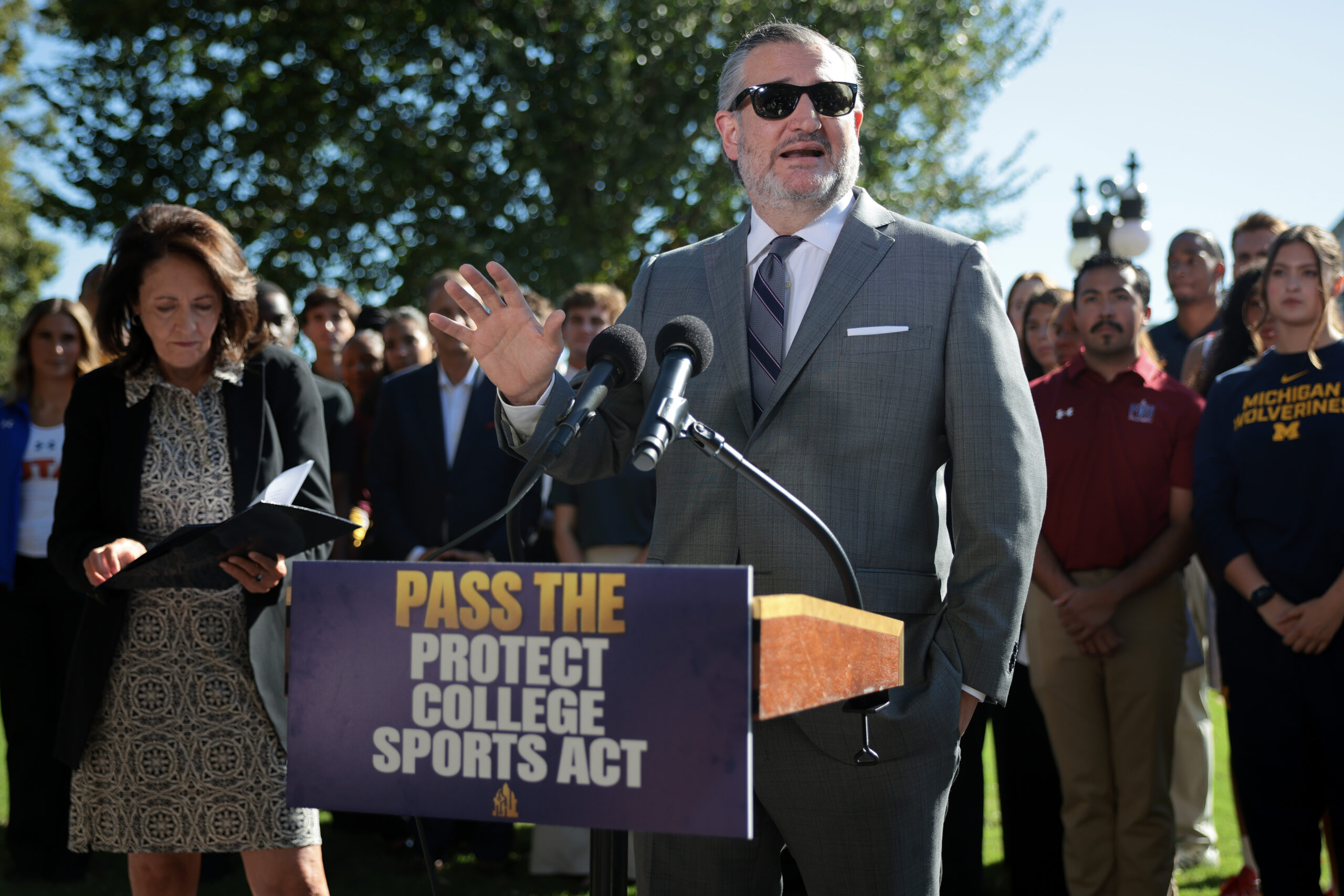
The Protect College Sports Act was approved by a vote of 77-22. The bill now heads to the House, which is divided over how Congress should intervene in college athletics.
Read more Trump dined with the Anthropic CEO who called for AI slowdown
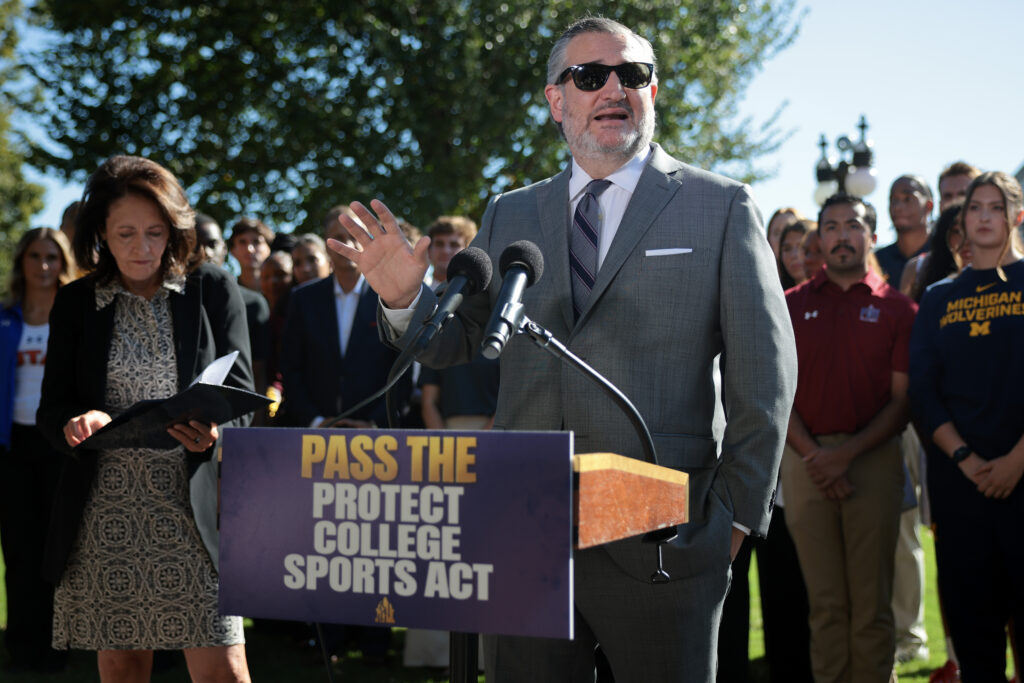
A sweeping bill that aims to remake college sports and impose order on a system transformed by athlete payments, frequent transfers and years of litigation cleared a major hurdle Monday night, passing the Senate with bipartisan support.
The Senate approved the Protect College Sports Act by a vote of 77-22. The bill now heads to the House, which is divided over how Congress should intervene in college athletics and is not expected to return to Washington until after the November election.
Sponsored by Sens. Ted Cruz (R-Texas) and Maria Cantwell (D-Washington), the bill would establish national rules governing so-called “name, image and likeness” payments to athletes, revenue sharing, transfers and eligibility. It also would create federal health, medical and academic protections for athletes while giving the NCAA, conferences and schools limited protection from antitrust lawsuits when enforcing the new rules.
“This bill puts an end to the chaos plaguing college athletics,” Cruz said on the Senate floor Monday, adding: “They system we have today is not sustainable, plain and simple.”
Sen. Cory Booker (D-New Jersey) made an impassioned plea to postpone the vote, citing the impact on athletes, especially Black athletes, and saying the Senate should focus on more pressing issues.
“Is this really what we should be spending our time on?” he asked. “I beg my colleagues not to do this. It’s wrong.”
Stakeholders across the college sports landscape have been calling for reform, but there has been little agreement over what it should look like or who should hold the power. Lawmakers have introduced numerous proposals in recent years, but none advanced this far. The Protect College Sports Act is the first comprehensive college sports bill to receive a full floor vote in either chamber of Congress.
For years, the NCAA was adamant that Congress should stay out of college sports. That changed as state laws and court rulings knocked big pieces out of its rule book. After losing in court again and again, the organization began lobbying lawmakers for a nationwide framework of rules, and enough legal cover to enforce them without being sued.
Since 2021, when a Supreme Court ruling and a wave of new state laws opened the door for college athletes to get paid, a patchwork of rules has governed their endorsement deals, creating a system that is at once difficult to understand and easy to exploit.
Under this bill, federal law would, for the first time, explicitly protect athletes’ right to profit from their personal brands and recognize their right to receive a share of athletic-department revenue.
The bill would keep the system created by the House v. NCAA settlement, a 2025 legal deal that allowed schools to begin paying athletes directly, sharing millions of dollars a year with them. The settlement limits how much each school can pay. The bill would let schools go over that limit through a separate fund meant to keep current players from leaving, with extra room if some of the money goes to athletes in women’s, Olympic and other sports that don’t bring in much revenue.
Athletes could continue signing outside NIL deals, but the agreements, which run the gamut from minuscule marketing deals to million-dollar contracts, would have to serve a legitimate commercial purpose and reflect an athlete’s market value. Schools, boosters and NIL collectives could not use purported endorsement deals to disguise recruiting inducements, as happens routinely now. Deals worth more than $600 would have to be reported, and agents’ fees would be capped at 5 percent.
The legislation also would create national transfer and eligibility rules. Division I and II athletes generally would have five calendar years to compete. They could transfer once without losing eligibility; a second transfer ordinarily would require them to sit out a season, with exceptions for such circumstances as a coaching change, the elimination of a sport or sexual harassment.
Schools could not reduce or revoke scholarships because of poor performance, injury or roster decisions. Division I athletes would receive coverage for out-of-pocket medical costs related to their sport for five years after their final competition, and former athletes generally would have 10 years to return to school and complete their degrees with scholarship support.
The bill also would establish national standards for concussions, heat illness, abuse and other health-and-safety issues.
Opponents’ central concern is the legal protection the bill provides to the institutions that would enforce its rules.
Athletes have spent years suing the NCAA and schools, arguing that limits on their pay and movement amount to illegal collusion, and many of the biggest changes in college sports have come out of those cases. The bill would block athletes from suing the NCAA, conferences and schools for enforcing its rules on revenue sharing, NIL, eligibility and transfers. It also would override state laws covering many of those areas.
Read more After mistrial, Pirro says she’ll bring Trayon White bribery case to new jury
“What this bill does, at its core, is to protect a system of exploitation,” Sen. Chris Murphy (D-Connecticut) said recently. He accused the college-sports industry of asking Congress to make conduct repeatedly challenged in court “magically legal” through an antitrust exemption.
For years, athlete advocates and labor groups have pushed for college athletes to be classified as employees, which would give them federal labor protections, including the right to unionize and negotiate over pay and working conditions. Murphy and Sens. Bernie Sanders (I-Vermont) and Elizabeth Warren (D-Massachusetts) have introduced legislation to do that.
The Protect College Sports Act sidesteps the fight. The bill does not give them collective-bargaining rights but instead would create a commission to study the issue and make recommendations.
That has prompted opposition from the AFL-CIO and several labor groups. They argue that schools should not be permitted to jointly limit athlete compensation and mobility without negotiating with athletes.
Some current athletes and advocacy groups also say they were not meaningfully included in the negotiations that produced the bill, even though it would establish rules governing their pay, transfers, eligibility and working conditions.
“There is an important difference between being heard and having power,” said Oluchi Okananwa, a Maryland basketball player and interim president of the United College Athletes Association. “If decisions can still be made for us without our agreement, that is not collective bargaining.”
The Congressional Black Caucus and NAACP also have opposed the legislation, saying Black athletes, coaches, agents and HBCUs were not meaningfully included in shaping a bill that will disproportionately affect them.
Critics additionally contend that the protections for women’s and Olympic sports do not permanently cover every school, and they note that the bill merely authorizes HBCU funding; Congress would still have to appropriate the money.
Supporters say college sports cannot continue operating under a patchwork of state laws, court rulings and NCAA policies. They argue that genuine endorsement deals have become difficult to distinguish from recruiting payments, and that unchecked spending threatens smaller athletic departments and nonrevenue sports.
“Real NIL is not the same as a disguised recruiting payment,” Cruz said. “Revenue sharing is not the same as unlimited cap evasion. Athlete mobility is not the same as permanent roster free agency.”
Cruz has said the bill provides legal certainty, not blanket immunity. Cantwell has emphasized that it would give athletes protections they do not currently have under federal law, including NIL and revenue-sharing rights, scholarship guarantees and post-college medical coverage.
President Donald Trump also has urged Congress to act, warning on social media that the current system could lead to “bankruptcies and disaster for many Colleges” and harm women’s and Olympic sports.
“We can’t have Professional Athletes going back to College for Big Dollars, and playing against much younger competitors,” Trump recently wrote. “It’s both dangerous and unfair!”
The bill is likely to encounter resistance in the House, where objections have been more vocal. The Congressional Black Caucus, a potentially important bloc in the closely divided chamber, has said it cannot support the legislation in its current form, arguing that it gives powerful institutions new legal protections without adequately representing the interests of Black athletes.
House lawmakers have pursued their own college-sports legislation but have struggled to assemble enough support to pass it. Members are not expected to return until after the election, leaving only the lame-duck session to consider the Senate bill.
The House would have to approve the same language or work with the Senate to reconcile the chambers’ approaches before the current Congress leaves town in mid-December. Otherwise, lawmakers would have to start over next year.
White House support means Trump’s signature is unlikely to be an obstacle. The question is whether the bipartisan coalition that carried the bill through the Senate can survive a more divided House and a crowded post-election calendar.
Read more The 9 Senate seats most likely to flip party control in November