In today’s edition … Trump is putting his face and name on more things … You tell us your thoughts on Trump’s potential NBA appearance … but first …
Read more Curtis Mead, a former top prospect whose career had stalled, finds traction in D.C.
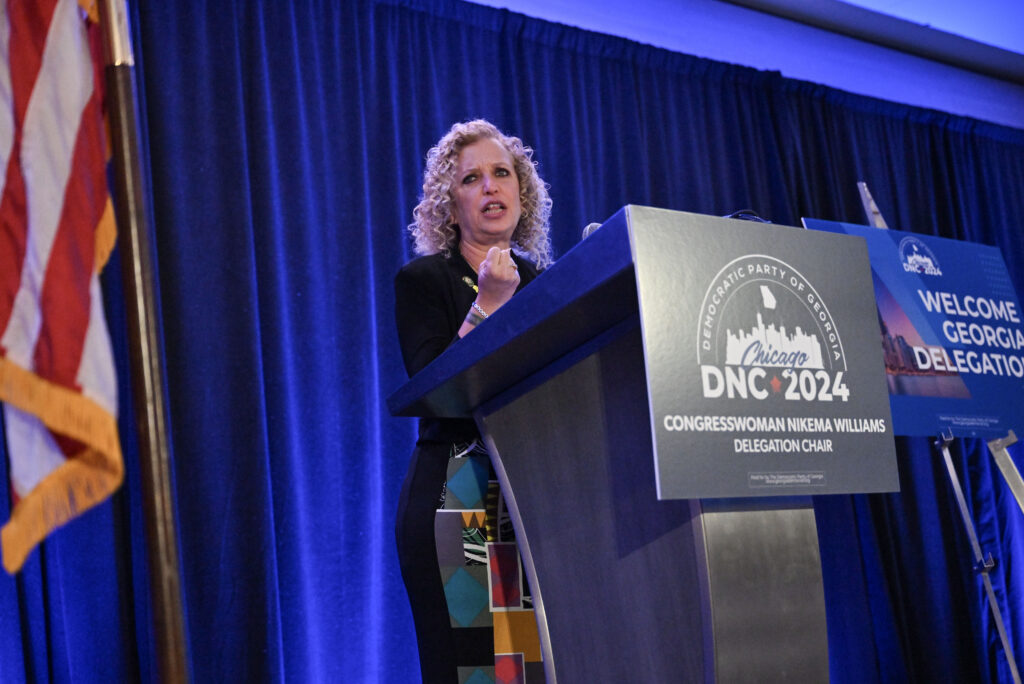
Can a White congresswoman represent a historically Black congressional district?
The provocative question is swirling around Florida’s 20th District, where Rep. Debbie Wasserman Schultz, a former DNC chair and longtime member of the House, announced last week she will run. She currently represents the 25th District, and her decision to switch is ruffling feathers in Florida.
The 20th District is nearly half Black and contains several historically Black communities in Broward County. It was drawn to ensure Black Floridians in the area would not have their votes diluted under the Voting Rights Act. Former representative Sheila Cherfilus-McCormick last held the seat from 2022 until her resignation this year. She stepped down following allegations she stole FEMA funds.
But after the state’s Republican-led legislature redrew district boundaries, Wasserman Schultz’s home district become much less Democratic, with Cook Political Report rating it a toss-up race this year. Rep. Jared Moskowitz (D-Florida) announced yesterday he would run in Wasserman Schultz’s old seat.
Wasserman Schultz’s move to the much safer 20th District angered many Black Floridians who saw it as taking a seat that should be held by a Black member. The new district is still roughly 45 percent Black and contains only a small portion of Wasserman Schultz’s original district.
“Majority Black districts are going away, and they’re important. They led to some great things and some amazing people in Congress, and those are going away,” former state representative Sean Shaw, who is Black, told us. “And for her to decide that she was so important and so senior and so necessary to the party that she would run in one of those few remaining Black seats is infuriating.”
The controversy expands beyond the district. After the Supreme Court struck down a provision of the Voting Rights Act protecting majority minority districts in Louisiana v. Callais last month, Democrats fear Black representation in Congress will be diluted with Republican-led redistricting.
Several Black DNC members condemned Wasserman Schultz in a statement this week. Shaw was one of the signatories to the letter.
“After Callais, Democrats across the country argued that majority Black districts matter and that we need to defend them,” Juan Cuba, another DNC signatory to the letter, told us. “She’s the former chair of our party. I think we would look hypocritical when we say, ‘well, the voters like me in the district so I’m going to run here,’ instead of running in a district where she currently lives.”
Similar dynamics have played out elsewhere in the country as mid-decade redistricting pits Democratic incumbents against each other. In Texas’s 37th Congressional District, Reps. Greg Casar and Lloyd Doggett, both of whom are Austin-based, faced off against each other in an intergenerational clash. Doggett, a 16-term incumbent who is the last White male Democrat from Texas in Congress, dropped out of the race after several prominent Austin Democrats told him to pass the torch to the 37-year-old Latino Casar.
Wasserman Schultz, with her high name-ID from decades in Congress and years chairing the DNC, is likely the favorite to win in the 20th District. But the move severely ruptured her standing with many Black Democrats, Shaw said.
Elijah Manley, a candidate in the 20th District, said Wasserman Schultz could win if the Black electorate splits its vote among the Black candidates in the race. He called her move “selfish” and “cynical.”
Republicans are noticing the tension in the district and joining in the attacks on one of their favorite targets.
“Debbie Wasserman Schultz is abandoning her home district because she knows she was headed for defeat in a seat President Trump won by double digits,” Maureen O’Toole, a spokesperson for House Republicans’ campaign arm, said in a statement. “Instead of facing voters after years of backing Democrats’ failed agenda, Wasserman Schultz is running scared and handing Republicans a prime pickup opportunity.”
But the sentiment that Wasserman Schultz would handily win in the primary relies on a fundamental premise: that few Democrats in the district actually oppose her. She may not look like a lot of the district, but she has represented her section of South Florida, including many Black voters, for years.
Jodi Davidson, who served as Wasserman Schultz’s district director from 2005 to 2016, said the vocal criticism of a few in the district does not reflect the larger community.
“Election Day will tell us what the community at large or even individual communities think of that,” Davidson said. “There’s a very loud vocal minority that’s upset about it, but I’m hearing just as many people from Black communities and other communities who are really excited about her run. … She knows how to turn policy into reality and bring home the bacon.”
Davidson defended Wasserman Schultz’s seniority in Congress as a crucial asset for the region. She cited Wasserman Schultz’s position on the Appropriations Committee and knowledge of inside baseball, which she said allowed her to stop drilling in the Everglades and bring money back to the district.
“There’s nobody who fights harder for her district than Debbie,” another former adviser to the congresswoman told us. “While I do understand the controversy there and I do think there are some credible candidates, I understand the situation she’s in as well. But she does have a proven track record of delivering for her community.”
State Sen. Shevrin Jones (D-Florida) had a similar perspective, though he ultimately thought Wasserman Schultz should not have run in the 20th District. Jones praised the congresswoman for effectively advocating for Broward County for years, including bringing federal funds for the county and coming out to churches during the pandemic to help with relief efforts.
“The work that Debbie has done in this community and the work that Debbie has done for the Democratic Party at large is unmatched. I would never take that away from her,” Jones said.
Still, he felt it important to have a representative whose “lived experiences” matched those of the Black electorate. He said she would have to have tough conversations to repair relations with many members of the community after the election.
Read more England forward Anthony Gordon set to complete his transfer to Barcelona from Newcastle
Jones said he spoke with the congresswoman before her decision to run in the 20th District and said she was “very receptive” to his concerns about not having a Black representative. But she felt the Florida Legislature had put the party in this position.
“This is not to say that Debbie cannot represent Black people,” Jones said. “What I am saying is that it is important that Black representation be seen in that community because that is what the legacy of that seat has been.”
Wasserman Schultz’s campaign didn’t respond to request for comment.
Our colleague, Jonathan O’Connell, broke the news yesterday that Trump administration officials have pressed the Bureau of Engraving and Printing to design a $250 bill featuring the president’s portrait, citing four current and former employees.
The push is the latest in a long line of Trump-acolyte suggestions to put the president’s face, name and likeness on all sorts of American institutions, from the Kennedy Center in Washington, D.C., to Dulles International Airport in Virginia to Pennsylvania Station in New York City.
As Jonathan reported, this would be the “first appearance of a living person on U.S. currency in more than 150 years.” Federal law currently allows only deceased people to appear on bills, but a bill introduced in Congress last year would allow Trump to appear on a $250 bill to commemorate the nation’s 250th anniversary.
The director of the printing bureau, Patricia “Patty” Solimene, was reassigned after she explained to officials pressuring her, “there were legal and procedural obstacles to producing the note and that it would take years longer than they envisioned.”
We have documented in this newsletter how Republicans have used Trump’s desire to see his name in prominent places to woo the president. Sen. John Cornyn (R-Texas) proposed that Highway 287 “be known as Trump Interstate” to impress the president before Trump endorsed Cornyn’s primary opponent. Palm Beach International Airport was successfully renamed President Donald J. Trump International Airport earlier this year. And a Republican event wanted to rename the Washington Metropolitan Area Transit Authority to the “Washington Metropolitan Authority for Greater Access” (WMAGA) — in honor of the president’s political movement — and the train system the “Trump Train.”
Democrats predictably lambasted the idea. “Ridiculous. So many Americans can barely even afford a $250 emergency, ” wrote Rep. Pramila Jayapal (D-Washington). “In violation of laws against putting a living president’s likeness on our currency, Donald Trump wants his image on a $250 bill,” wrote Sen. Adam Schiff (D-California). “How about trying to help Americans with their bills instead?”
Whether the plan happens or not, it is yet another sign that Trump’s push to remake Washington, D.C., and the federal government is as much about his legacy as a leader as it is about seeing his image anywhere and everywhere.
Spectrum News Maine: The race to be Maine’s next governor is getting very interesting. Former state Senate president Troy Jackson and former Maine CDC director Nirav Shah are locked in a tight race on the Democratic side, besting a few well-known names. Former assistant U.S. secretary of state Bobby Charles is leading on the Republican side, besting a member of the Bush family.
The Salt Lake Tribune: How dire are drought conditions out West? Utah officials have been burning stands of phragmites, an invasive wetland plant, because they drink considerable water that is needed for noninvasive plants and animals.
Washington City Paper: Yelling “fire” in a government office? That will cost you more than $1 million. According to the local publication, D.C. officials spent $1.5 million on a human fire watch and fire alert system repairs in the district’s long-maintenance-plagued Marion Barry Building.
Trump may go to an NBA Finals game in New York in the coming days, raising the specter of fervent boos from the famously blunt New York Knicks fans.
Our readers think Trump will welcome the boos because, after all, it is attention.
“If people are booing, it means they are giving him attention — and that’s what he craves. Whether it’s a cheer or a boo, he is in your mind, which means he’s got your attention. It’s sad, really,” wrote Michelle Justiniano.
“As I see it Trump shows up just to make an appearance, just like he did in the movie ‘Home Alone,’” wrote Rick Prescott. “He walks in waving at no one just so he can use it for some form of demented PR.”
And Debbie Jarmusik said, “he probably thinks the fans are booing someone else, not him.”
We’ve asked this in the past but with Michigan Gov. Gretchen Whitmer causing a stir with her 2028 stance, we’d like to check in with you again.
Are there any 2028 candidates you’re excited about, Republican and Democrat? Who?
Let us and your fellow Early Brief readers know at [email protected].
Thanks for reading. You can follow Dan and Matthew on X: @merica and @matthewichoi.
Read more This is how Arsenal can upset the odds to beat PSG in the Champions League final