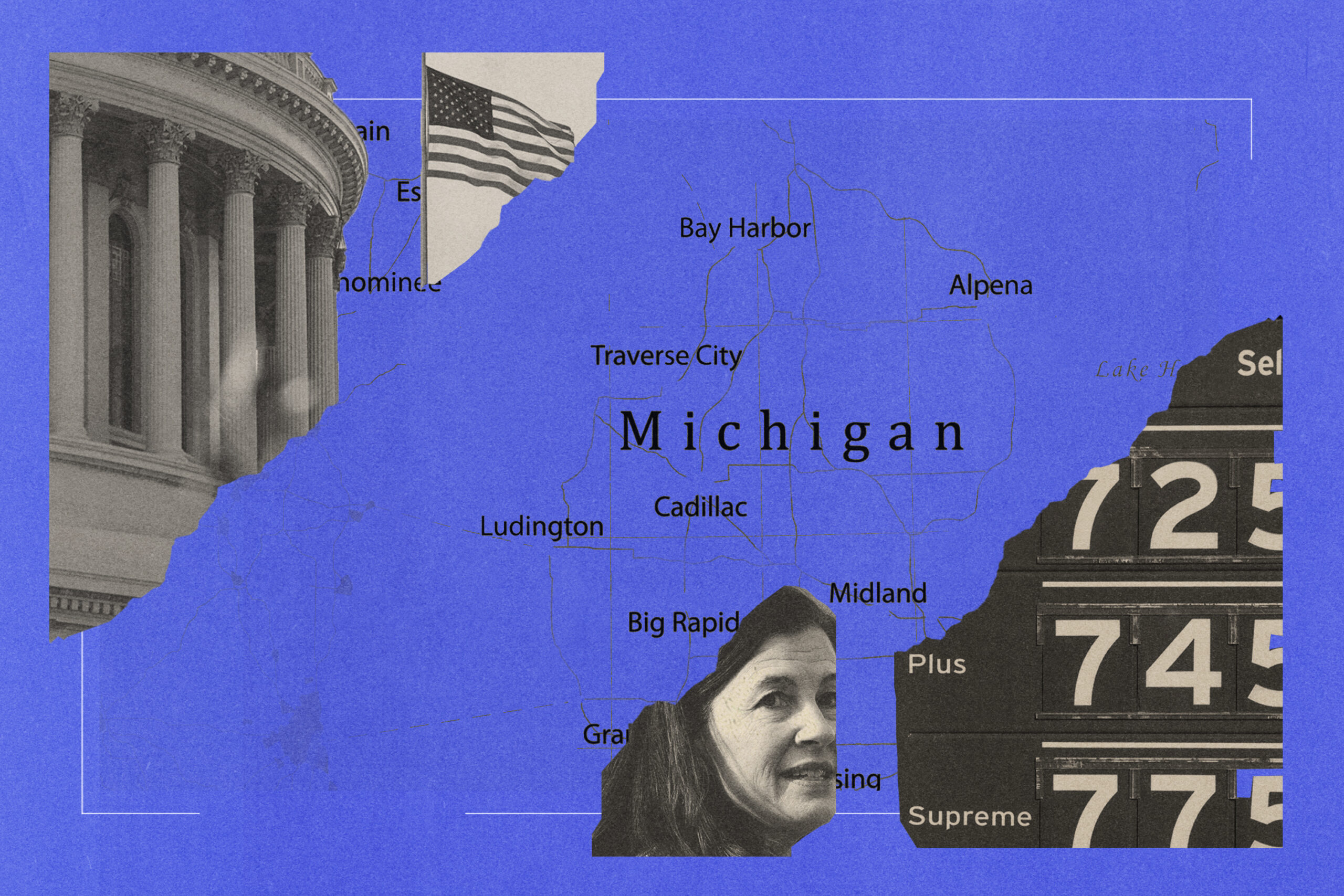
The race for Michigan’s Democratic Senate nomination, which will be decided in its Aug. 4 primary, is potentially the most significant battle in the struggle this year between the party establishment and its democratic socialist-aligned left.
Read more Trump approval stuck in the 30s amid pessimism on Iran and economy, poll finds
But that sectarian drama inside the party rarely comes up when Rep. Kristen McDonald Rivet speaks with her constituents. The freshman Democrat won by almost seven percentage points in 2024, even as Donald Trump narrowly carried her district, Michigan’s 8th, by two percentage points.
More typical is the anguished conversation she had recently with a mother in Saginaw who works two jobs and still doesn’t have enough money left over from paying her bills to take her two small children on a vacation.
“It’s this frustration that I hear over and over and over again from people. Their utility rates are rising. Grocery prices are rising. Gas prices are rising in Michigan,” McDonald Rivet said. “You hear a little bit of talk about politics, but most people are just talking to me about how to figure out how they can make it.”
That is why McDonald Rivet asserts that Democrats cannot afford to argue over ideology and doctrine and that instead they should reconnect with the working-class voters who have abandoned their party.
“There is this debate around philosophy inside the Democratic Party that actually isn’t real for me. It’s not real for me and my district. It makes for great talk on a 24-hour news channel, but what we really need to do is to make sure people are safe, that people can afford their groceries, that they can afford their utilities,” she said. “What’s capturing the political conversation is this debate around the democratic socialists versus the moderates. That’s a conversation about philosophy when people are drowning.”
“Drowning” is a word that has also been coming up in the focus groups being conducted by the Democratic Congressional Campaign Committee to gauge voter concerns in key districts.
Starting around the beginning of this year, “there was this change,” said Will Van Nuys, the DCCC’s deputy executive director, who has monitored focus groups since 2008.
“It is not unheard of, when you are talking to working-class voters, to hear folks talk about how they’re fighting paycheck to paycheck,” he said.
But what Van Nuys is hearing lately has deviated from that. “It moved into what I would call a little bit more of an existential fear about the economy, where voters are now starting to say, ‘I am drowning,’” he said. “I don’t remember hearing that — seeing that — since the financial crash of 2008-2009.”
Despite the attention on how backlash against establishment Democrats has boosted progressive candidates in their primaries, those victories have largely happened in deep-blue areas where the party was pretty much certain to win in November.
Michigan’s Senate primary will test the appetites of Democratic voters in a swing state that is crucial to the party’s hopes of regaining a majority.
Read more Sununu’s false answer about Qatar fuels Epstein-files fight
It pits Abdul El-Sayed, a former public health official who has the endorsements of Sen. Bernie Sanders (I-Vermont) and Rep. Alexandria Ocasio-Cortez (D-New York) and the organizational backing of the Democratic Socialists of America, against Rep. Haley Stevens, a moderate House member around whom Senate Minority Leader Chuck Schumer (New York) and much of the Democratic establishment have rallied.
Stevens picked up what could be a key endorsement on Monday, when retiring Democratic Sen. Gary Peters announced she had his backing, largely because he believes she has the best chance of winning in the fall. “It’s pretty difficult to win the majority without Michigan,” Peters said. “Not that it can’t be done — but it’s certainly a lot easier if we hold this seat.”
El-Sayed and his supporters dispute the perception that Stevens is more electable. And it is not outside the realm of possibility that, in the current political environment, Peters’s endorsement backfires by bolstering El-Sayed’s argument that he is the best choice for voters seeking to upend the status quo.
Also open to question is how influential the progressive Democratic wing really has become across the map — something the Michigan result could help clarify.
More moderate candidates favored by the establishment have been holding their own in competitive areas, a recent analysis by Cook Political Report’s Erin Covey found.
In the 22 primaries that have taken place in Republican-held districts that Democrats hope to flip, 14 winners had the explicit backing of the DCCC, the center-left New Democrat Coalition, or the Blue Dog Coalition.
Some Democrats argue that they can win the midterms by ginning up the educated, activist left and that it would be fruitless for the party to pursue working-class Americans, who increasingly have voted Republican.
But looking at places where the election will be won or lost gives a different picture. In the three House districts where Democrats lost by the closest margins in 2024 — a combined 7,309 votes in Iowa, Pennsylvania and Colorado — roughly two-thirds of registered voters do not have college degrees, according to DCCC data. Had the party done better with these working-class voters, Democrats would have regained control of the House.
McDonald Rivet is a slight favorite to win her bid for reelection this year and has not endorsed a candidate for the top of the ticket on which she will be running.
“I want to support whoever comes out of the primary,” she said, even as she took issue with some of El-Sayed’s more liberal stances on the environment, which she suggested would hurt the Michigan economy, and Medicare-for-all, which she says is politically infeasible.
“It’s possible to be pragmatic and bold at the same time. It is a certainty that every single person in this country needs access to health care. Full stop. Full stop,” she said. “We have to use the system that we have in this country and actually work on getting there, not debate what label people put behind their name.”
Read more 5 things we learned on the first day of Blanche’s confirmation hearing