President Donald Trump used his prime-time address Thursday to amplify an exaggerated claim that noncitizens are registering to vote en masse, threatening to undermine the nation’s secure elections.
Read more Trump expected to award World Cup trophy on Sunday
Doubling down on these dubious assertions, the Trump administration then threatened to punish states by withholding funding and arresting election officials if noncitizens vote in states that fail to participate in federal programs purporting to secure elections.
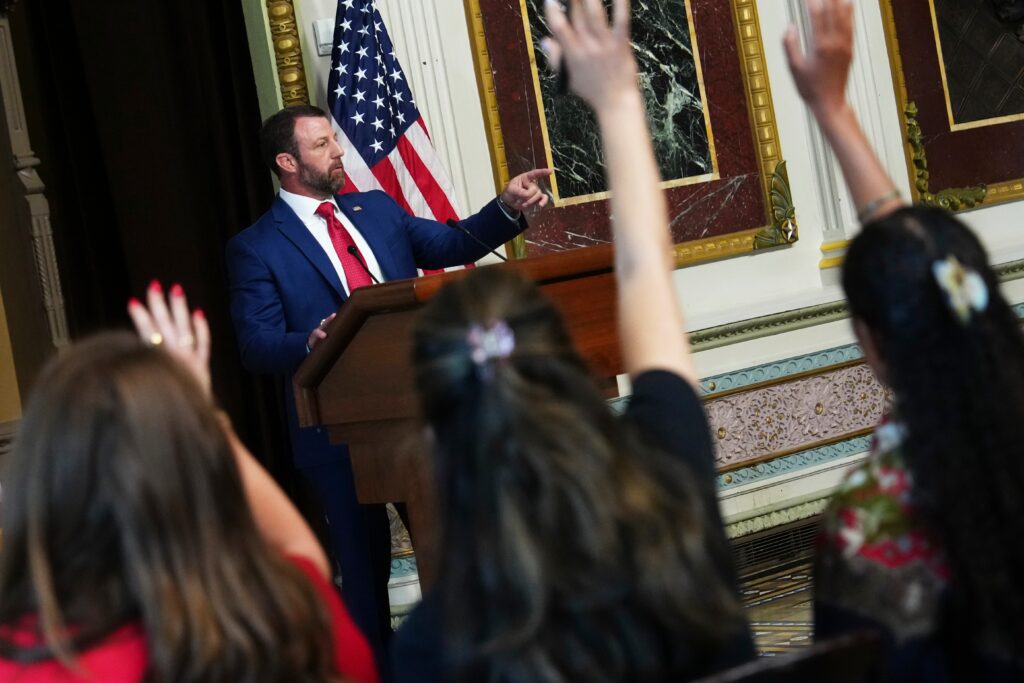
“We are not going to spend taxpayer dollars reimbursing a state that is refusing to secure our elections,” Homeland Security Secretary Markwayne Mullin said in a news conference Friday morning, the day after Trump’s address on election security.
According to Trump and Mullin, about 278,000 noncitizens are unlawfully registered to vote in federal elections in a number of states where they said the rolls were reviewed. They said 250,000 of those people were in just four states: Nevada, California, Pennsylvania and New Jersey. Their assessment did not include all states.
The president’s claim suggests that noncitizens who cast ballots could unlawfully swing election results in a particularly tight federal race.
But a review of public documents and interviews with government officials and election experts shows that the figure is significantly overstated and that officials have struggled to find instances of voter fraud by noncitizens to back the president’s assertions. Assessments by government officials and outside election experts have repeatedly concluded that noncitizens represent a miniscule number of voters.
“We can affirm that on its face, we refute these claims. These numbers are wildly speculative at best and the Department of Homeland Security hasn’t shared anything that backs it up,” Nevada Secretary of State Francisco Aguilar said in a statement.
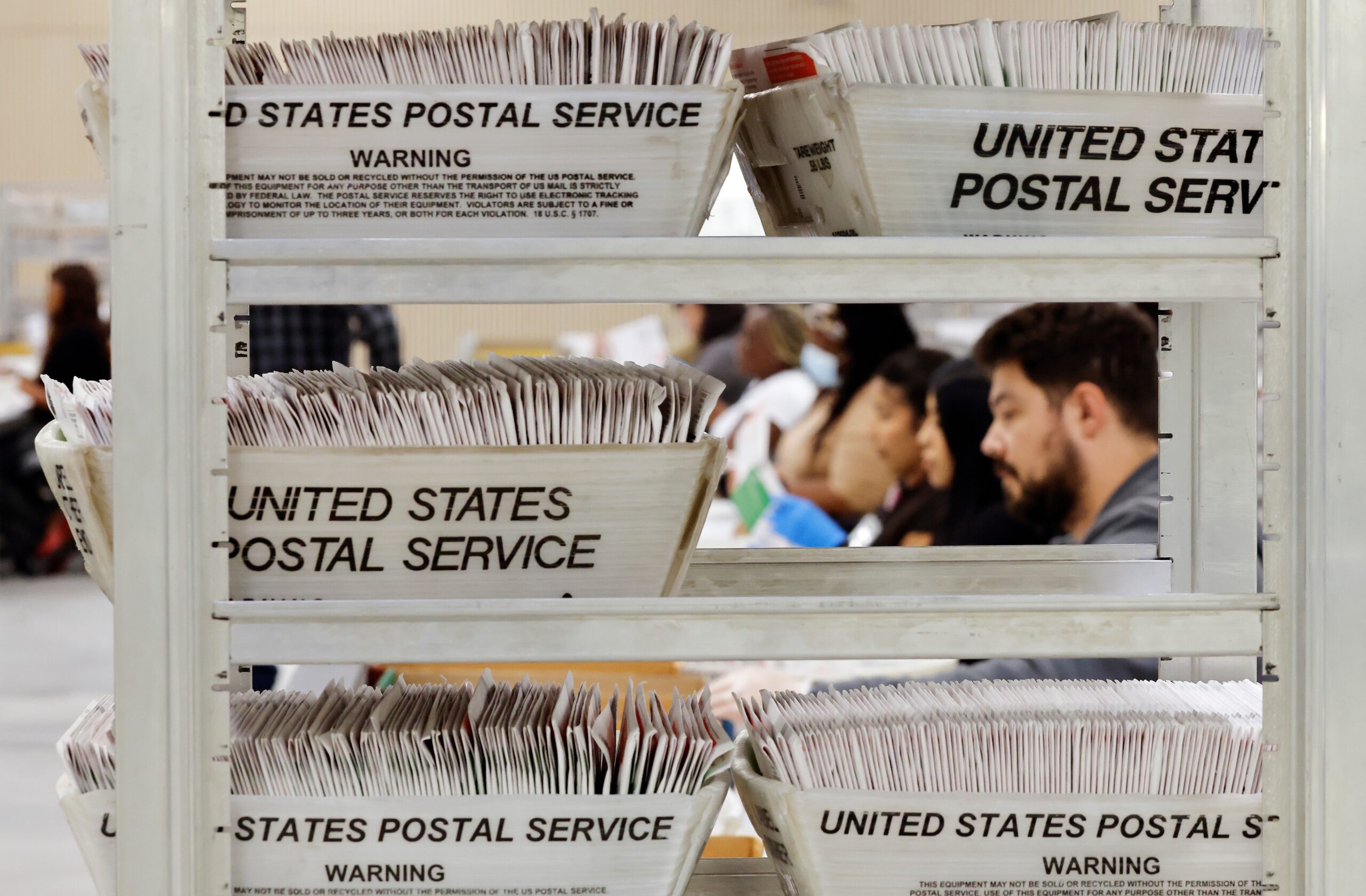
Under federal law, states run the nation’s elections — not the federal government. States have historically not been asked to hand over their voter rolls to the federal government, and many of them balked when the administration started asking for them last year. The Justice Department has sued 30 states and D.C. for their voter rolls, but so far it has lost every one of the 15 legal challenges that have been decided.
It has long been illegal for noncitizens to vote in federal elections and, in 1996, the federal government imposed hefty penalties for noncitizens who register to vote or cast a ballot, including fines, jail time and deportation. But relatively few cases are prosecuted, largely because federal officials have struggled to find the rampant noncitizen fraud that Trump has described.
Mullin said Friday morning that the 250,000 figure came from a DHS review of public voting data from four Democratic states that did not willingly hand over their voting rolls to federal officials. Officials did not specify how they examined those rolls to determine whether a person is a citizen.
But relying on publicly available data means that federal officials were probably not using verified and up-to-date information. States often intentionally publish incomplete identifying information on their public voting rolls — such as an incomplete birthday — to protect people’s privacy.
Election experts said that using this public data would result in confusing the identities of people who have common or similar names. In many instances, naturalized citizens remain improperly labeled as noncitizens in government databases, experts said.
Without a state’s full, official voter list, it was not clear whether the administration had access to Social Security numbers or other specific identifiers to verify its findings.
David Becker, executive director of the Center for Election Innovation and Research, called Trump and Mullin’s claim of at least 250,000 noncitizen voters an “irresponsible number” generated using a “shoddy methodology.”
Mullin said that federal officials detected far fewer noncitizen voters in nearly two dozen states that cooperated with officials and took full advantage of the federal Systematic Alien Verification for Entitlements database. That database allows states to use a federal intergovernmental portal to verify the citizenship status of people seeking to vote or receive government benefits.
In a review of two dozen or so states using this SAVE database, DHS found 28,000 noncitizens registered. That amounts to 0.04 percent of the 68 million registered voters in those states, according to an analysis by the nonpartisan Center for Election Innovation and Research.
“If we have individuals who are voting who shouldn’t be, it cancels out the vote of someone who should be,” Mullin said.
Read more What happened under Trump this week
Even as the administration is touting the SAVE database, contradictory court rulings muddled the picture on whether states can participate.
In June, a federal judge in D.C. halted full use of the database when she found some citizens had wrongly had their voter registrations revoked because officials were relying on a system they “knew to be unreliable.” The D.C. Circuit is considering an appeal of that ruling.
A judge in Florida issued a conflicting ruling, siding with four states that challenged the block.
Amid the confusion of those court cases and with the pivotal midterms only months away, Mullin on Friday said the administration would pull funding from states that do not comply with the federal government’s demands for state voting rolls and could pursue legal action against election officials..
“If the election officials, once we gave them the information they need to secure their elections, and they chose not to, then those individuals can also be held accountable by fines, by penalties, and even depending on how far it goes, prison time,” Mullin said.
Separately, Harmeet K. Dhillon, the assistant attorney general who leads the Civil Rights Division at the Justice Department, recently sent letters to top state election officials warning them they could be charged with crimes if they knowingly allow noncitizens to vote this fall.
Reviews have shown noncitizen voting rarely happens in state and federal elections. A federal judge in 2018 found that at most 39 noncitizens were placed on the voter rolls in Kansas over 19 years. Georgia’s secretary of state in 2024 found 20 noncitizens on its rolls of 8.2 million voters. A University of St. Thomas study that year found three noncitizens were convicted of voting illegally in Minnesota over nine years, when more than 13.4 million ballots were cast.
Noncitizens sometimes inadvertently register to vote when they get IDs, experts said. Officials in motor vehicle offices in most states have to give people an opportunity to register to vote, and noncitizens sometimes don’t understand they’re not allowed to register, they said. Many of those who inadvertently register never try to vote.
The scouring of voter rolls is only one way Trump has focused on potential voting by noncitizens. He delivered his prime-time speech as part of his administration’s effort to push Congress to enact the Save America Act, which would require Americans to prove their citizenship when registering to vote and show photo identification to vote.
That legislation has been stalled in Congress, and Republicans and Democrats are not pushing it forward.
“But most importantly, addressing this crisis of election security demands that Congress must pass the Save America Act,” Trump said in his address Thursday.
On Thursday, Mullin sent a letter to Pennsylvania’s secretary of state, saying that preliminary review of the state’s voting rolls found there “may be” as many as 14,576 noncitizens registered to vote.
In response, Pennsylvania Secretary of State Al Schmidt said in a statement that the state’s voter rolls are well-maintained and that every voter must verify their identity before casting a ballot.
“All evidence has shown that noncitizen voting is extremely rare across the country, including in Pennsylvania,” Schmidt said.
DHS has not provided a list of potential noncitizens to Nevada, said Cecilia Heston, a spokeswoman in the Nevada secretary of state’s office.
Mullin said that officials are going through voter files one by one, “one identifying the individual, two did they vote, and three where do they vote at” in states that did not cooperate with the federal government. The Trump administration will file public records requests with California, Pennsylvania, Nevada and New Jersey for voter information, he said.
Read more Despite expectations, Georgia never came up in Trump’s prime-time speech
Jeremy Roebuck contributed to this report.