

NEW YORK — Among the dreamy wonders of the sports fan is a world where watching games is a job. A land where office chairs transform into overstuffed sectionals, noon kickoffs replace 4 p.m. product meetings. What would one exchange for such a fairy tale?
Read more Voters are struggling to keep up with Iran war’s twists and turns
“Naturally, that seems like the dream, waking up every day and getting paid to watch sports,” Kevin Akoto says on a recent afternoon, separated by less than an inch of plastic from hundreds spectating his every move. “I’d do anything for that.”
For the largest-in-every-way World Cup in history, millions arrived in the U.S. to traverse the land of Buc-ee’s, Costco and Cheese Whiz. The pursuit of the “American experience” became a social media phenomenon for foreigners.
But perhaps no experience has been more American than that of Akoto and Austin Franklin, who quit their jobs for $50,000 and the opportunity to watch every World Cup game from a clear plastic box in Times Square, creating social content along the way.
“To turn down that would be insane,” Franklin says. “I think we both just decided that, you know, we were going to be watching all the games anyway. ‘Like, how bad can it be?’”
Their stint is now nearly over. Only Sunday’s final between Argentina and Spain remains. The crowds, the games, the content will be optimal. Yet Akoto and Franklin, like soccer fans around the globe, can hear the clock ticking toward reality.
Living out this “dream” brought paradoxical experiences. They’re both attached to the attention and opportunity and simultaneously prepared for it all to disappear. The “work” in its own right has become consuming, which is evident in the moments before England and Argentina’s semifinal match as Franklin and Akoto bounce from task to task, the Times Square crowd swelling outside their walls.
“We get a rundown each morning about who we need to talk to,” Franklin says. On this morning, four news outlets are waiting.
So how long have you all been in here?
“Uh, I think six weeks,” Franklin, 29, says with a smirk. “It’s all kind of blurring.”
Did you quit your jobs for this?
They share a look and burst out laughing.

It was sometime in March when Akoto saw the too-good-to-be-true job listing, posted by World Cup broadcaster Fox: A paid position for a fan to spend two months watching every match of the tournament. His finger sprang to the application button.
Those selected would be required to produce a fire hose of relevant social media content for Fox, Indeed and other sponsors, including plenty of videos interacting with fans in Times Square.
Akoto, of Jacksonville, Florida, had been a soccer fan since elementary school when his family introduced him to the Ghanaian national team, desperate to keep his heritage alive. He recounts evenings watching the World Cup with his parents in 2010, passionately trying to will his side past the quarterfinals. In the decade-plus since, he’d blossomed into a fútbol fan deep in “football territory.”
His story, he reasoned, might be interesting enough. But he worried his influencer bona fides might fall short. He operated a relatively active Instagram account but worried that his background, working his way through school at the University of North Florida as a line cook, wasn’t “content-creation-y” enough for the mystical, scarcely outlined position.
“And two months later, the good folks of Fox Sports called me,” he says. “Then they told me what we were going to have to do.”
A few years back, Franklin moved to Los Angeles to pursue social media. He’d always been a soccer fan since his parents put him on the pitch in Massachusetts. He’d also grown interested in content creation in the peak late-2010s days of Vine and Twitter, and was animated. That combination made Franklin a natural fit for Fox’s objective.
This World Cup drew a cumulative global audience of 11.53 billion people globally across the first 96 matches, including an average of 15.6 million on Fox’s networks during the quarterfinals. But social is king, for Fox and other sports media companies. Last summer, ESPN hired Katie Feeney, a 22-year-old recent Penn State grad with nearly 8 million TikTok followers, to lead its influencer aspirations. To spark its college sports vertical, Fox blended Barstool Sports into its Saturday-morning brand “Big Noon Kickoff,” which now leans on social media content.
The hope among each is to reach an audience ranging from teens to young parents, who are watching network TV at an all-time low.
“Sports social media content is a rapidly growing field,” Franklin says. Recent studies have found that more than half of young adults wish they could be content creators.
“This is what we both want to do.”
So they quit their jobs, packed clothes for two months and ventured north.
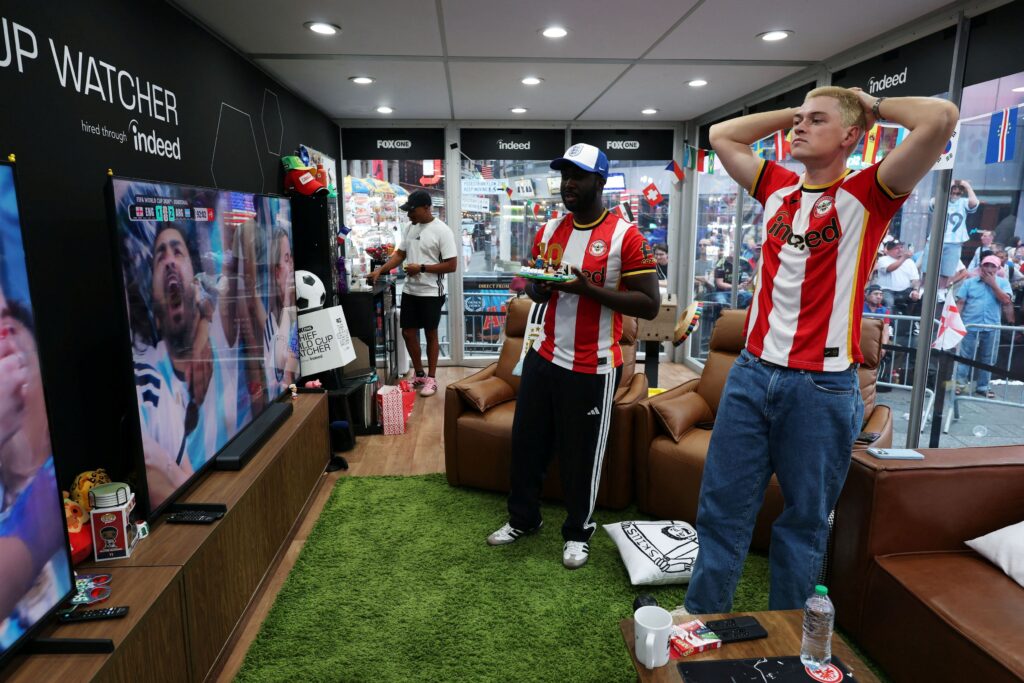
The day before the tournament began, the pair moved into the Times Square space with few expectations.
Then came the details. For all 104 World Cup games, they would spend their time in the public gaze, milling about in a clear, camper-size cube located in the middle of America’s most-walked intersection. They’d have the essentials, but they wouldn’t be allowed to leave or even step out of view when a ball was live.
“It’s a fishbowl,” Akoto says. “That was a little concerning.”
Their motivator: the money. For each, the 39-day job would earn $50,000 or, roughly $480 per game before taxes.
The first half of the tournament would be long, with three weeks of four or more games every day, their schedule running from 10 a.m. to around 2 a.m. They’d wander to a hotel a block over, paid for by the sponsors, for a few hours of sleep each night before returning for early-morning content call times.
Read more DOGE was supposed to be dead. Its remnants are everywhere.
When the games weren’t on, they ate meals that were provided by Fox’s staff, frequently going out to eat with the crew working around them. During the games, their sponsors would roll out a lineup of platters, typically with specific dishes tied to the countries competing in each game.
Many matches were thrill rides. Others plodded along. To pass the time, the pair started playing games with a pair of mini soccer balls in the room. During MLB All-Star Game promotions, they wound up with a plastic bat, and soon they were using pillows as bases.
“Any fan thinks they want to watch everything,” he adds, “but it’s a lot.”
They’d also have to sprint to the One Times Square building’s revolving door to go to the bathroom on the seventh floor. (Fox, for all its planning, made no prior arrangement for relief.)
All of this would occur in front of hundreds (if not thousands) at every moment. Roughly 330,000 people pass through Times Square on any given day.
Yet after weeks, they explain, the performance became robotic. The attention has seemingly disappeared. Or maybe transformed.
Chairs and circular red coffee tables sit between the One Times Square building and the Nasdaq headquarters, and even when games aren’t visible on the TVs in the box, some New Yorkers lounged around watching Franklin and Akoto’s shenanigans.
But inside and out of the box, the match is still the primary spectacle. Throughout the tournament, Times Square has become a melting pot of nationalities and fan bases, jersey-clad fans trading chants and jeers. In these moments, Franklin and Akoto’s antics disappear, and if they disrupt the walk-in theater with waving arms or attempts to interact during a match, the reaction can be sharp.
When England scores first during Wednesday’s semifinal, Franklin, who took to rooting for the Three Lions for the day, stands and turns to the crowd. In response, an Argentina fan from New York boos just as passionately to make him sit as she did for the score itself.
“They’re just kinda obnoxious,” she says later. “I’m not sure I’d do that even for that money.”
A few minutes after the goal, Franklin pulls out his phone and his red-and-white striped jersey and clicks the red circle.
“What’s up, everyone …”
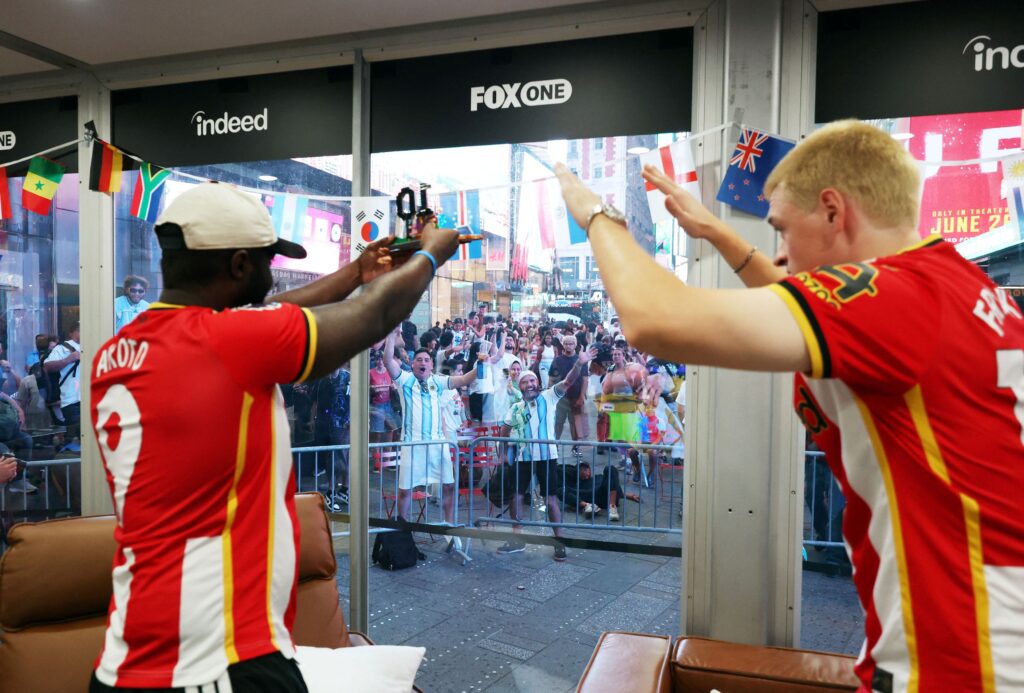
As England’s grasp on the semifinal releases in the span of two quick punches, Akoto stares, motionless. The crowd roars, dominated by Argentina supporters, fans jumping against one another and tossing jerseys into the air.
After most close games, the pair have walked out to the onlookers, filming reactions for Fox’s and their own channels. But it’s pouring, the rain pattering against the top of the box, and those who waited for the game to end take off running with the whistle. Franklin and Akoto decide to stay put for a while.
They arrived hoping to leap further into the rapidly expanding influencer space, Akoto escaping his line-cook job and Franklin looking to grow a social media page dominated by deadpan stand-up videos about trending sports topics. The eyes, uncomfortable at first, have become their lifeblood, a sort of craving.
“This is a leaping-off point for us,” Franklin, giddily, says. “Like you can only imagine what’s next. This has been so big.”
For some of their relationships, it has been a bit of an adjustment. Franklin has more than 206,000 followers on TikTok, and Akoto trails at 167,000. They’ve spent time with actor Jerry O’Connell, and their faces were plastered on a rotating billboard in the square. They’ve scarcely spoken with friends and family in a month, and those conversations now rarely go a few minutes without navigating back to “content” and “views” and their very temporary day jobs.
They ventured into the spotlight, drifting from their daily lives. Now, they must return.
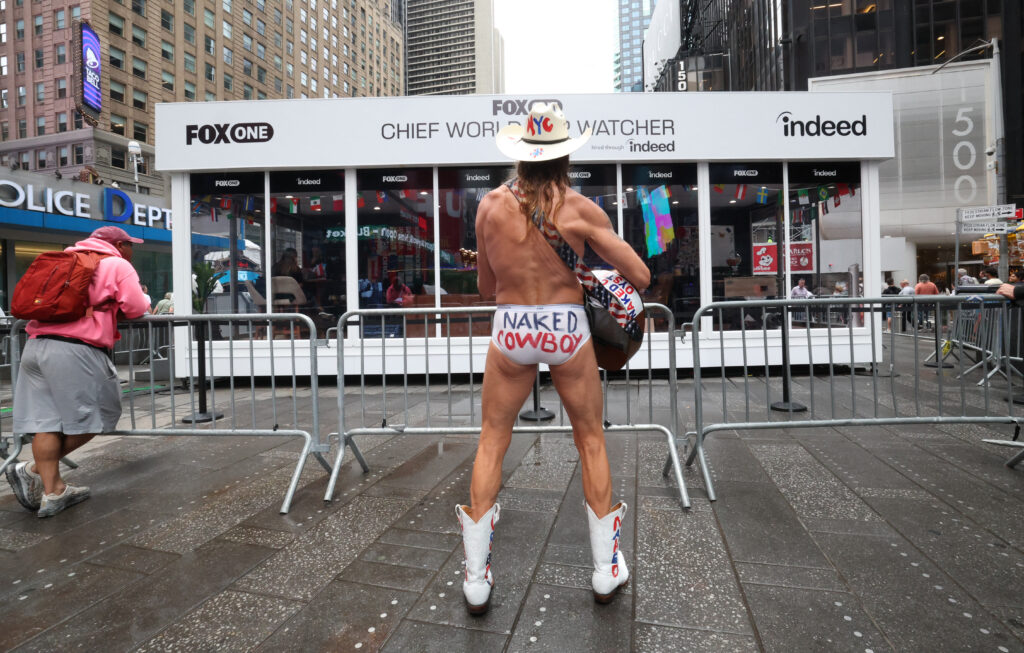
“At this time next week, I don’t know what I’ll be doing,” Akoto says. “That’s frightening.”
Franklin buzzed his hair last week to imitate late-2000s David Beckham. Akoto, as he’s told dozens of reporters, no longer has a job. He said he’d call his former employer, though he’s trying to make social media work full-time. With each day, he grows more concerned.
“This has definitely changed what I’ll do next,” he says. “I can’t tell you if I want it to end or not.”
“Everyone asks the question,” Franklin adds. “What would you do to get paid to watch sports? I’m still not sure I have an answer.”
It’s pouring now, and Franklin looks out across the darkened square, the emptiest it’s been in nearly 40 days. Then he glances down at his phone, letting out a small sigh, and taps record.
Read more With nearly 700 passes and counting, a Spanish star quietly dominated this World Cup
“Such an unbelievably bad decision,” the video begins.