In today’s edition … The rise of Flock cameras as a political issue … The disingenuous outrage over the national debt … but first …
Read more Swing-state Democrats criticize an unpopular institution: Their own party
This newsletter will take its annual summer break next week and will return on Aug. 31, when we will start our all-out sprint toward November’s midterms. An ask for our readers: If you have races you think I should be covering, or topics you feel deserve more attention, please email me at [email protected].
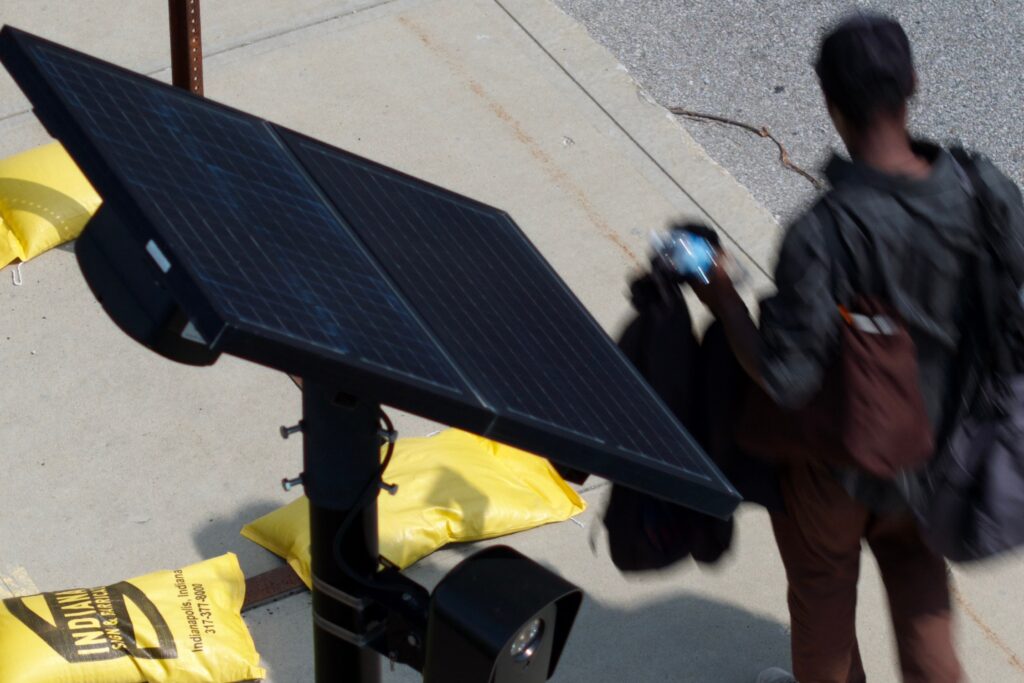
A growing political conversation — and some bipartisan consensus — is forming around the surveillance systems known as automated license-plate readers, especially those produced by Flock.
As my colleagues’ reporting has shown, the systems — generally meant to record traffic violations but used for a variety of law enforcement tasks — aren’t popular. Now, a growing number of candidates and lawmakers are doing all they can to let people know they don’t like the readers either.
The reason is a call back to earlier political moments when concerns about a surveillance state ran high. Also, we’re in a moment when people don’t trust institutions and think new technology — such as data centers and AI-enabled cameras — is being implemented without much public buy-in.
“Do you ever feel like you are in a cage, kind of stuck, being watched?” asks Michigan Senate candidate Abdul El-Sayed in a video he posted this week. “Well, that is because you are,” he added, before lambasting what he calls the “mass proliferation of” Flock cameras “any and everywhere.”
Rep. Keith Self, a Republican running for reelection in Texas, recently mentioned Flock cameras in a post that included, “Big Brother has NO place in the Lone Star State.”
“In Congress, I am fighting to stop warrantless government surveillance, defend your constitutional rights, and ensure Americans never have to choose between their liberty and their privacy,” Self wrote.
And Clyde Jones, a Democrat running in a deep red district in southern Alabama, recently took to Instagram to ask, “How much power are you willing to give the government to feel safe?”
“This is another step towards authoritarianism,” he wrote. “This is the beginning of mass surveillance.”
I want to be clear: This conversation is still politically small, and many candidates aren’t talking about Flock cameras at all.
But it is a potentially salient issue that comes as The Washington Post’s stellar investigations team, including Drew Harwell, Douglas MacMillan, Aaron Schaffer and others, has published several compelling stories about Flock:
And we recently highlighted in this newsletter an article by Annie Gowen about how vandals are destroying Flock license plate cameras as anger at them grows.
The idea of resisting a surveillance state has long been something Americans — and Republican voters in particular — have been animated by, with the argument generally being that mass surveillance runs counter to the individual freedoms the country was founded on.
And those concerns have only grown as confidence in American institutions, including government, has reached historic lows. A Gallup survey from earlier this year found “27% of Americans express ‘a great deal’ or ‘quite a lot’ of confidence in these core institutions, one percentage point above the record-low average in 2023.”
That ambient fear of government surveillance, coupled with distrust in the government, could turn the cameras into a potent political issue, mirroring the rise of concerns over data centers.
“Americans are reacting to the fact that a small group of unelected people have been given extraordinary power to shape their lives and the country’s future,” said Alyssa Cass, a partner at Democratic political strategy firm Slingshot Strategies. “A data center permit or a Flock camera are tangible reminders to the electorate to ask themselves, ‘Do I have to just accept this?’”
Cass added: “Very few issues aren’t ideological or factional these days — but wanting to control your own future is about as universal as it gets.”
That is why some lawmakers are now questioning the need for cameras like those produced by Flock — especially who has access to the data collected, and how those users can use the data.
Rep. Tim Burchett (R-Tennessee) introduced a bill earlier this year that would ban the federal government from purchasing automated license-plate readers, like those produced by Flock, and from using federal funding for states to buy the cameras. The legislation, Burchett said, would “ban these dadgum” cameras.
“Post covid, I think people are seeing these things all of a sudden everywhere, and they think, like I do, that it needs some guardrails,” Burchett told me.
Los Angeles Mayor Karen Bass (D), who is fending off a challenge from the left in her bid for reelection, recently came out against a possible contract between Flock Safety and the Los Angeles Police Department.
Read more Dunedin Movers Experts: Reliable Local and Long-Distance Moving Solutions
“Flock Safety has lost the trust of Angelenos and residents of other cities across the country, especially in immigrant communities targeted by the federal administration,” Bass said recently. “The LAPD needs to identify another company that doesn’t share data.”
And Sen. Adam Schiff (D-California) recently posted a six-minute video on YouTube explaining the cameras to his constituents and observed that they are “bringing people together across the political spectrum who are raising deep concerns.”
“Are we in a surveillance state?” the senator’s video posits.
Whether this becomes an issue most political candidates run on depends on whether the technology continues to proliferate and how companies like Flock respond to the blowback.
When I reached out to Flock spokespeople, they did not respond to my questions.
The national debt feels like a political issue of a bygone era.
But you should still care.
The U.S. national debt officially surpassed $40 trillion this week, with colleagues Steve Thompson and Riley Beggin reporting days earlier that the record would be surpassed earlier than expected “in part because of billions of dollars in lost revenue from President Donald Trump’s invalidated tariffs.”
That debt has markets skittish. The Dow Jones Industrial Average, the Nasdaq composite index and the S&P 500 all fell around 1 percent yesterday.
It has also affected the bond market, with the 30-year bond yield rising despite what Steve and David J. Lynch described as Treasury Secretary Scott Bessent’s “unusual effort to head off rising government borrowing costs.”
The national debt was a major political issue in the early 2010s, when the rise of the tea party following the Great Recession put a focus on government spending. That focus has largely fallen by the wayside in recent years as both parties have spent with abandon.
That, however, hasn’t stopped Republicans from looking to play the 2010 hits and blame others for the rising debt.
“Our national debt just hit 40 TRILLION DOLLARS!” Sen. Rick Scott (R-Florida) wrote on Twitter this week. “This is bad. Congress needs to get spending under control and BALANCE THE BUDGET. Americans deserve better.”
The urgency of that tweet ignored one fact: Scott voted for Trump’s One Big Beautiful Bill, a law that was forecast to raise deficits by $3.4 trillion over the next decade.
Utah News Dispatch: How are lawmakers educating themselves about data centers? It’s a complicated topic, even for the technically inclined. But nationwide, lawmakers asked to regulate the booming industry are having to go back to school on how data centers actually work.
Michigan Advance: Free pre-K is really popular. This report finds that Michigan’s program fielded nearly 53,000 applications for its free pre-K program, a growth in enrollment.
LAist: Homelessness, expectedly, is dominating the race to be Los Angeles’ next mayor.
Do you keep your enemies close? Or do you think it’s better to isolate them?
That was at the heart of the question we asked about Trump possibly meeting with North Korean leader Kim Jong Un. And many of you expressed reservations.
“While keeping enemies close serves its own purpose, in North Korea’s case they collectively want to be respected and feared by the big guys,” wrote Douglas Wolf. “Trump loses nothing by meeting with miniature Castro and shows the NK power structure they are in the ‘big’ leagues.”
“Exactly what is the point? Is he going to reunite the North and the South? Put a line in the sand about nuclear proliferation like he did Iran? Is he going to find some nice beachfront property to build a luxury hotel? Or is he just going so he can be fawned over by a murderous dictator and piss off our allies in South Korea and Japan? What is the point?” Bruce Berkowitz asked.
“North Korea sends munitions and troops for Russian use in its war with Ukraine. Would FDR visit Hitler? Of course not. Trump’s meeting is ill-considered,” added Jim Charne.
Not everyone was so skeptical.
“The issue is not validating a dictator. The purpose is to maintain a dialog to maintain peace. It can also maintain mutual accountability,” wrote Norman St. Amour.
“In the interest of maintaining cordial arms-length relations, there is nothing inherently wrong with presidents meeting dictators, as in the mooted meeting between Trump and North Korea’s Kim,” wrote David Olsen. “But Trump is deluded in supposing that he has any sort of friendship with Putin, Xi, Kim, or Netanyahu. All of them exploit Trump’s vanity and craving for admiration.”
I ride my bike to work every day. Most of the time, I ride up Pennsylvania Avenue NW in Washington, D.C. That hasn’t been possible for the past week because of Trump’s Grand Prix race in D.C. this weekend. It’s been a minor inconvenience — I am writing this from the office! — but it has had me wondering whether people really care about how Trump’s projects have altered downtown Washington.
So: Do you care about Trump’s physical impact on Washington? Why or why not? And this goes out to our readers far outside the Washington region — I am particularly interested in whether these stories move you. Let me and your fellow Early Brief readers know at [email protected].
Read more Movers in Atlanta — BigT: Reliable Moving Support Across Georgia
Thanks for reading. You can follow me on X at @merica.