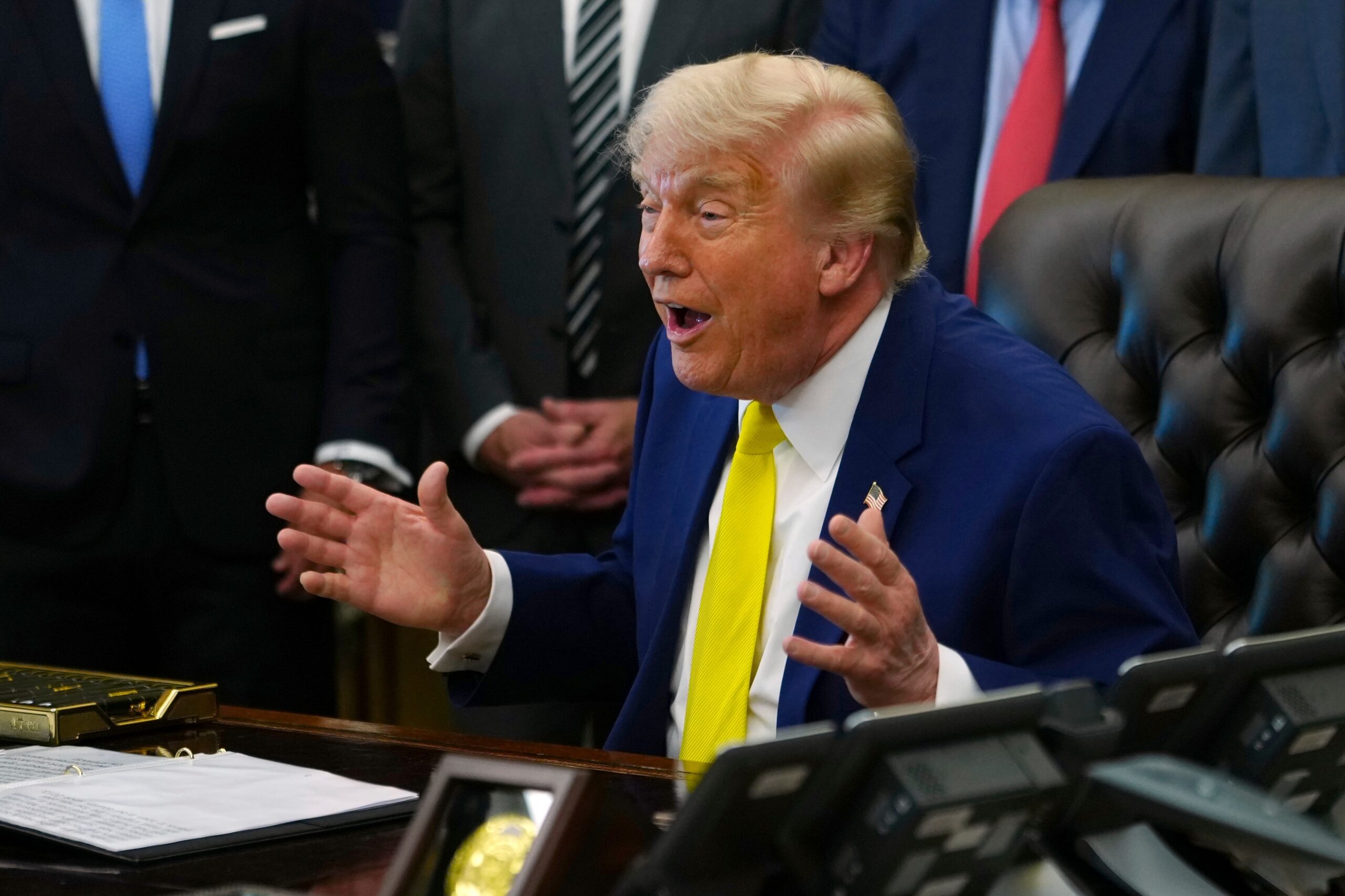
The president has reacted to recent setbacks, notably the resistance of congressional Republicans, with angry defiance, saying he’ll nominate the unpopular Todd Blanche as attorney general and refusing to admit his payout fund is dead.
Read more Democrats are worried this upstart candidate could cost them in November
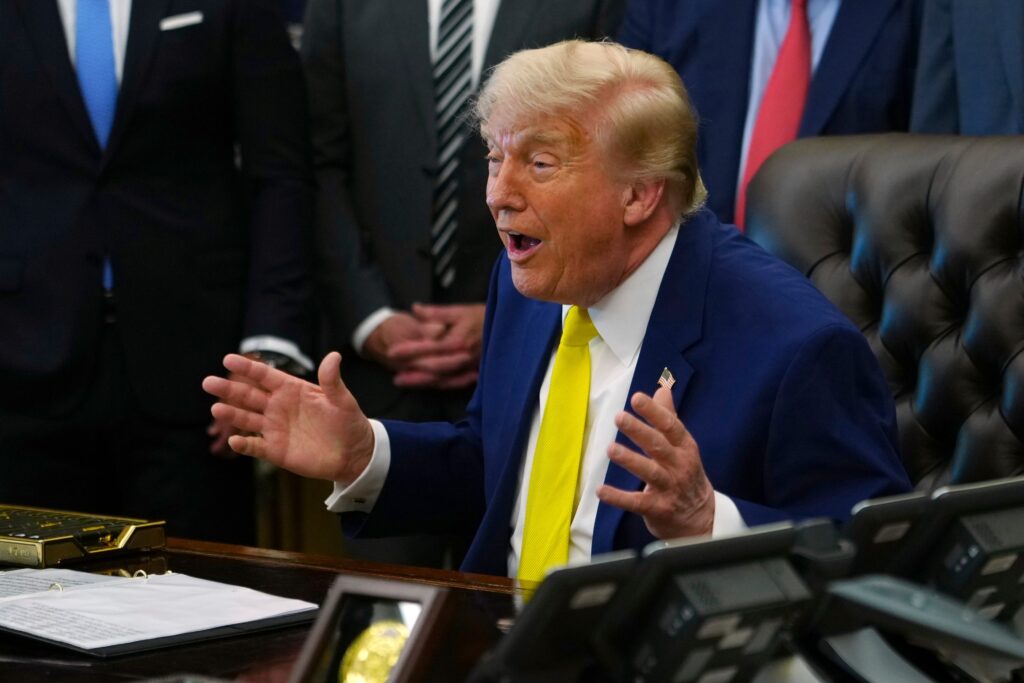
President Donald Trump is reacting with a blend of indifference and hostility to a widening rift with congressional Republicans, declining to accommodate their concerns about his controversial nominees or IRS settlement that are complicating legislation and raising tensions in Washington.
He lambasted four House Republicans who broke ranks Thursday to help pass a resolution to oppose his conduct of the war in Iran. He declined to rule out moving ahead with a fund that could compensate January 6 Capitol rioters. He said he’d name Todd Blanche, the acting attorney general who became the face of the IRS deal, to the position permanently. And he brushed off GOP reservations about his choice of acting spy chief, Bill Pulte, at the moment lawmakers are trying to pass sensitive surveillance authorities.
Both sides of Pennsylvania Avenue attribute the schism — and Trump’s lack of sympathy for congressional Republicans — to the fact that lawmakers are on the ballot for this November’s midterms and Trump is not. Vulnerable Republicans have reached the point of seeing political advantage in bucking the unpopular president on his most controversial moves. Sen. Jon Husted (R-Ohio), who trails former senator Sherrod Brown (D) by 8 points in a new Fox News poll, and Sen. Dan Sullivan (R-Alaska) joined Democrats to support an unsuccessful amendment to block Trump’s fund.
“We don’t want to oppose the president just for the sake of opposing the president,” said Sen. Thom Tillis (R-North Carolina), who is retiring. “But unlike the president, we have a third of our members up for reelection this year.”
But Trump is not of a mind to change course on Iran, the fund or his Cabinet picks to make Republicans’ lives easier on the campaign trail or to smooth relations with Capitol Hill. The president recognizes he’s paying a price among Senate Republicans for endorsing victorious primary challengers to Sens. John Cornyn (R-Texas), but he also believes the senators who are voting against him probably would have done so anyway, according to an adviser who spoke on the condition of anonymity to relay confidential discussions.
Trump does not think he needs Congress as much as the lawmakers think he does, the adviser said. And with House and Senate Republicans expected to suffer significant losses in November, the president feels no need to accommodate them.
“He doesn’t care, but here’s the reason he doesn’t care: They are losing everywhere, including the center of the country and the heart of MAGA,” Stephen K. Bannon, the former White House strategist and and an influential pro-Trump podcast host, said in an interview. “They have abandoned the president and the grassroots. So Trump doesn’t care about it. He’s not going to put that on his shoulders.”
White House spokeswoman Abigail Jackson said Trump is committed to maintaining Republican majorities in the House and Senate.
“The White House and President Trump have enjoyed working closely with House and Senate Republicans to deliver on many important promises to the American people, including the largest tax cut for working Americans in history,” she said. “While the media and Democrats attempt to sow nonexistent divisions, we look forward to continuing this close relationship to continue fulfilling President Trump’s agenda that Americans elected him to enact — especially funding ICE and CBP,” referring to Immigration and Customs Enforcement and Customs and Border Protection.
Trump repeated on Thursday that the midterms and domestic political pressures are not his main concern when dealing with Iran. He criticized the Republicans who voted against the war for undermining his negotiating position amid talks to end the war, saying in a social media post, “Who would do such an unpatriotic thing[?]” (The measure failed six previous times in the House, and this one probably would have too except for five Republican absences.)
In the Oval Office on Thursday, Trump added, “I just do what’s right.” He went on to repeat a comparison to the historically unpopular wars in Iraq and Vietnam that lasted for years and cost thousands of American lives, saying the conflict in Iran has proven far less costly.
He continued to resist modulating his economic messaging to express more empathy with Americans’ everyday struggles, calling affordability concerns a “con job” and pointing to rising 401(k) retirement accounts, which about 40 percent of Americans lack.
Read more Russell says Mercedes teammate Antonelli has F1 title ‘to lose’. Ferrari might beat both in Monaco
Throughout the first half-hour of an Oval Office event about his intent to use wartime powers to expand coal production, before taking questions from reporters for an hour, Trump spent seven minutes returning three times to the subject of his construction projects around Washington, D.C., such as the Reflecting Pool on the National Mall, a triumphal arch he wants to build along the Potomac, a garden of historic figures, a new promenade for the Lincoln Memorial and restored fountains.
He also brought up the voting restrictions he is demanding the Senate pass, although the bill currently lacks enough support to overcome a filibuster. Privately, Trump has said that if Republicans lose the House in November, he will say the election was stolen and blame Senate Republicans for failing to pass the bill, according to a GOP strategist familiar with the comments. A White House official disputed that account, pointing to Trump’s public remarks warning of election fraud if the bill doesn’t become law.
Trump maintains a good relationship with Senate Majority Leader John Thune (R-South Dakota), with whom he talks every day. But Thune’s members have grown increasingly frustrated over the last six months — a period that started with federal immigration agents killing two U.S. citizens in Minneapolis, followed by the unpopular Iran war that drove up energy prices, Trump’s focus on a White House ballroom and other construction projects, and the IRS settlement that included a fund for those who claimed they’d been targeted for their political views.
“It’s been one self-inflicted wound after another,” a Republican strategist said. “Senate Republicans are tired of carrying that weight and making excuses for things they can’t make excuses for.”
Trump does not blame Blanche for the defeat of the settlement fund, appreciating that he sought to defend the proposal in the face of fury from senators of both parties, the adviser said. “Todd is very popular, he’s doing great,” the president told reporters on Thursday.
He has signaled he plans to nominate Blanche shortly to become attorney general, a position that requires Senate confirmation. Given the Republicans’ narrow 53-47 margin in the Senate, including several increasingly independent-minded GOP senators, and Blanche’s role defending the fund, a confirmation battle would likely be long and bitter with no guarantee of success.
Trump is also standing by Pulte as acting director of national intelligence, despite his lacking the national security experience that is required by law for the role. “Bill is a guy that will be able to figure it out very quickly,” Trump said, adding that Pulte is serving temporarily while the president considers a permanent replacement for Tulsi Gabbard.
In another measure of Senate Republicans’ frustration, 12 voted on Thursday to take up Tillis’s amendment to bar the use of federal funds in connection with the payout fund, even though it was clear the amendment would fail on a procedural vote. Seven Republicans voted with Democrats to prohibit using federal funds or private donations to build Trump’s proposed White House ballroom without congressional approval, which also failed on a procedural vote.
The White House official said the administration is working actively with Congress in a bipartisan way to listen to its concerns and priorities. Trump is clearly the leader of the GOP, and he and Congress remained aligned on the issues they were elected to enact, the official said. The official pointed to Thursday night’s bipartisan deal on a housing bill, as well as a bipartisan markup on crypto legislation and a highway bill that was passed in committee with a provision on rail safety that was a presidential priority.
Rep. Don Bacon (R-Nebraska), who is not running for reelection and became one of the earliest elected Republicans to openly criticize some aspects of Trump’s agenda, said the White House is taking a “go-it-alone” approach that is backfiring.
“Congress will not be a rubber stamp for rest of the term,” Bacon said, noting that he gladly supports many of Trump’s policies and voted to support Trump on the war resolution this week, while speaking out on other policies such as tariffs. “We should speak the truth and be the independent branch like the founders envisioned.”
Read more Bosnia’s World Cup pursuit begins at a home-away-from home in the American Midwest
Theodoric Meyer contributed to this report.