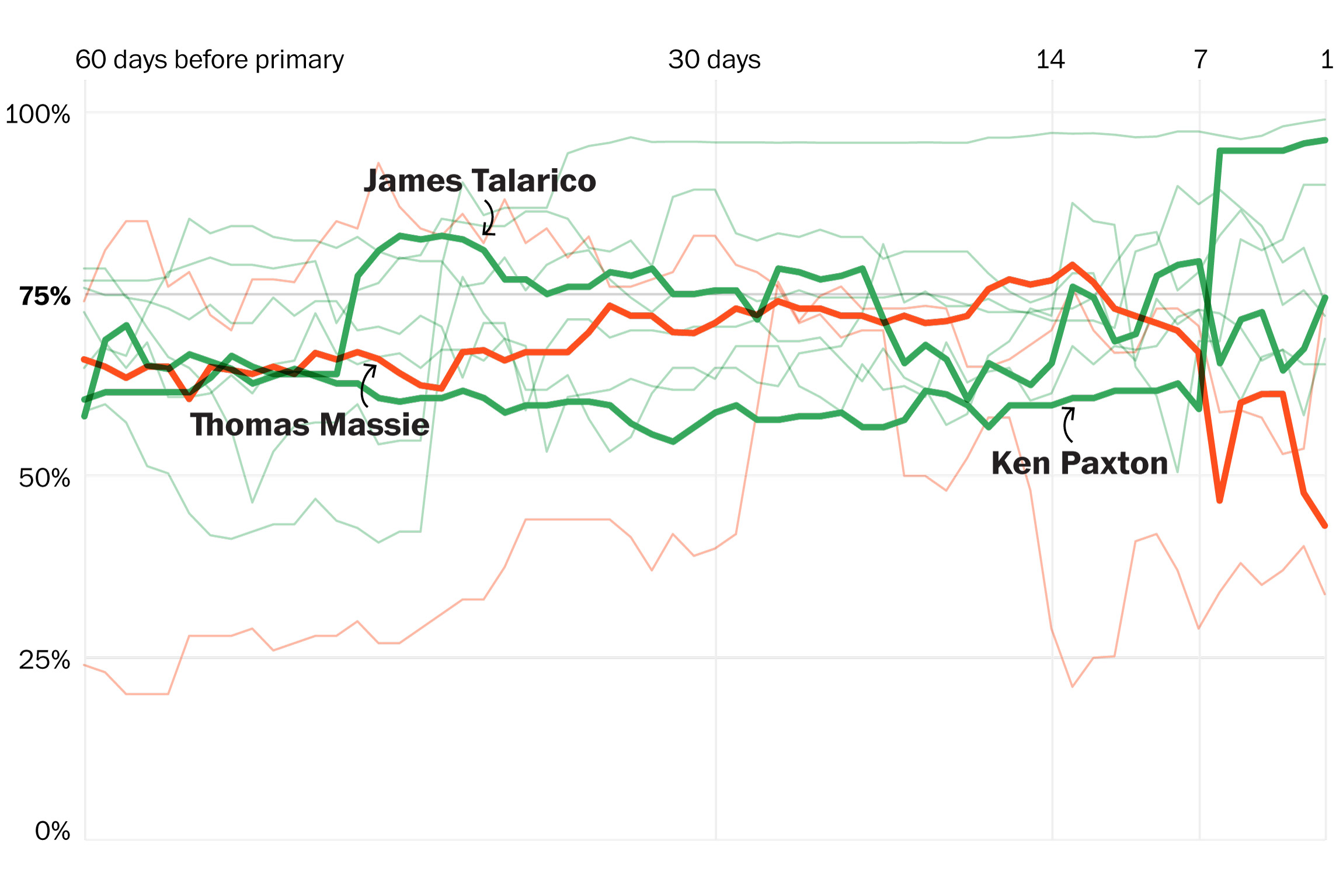
A Post analysis found that primary candidates ended up winning about as often as bettors thought they would.
Read more Two rich Democrats were friends. Now they are spending millions to attack each other.
A few days before the first round of Los Angeles’s mayoral primary, Kalshi and Polymarket gave reality TV star Spencer Pratt a 75 percent chance of advancing to the general election.
Kalshi published campaign-style updates on his odds, and Polymarket hosted multiple active markets on whether Pratt would finish first or second in the city’s nonpartisan, ranked-choice primary. On Kalshi alone, the mayoral race market surpassed $40 million in bets before voting ended.
And then Pratt ended up badly trailing Nithya Raman, a left-wing rival, for the second slot in the general election.
Pratt’s third-place finish inspired claims of voter fraud from some of his right-wing fans, who were irate that the prediction market favorite had come up short, even though polls had shown him closer to Raman throughout the campaign.
That pattern — a prediction market favorite ending up as a loser — has occurred several times this primary season.
Candidates favored by the markets, for example, also lost in the Georgia gubernatorial primary — where a candidate endorsed by President Donald Trump lost to a health care executive — and in Kentucky, where longtime Rep. Thomas Massie (R) lost to a Trump-endorsed primary challenger.
But people who rely on prediction markets to help them understand politics, however, aren’t panicked. Because these losses aren’t a failure: they’re a sign the markets are doing their jobs.
“They’re reasonable-ish,” says Josh Clinton, a political science professor at Vanderbilt University who has studied prediction market accuracy on the 2024 election.
For each of those high-profile misses in midterm primaries this year, a Post analysis found there were about three other elections where a favorite with a 75 percent chance of victory did win. The Post examined 268 candidates who received a 70-80 percent chance of winning on either Kalshi or Polymarket on any day in the two months prior to their primary.
Prediction markets have exploded in popularity, with many Americans now placing bets well outside the realm of sports. According to the Pew Research Center, nearly a third of all bets placed on Polymarket since July 2024 have been political. During the 2024 presidential election, billions were bet on prediction markets, where bettors buy “shares” that each pay one dollar if a certain candidate wins, and nothing if they lose.
But while the markets do a good job at predicting election results, political experts, pundits and campaigns themselves are not rushing to substitute traditional ways of understanding elections — like polls — with Polymarket or Kalshi.
In fact, experts say that without traditional polling and news, prediction markets would not exist.
Prediction market bettors don’t have prophetic powers: they are a “quantification of conventional wisdom,” said Ross Dahlke, a data science professor at the University of Wisconsin-Madison School of Journalism and Mass Communication.
Interpreting predictions is hard
Political predictions have long been contentious: In 2016, Nate Silver’s 538 gave Trump a 29 percent chance of winning on Election Day and The New York Times gave him only a 15 percent chance. Trump won.
Critics accused both forecasters of being wrong — but their defenders said they’d just predicted that Trump’s victory was unlikely, not that it was impossible. Unlikely things happen all the time: for example, there’s only a 25 percent chance of flipping a coin twice and getting heads both times, but nobody’s surprised when it happens. If it happened 10 times, that would be surprising.
That’s how prediction nerds measure “calibration”: if one makes 10 predictions that various things will happen with 70 percent probability, and then about seven of those 10 things happen, then the predictions were good. If far more or far fewer happen, then the predictions were bad.
The Post’s analysis grouped together candidates who were given about the same probability of winning in the 60 days prior to each primary. Generally, candidates in each group won about as often as the predictions said they would. Candidates predicted to win with 95 percent probability won almost all the time. Those given a 50 percent chance of winning won about half the time.
But what good is knowing someone has a 75 percent chance of winning?
“Prediction markets over time have confused some people,” said Rothschild. “People see the percentages and they think in terms of popular vote percentages and not in terms of probability, and so [a] 75% [chance] seems very extreme, because a lot of people’s minds, they’re almost conflating that with 75% of vote.”
Read more Mamdani views 2026 House endorsements as a 2028 test
The Cook Political Report doesn’t attach probabilities to its ratings. Its weakest rating, “Lean,” has been correct 85% of the time in May before the 2020, 2022 and 2024 elections, and even more accurate as Election Day draws near, according to a Post analysis.
“If you just put a number instead of calling it a toss-up or a lean … it gives people a sense of certainty that’s just not there,” said Cook editor-in-chief Amy Walter.
Rothschild agreed: “There is no reason to believe that prediction markets are as precise as the numbers you may want to draw from them.”
“Prediction markets are becoming a foundational source of real-time information and forecasting,” Polymarket said in a statement. “From the 2024 election results to predicting Biden’s withdrawal from the race, Polymarket has proved to be an accurate tool for political forecasting.”
“We’re not surprised at the Post’s findings, as they corroborate open-source data showing that Kalshi’s markets are extremely well-calibrated,” Kalshi spokesman Jack Such said in an email.
Predictions depend on ‘conventional wisdom’
Some prediction market bettors are simply wagering on the outcome they’re hoping for, like sports fans betting on the home team. But most of the money bet on political markets on Polymarket comes from about 8,000 mostly anonymous and more sophisticated traders, Dahlke’s research has found.
Others rely on polls, but Clinton says knowledge about which polls to believe and which to discount is one way smart bettors can make money.
Others are even more strategic: “you have highly technical people running their own models,” he said.
And still others buy and hold only for a short period of time — perhaps because they think some piece of breaking news will drive other people’s opinions of the candidate’s chances up — then sell once they think the price has adjusted.
All of those more sophisticated strategies are what make the predictions accurate, said David Rothschild, an economist at Microsoft.
Prediction markets are “a way of aggregating information,” from all those disparate sources, models, strategies and vibes, Clinton says.
Dahlke calls them a “quantification of conventional wisdom.”
That makes them different from polls, which directly ask voters who they plan to vote for.
Prediction markets also predict wars and other geopolitical events, but experts said markets’ success on elections may not carry over — because far less public information exists.
Rothschild disagreed that polls are essential. Even though information from polls does make predictions stronger and more accurate, election prediction markets operated 150 years ago in the United States, predating modern polling, and they still had a pretty good track record, Rothschild said.
The markets can’t replace polling, said John Aristotle Phillips, a political data guru who also co-founded PredictIt, a smaller politics-focused prediction market that predates Kalshi and Polymarket. Good polling, he said, is necessary to understand voter behavior. Prediction markets, he argued, “are quite the opposite.”
“Prediction markets [are] pretty damn good at telling you what the outcome’s gonna be,” he said. “Prediction markets are no good at telling you why people feel the way they do.”
Methodology: The Post examined 1,276 markets, each representing a candidate, in 344 primary races from Kalshi and 829 markets from 152 races from Polymarket, through June 18, 2026. We examined only markets for the winner of House, Senate and gubernatorial primaries in 2026 (or advancers in states with “jungle” primaries), excluding markets related to voter turnout, margins-of-victory, endorsements, drop-out decisions or finish order. The analysis also omitted the first rounds of multi-round primaries in states such as Oklahoma, where the nominee is sometimes determined by a runoff that hasn’t yet occurred.
For all 2026 markets, we fetched the price of a “Yes” share for each candidate at noon Eastern time for each of the 60 days prior to the election; for Kalshi, which reports prices only for hours with trading, we used the mean price for the hour if present, otherwise we used the most-recent previous price.
Read more New York’s primary went from celebrity contest to AI proxy war. See live election results.